Stelae, rock churches and a moving court: Christian kingship in the Horn, c. 100–1529
Aksum, Zagwe and Solomonic Ethiopia
100 CE – 1529 CE
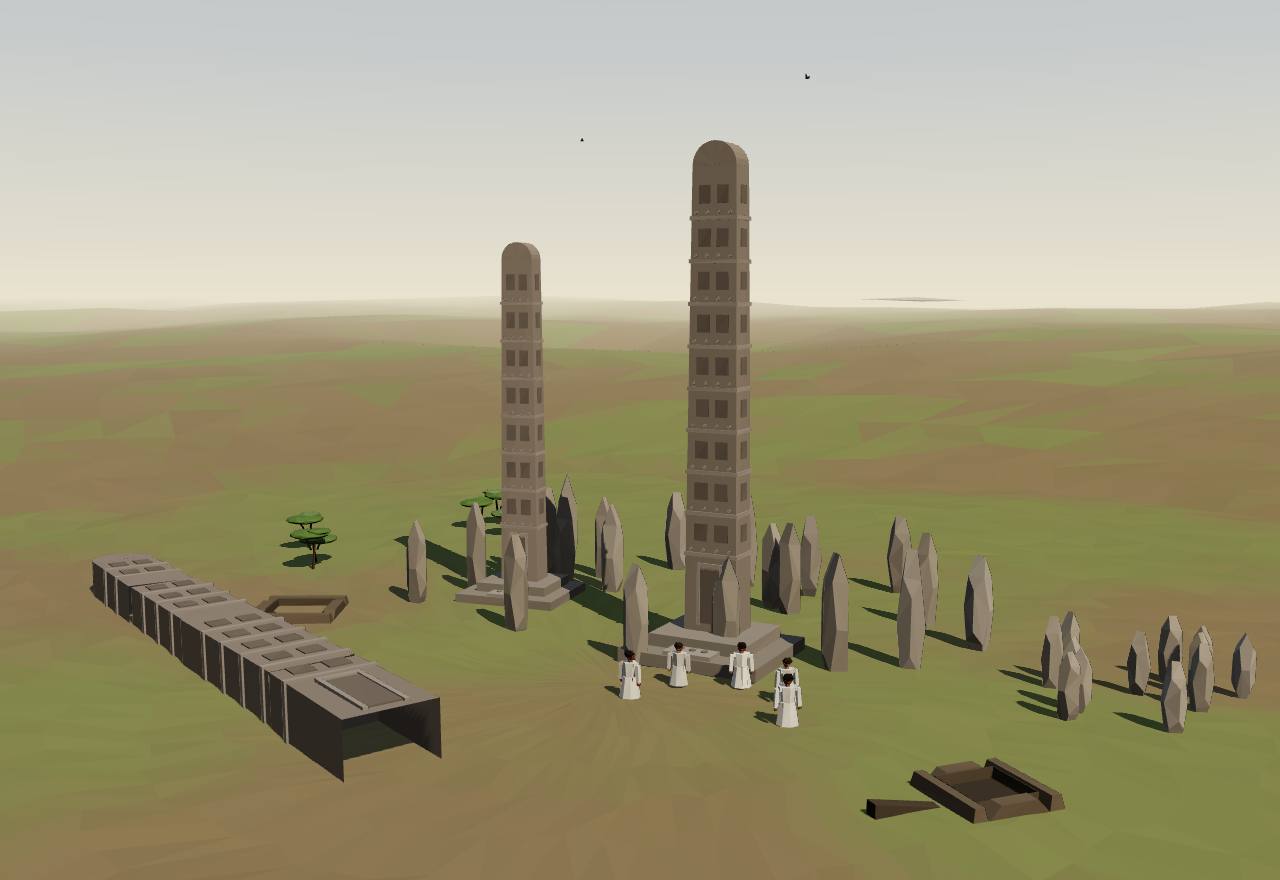
The stelae field at Aksum, about 350 (staged)
100 CE – 940 CE
Aksum
On the northern highlands of the Horn, kings ruled from a city of carved granite stelae, traded ivory and gold through the Red Sea port of Adulis, struck coins of their own, and called themselves king of kings. In the fourth century one of them, Ezana, presented himself as a Christian, at least to those who read Greek.
Terms: Aksum, Zagwe and Solomonic Ethiopia: Aksum
- ʾəgziʾa samāyለእግዚአ፡ሰማይ፡ዘአንገሠነ 'to the Lord of Heaven, who has made me king': Ezana's Ethiopic inscription RIÉ 189 as Butts prints and translates it; the Greek version of a sister text names the Trinity 4
- Mäḥrǝm 'the Aksumite god patron of the king', whom the Greek versions of the royal inscriptions call Ares; Müller's 1896 translation has Ezana 'son of Mahrem' 12,13
- Habashat a people in Ezana's titles; Müller notes 'the word Habashat appears here for the first time in an Ethiopian text' 13
- bəʾsi an epithet-name Aksumite kings bore beside their own: Ousanas's bəʾsi-name, Gisene, is printed on his coins 4
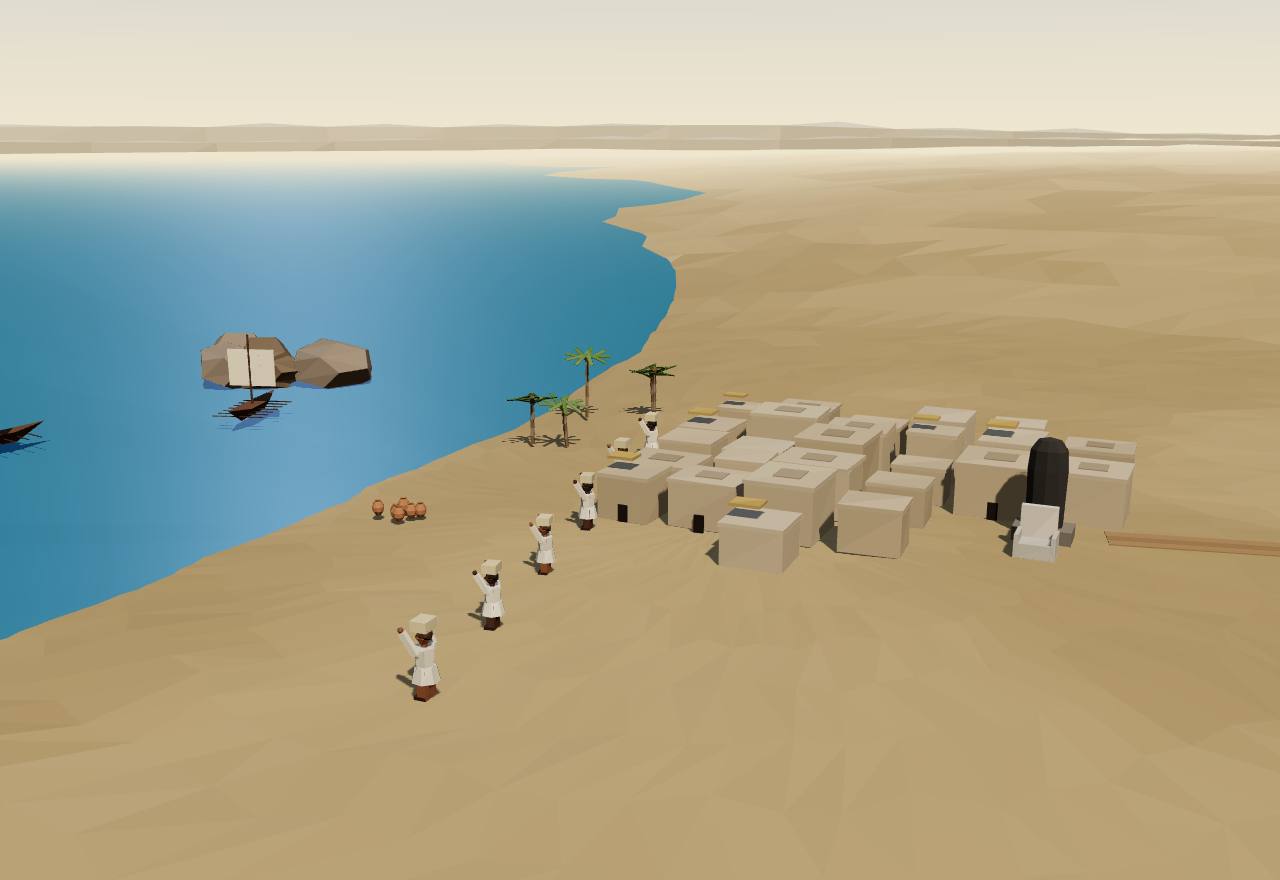
Adulis, the port of the Aksumites (staged)
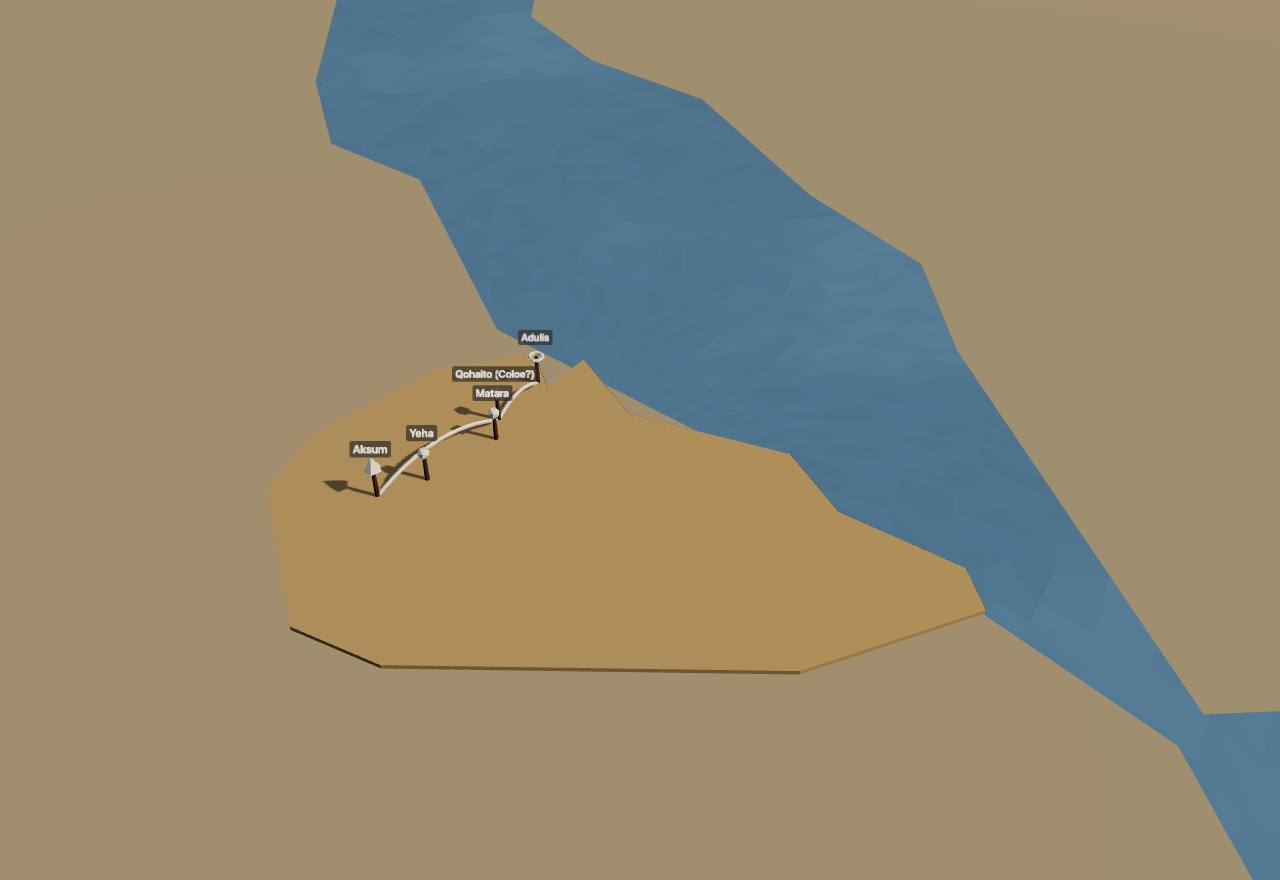
The first text to name the city is a Greek merchants' guide of the first century. Adulis was 'a port established by law', but ships anchored off an island 'because of attacks from the land'; from there it was three days to Coloe, 'the first market for ivory', and five more to 'the city of the people called Auxumites', where 'all the ivory is brought from the country beyond the Nile'. The coast was governed by Zoscales, 'miserly in his ways and always striving for more, but otherwise upright, and acquainted with Greek literature'. 14 Consensus Texts
Adulis took in Egyptian cloth, glass, iron 'made into spears used against the elephants', a little wine of Laodicea and Italy, Indian iron and cotton, and 'for the king, gold and silver plate made after the fashion of the country'; it sent out 'ivory, and tortoise-shell and rhinoceros-horn'. Five centuries later Cosmas heard that the region's tusks went 'by sea from Ethiopia even into India and Persia and the Homerite country and the Roman dominion'. 14,15 Consensus Texts
At Adulis Cosmas saw 'a marble chair' by the road to Aksum, with a basanite tablet behind it; about 525 he copied both inscriptions for King Elesbaan's governor, Abbas. The chair's text, by an Aksumite king whose name is lost, lists wars on peoples from the Agame and the Bega to the Arabian coast 'from Leuce Come to the country of the Sabaeans', the conquered paying 'half of all that they possessed', and thanks 'my mighty God, Ares, who begat me'. Cosmas adds that condemned criminals were executed in front of it. 15 Consensus Texts
Every other year, Cosmas reports, 'the King of the Axomites … through the governor of Agau, sends thither special agents to bargain for the gold', with upwards of five hundred traders bringing oxen, salt and iron to Sasu. Trade was silent: the people laid nuggets 'like peas' beside what they wanted and withdrew, 'because their language is different and interpreters are hardly to be found'. The round trip took six months. Cosmas says this was partly seen and partly told him. 15 Consensus Texts
Aksum's largest stelae stand in the May Ḥǝǧǧa field in the town's centre, 'up to 30 m high, weighing up to 520 tons', presumed 'late third–mid fourth century CE'. The standing one rises 'over 23 meters' and is carved 'to represent a nine-storey building', with a false door at its foot, rows of windows and the round beam-ends known as 'monkey's heads'. In 1893 Bent counted 'somewhere about fifty' stelae of all sizes, carved and plain. 12,16,13 Consensus Excavation
Manzo reads the carved stelae as palaces in stone: they 'represent monumental royal palaces, and the palace is a symbol of the authority of the king himself', and since they stand over large tombs for several members of the royal family, 'the palace may have been regarded as a symbol of the dynasty'. Metal plaques were once pegged to their tops; Krencker thought they showed the disc and crescent, Van Beek in some cases a cross. 12 Debated Excavation
The largest stela, 'some 33 meters long', 'lies where it fell, perhaps during the process of erection'. Butts suggests it was the last of the series, set up by Ousanas or Ezana, 'because the cessation of the practice seems to coincide with … the adoption of Christianity'; Manzo notes the suggestion that one great stela was deliberately toppled in Aksumite times. 'As to when and how the great monoliths fell there is no record or legend', Bent wrote. 16,4,12,13 Debated Excavation
The custom is old: excavations on Beta Giyorgis hill have shown 'that the occurrence of funerary stelae in Aksum goes back at least to the third, perhaps late fourth century BCE'. The great decorated stelae marked tombs 'apparently always intended to be family or lineage graves', enlarged over time for more burials. 12 Consensus Excavation Dating
One carved stela (Stela 2) was taken to Rome in 1937 'as a war trophy during the Italian occupation'; it was returned in 2005 and re-erected in 2008 'at the exact location where it stood in the 3rd or 4th century AD', after excavation of its foundation in 1999. 17,16 Consensus Excavation
Ezana's own inscriptions give his titles. In Müller's 1896 translation of a bilingual: 'Aizan, king of Aksum, and of Homer, and Raydan, and Habaset, and Saba, and Silh and Tiyam, and Kas, and Bega, king of kings, son of Mahrem, who is never triumphed over by his foes'. The Bega had revolted, so 'he sent his two brothers Shazan and Hadefah', who brought back six kings with their tribes. Several of the lands named lay across the Red Sea, and some the king may only have claimed. On coins and in inscriptions the kings called themselves 'king of Aksum' or 'king of the Aksumites', Munro-Hay notes, 'never as "king of Ethiopia"'. 13,4,11 Consensus Texts
Aksum struck its own coins from about 250, Seshat codes, in gold, silver and bronze; the first-century Periplus still has brass used 'in cut pieces instead of coin'. Ezana's earlier gold shows the pre-Christian disc and crescent; his later gold shows a cross, while 'he did not include crosses on his silver or copper coinage'. Gold travelled: Aksumite gold coins 'have been found … in South Arabia and as far away as India'. 14,4 Seshat Consensus Excavation Texts
There is 'now general consensus that the fourth-century Ezana is the first Aksumite ruler to present himself as a Christian', on the strength of a Greek inscription that opens 'In the faith of God and in the power of the Father, Son, and Holy Spirit, who saved the kingdom for me'. Its Ethiopic counterpart on the back of the same stone speaks of the 'Lord of the Land' and the 'Lord of Heaven', and ends with a cross. Ezana stopped calling himself 'son of the invincible Mahrem' and became 'son of Ella Amida', his father. 4,11 Consensus Texts
An outside text names him. In 356 Athanasius copied into his Apology a letter of the emperor Constantius 'to Æzanes and Sazanes', rulers of Aksum, ordering them to send 'the Bishop Frumentius' to Egypt, because he had been 'advanced to his present rank by Athanasius', whom the emperor had deposed. Sazana is the brother Ezana's inscriptions name. 5,4 Consensus Texts
At Beta Samati, a town near Yeha found in 2009, excavators dug a basilica of 18.7 by 12.4 metres whose earliest use radiocarbon dates to the fourth century AD. Clay figurines and stone bull heads lay inside, 'a mixing of pagan and early Christian traditions', and outside its wall a stone pendant bears a cross and letters read as 'venerable'. 2 Consensus Excavation Dating
By the sixth century Cosmas, who had been there, could write that 'in Ethiopia and Axom, and in all the country about it … there are everywhere churches of the Christians, and bishops, martyrs, monks and recluses'. 15 Consensus Texts
Aksum's kings fought across the sea. Procopius has Hellestheaeus, 'a Christian and a most devoted adherent of this faith', cross against the Homeritae of Yemen, who were oppressing Christians, kill their king and set up a Christian Himyarite to pay tribute; when the slave Abramus seized power, an Aksumite army of 3,000 went over to him. Justinian's envoy Julianus then asked the Aksumites to buy silk from India for Rome, which proved impossible: 'the Persian merchants always locate themselves at the very harbours where the Indian ships first put in'. 18,15 Consensus Texts
Cosmas saw giraffes kept young 'to make a show for the King's amusement', elephants trained for show, and 'four brazen figures' of the unicorn 'set up in the four-towered palace of the King of Ethiopia'. He does not say the palace was at Aksum. 15 Consensus Texts
In 615 the king of Aksum, 'possibly King Armah', 'granted refuge to early Muslims, including one of the Prophet Mohammed's daughters, and his son-in-law/successor ʿUthman Ibn ʿAffan'. Aksum was spared the first Islamic conquests. 2 Consensus Texts
Seshat codes Aksum at its height (350–599) at 600,000–700,000 km² and half a million people or more, with four to five administrative levels and its largest town at 50,000–60,000; by 800 it codes 50,000 km². Of succession it notes that 'only for Wa'zeb … do we have primary evidence from Aksumite documents for hereditary succession'. Seshat DB Consensus Texts
Taddesse traces Aksum's decline to the sea: 'the first serious blow to Aksumite economic and political interests in the Red Sea was inflicted by the Persians', and between the seventh and mid-eighth centuries 'the Christians seem to have gradually lost their control of the maritime trade'. The kings 'seem to have stopped issuing coins towards the middle of the eighth century', yet 'the kingdom held its own on the mainland', its centre shifting south towards the Agaw country. 6 Seshat DB Debated Texts
How power worked King · Heredity · Empire · 1 unknown
How power worked
- Who rules
- King Consensus
Why?
- How chosen
- Heredity Debated
Why?
- Limits on power
- Unknown
Why?
No text read says what, if anything, bound an Aksumite king; Seshat codes judges and courts 'suspected unknown' to 349 and 'unknown' after.
- Scale
- Empire Debated
Why?
- Claim to rule
- Divine mandate Consensus
Why?
- Who has a say
- A narrow elite Debated
Why?
Disc and crescent, or cross: what Aksumite coins show
Data: Butts 2026, Harrower et al. 2019, the Periplus, Seshat
Aksum's kings struck coins in gold, silver and bronze, with Greek legends, from about 250 to the eighth century. 13,6 Seshat Under Ezana the symbol above the king's head changes, and Butts's point is where it changes: the cross appears on gold, which travelled abroad, not on the silver and bronze that circulated at home. 4 The drawings are schematic, not of any one coin.
-
Ousanas before Ezana
metal not stated · disc and crescent
Ousanas, probably Ezana's older brother, 'produced coins with disc and crescent … but none with crosses'. 4
-
Ousanas before Ezana
silver · no religious symbol
Silver coins of Ousanas with no religious symbol. Butts reads the gap as a matter of design: 'the triple rim simply did not provide space for the disc and crescent'. 4
-
Ezana earlier reign
gold · disc and crescent
Gold coins of Ezana's earlier period with the disc and crescent, 'associated with pre-Christian religious practices in Aksum, as well as more broadly in the Horn of Africa and the Arabian Peninsula'. 4
-
Ezana c. 300–330
silver · symbol not described
A 'pre-Christian silver coin of King Ezana (c. AD 300–330)' was found at Beta Samati. 2
-
Ezana later reign
gold · cross
'Ezana's coins with crosses are gold; he did not include crosses on his silver or copper coinage.' Aksumite gold has been found 'in South Arabia and as far away as India'. 4
-
Ezana later reign
silver · no religious symbol
The 'lower-denomination silver and bronze coins of the later period' carry neither cross nor disc and crescent: 'not the old way, but the new way is left unstated'. 4
-
Ezana later reign
silver · an uncertain symbol
Silver coins, some gilt, with a symbol where the disc and crescent or the cross would be; 'perhaps a Christian "sun-cross", but the interpretation is far from certain'. 4
-
Armah c. 600–630
bronze · symbol not described
Two bronze coins of King Armah, 'c. AD 600–630', at Beta Samati (a proposed date of 540–580 'is not yet widely accepted'). 2
- Before coins. In the first century the Periplus lists 'brass, which is used for ornament and in cut pieces instead of coin' among the goods landed at Adulis, and 'a little coin for those coming to the market'. 14
- First coins. Seshat codes indigenous coins absent in Aksum before 250 and present from 250. Seshat
- Last coins. 'The Aksumite kings seem to have stopped issuing coins towards the middle of the eighth century'; Seshat codes them absent from 700. 6 Seshat DB
940 CE – 1137 CE
Between Aksum and the Zagwe
After Aksum's decline 'the Christian kingdom had centred around the region of southern Tigre and Angot', Taddesse writes; for about a century and a half after the war of the tenth-century queen described below, its effective frontiers 'were probably limited to the area north of the Jama river'. No king's name from these centuries can be dated from the sources read. 6 Debated Texts
The best-attested event is a war. The History of the Patriarchs of Alexandria tells of 'a pagan queen of the Bani al-Hamwiyah who led her people against the Christians in the tenth century', and the geographer Ibn Haukal, about 977, heard that Ethiopia had been 'gouvernée par une reine depuis une trentaine d'années', which puts her rise about 945. Ethiopian tradition remembers a destroying queen, Gudit; Taddesse links the two. 6 Debated Texts
Whether the gap is a dark age or a gap in the record is itself argued: Cerulli held that 'this vacuum of centuries … is only apparent; and it only indicates a lacuna in the transmission of MSS.' Seshat stops coding Aksum at 800; Cliopatria draws the Kingdom of Axum to 946 and a Zagwe polygon from 947, a continuity no text read here can date. 6,9 Seshat DB Debated Texts
1137 CE – 1270 CE
The Zagwe kings
In the twelfth century a new Christian dynasty from Lasta, in the Agaw country, took the throne. Later chronicles called its kings usurpers; they also left the rock-cut churches of Lalibela, the work of a king who was certainly reigning between 1205 and 1225.
Terms: Aksum, Zagwe and Solomonic Ethiopia: The Zagwe kings
- Roha the old name of the town of the churches, in the Life of Lalibela: 'la ville sainte de Roha' 8
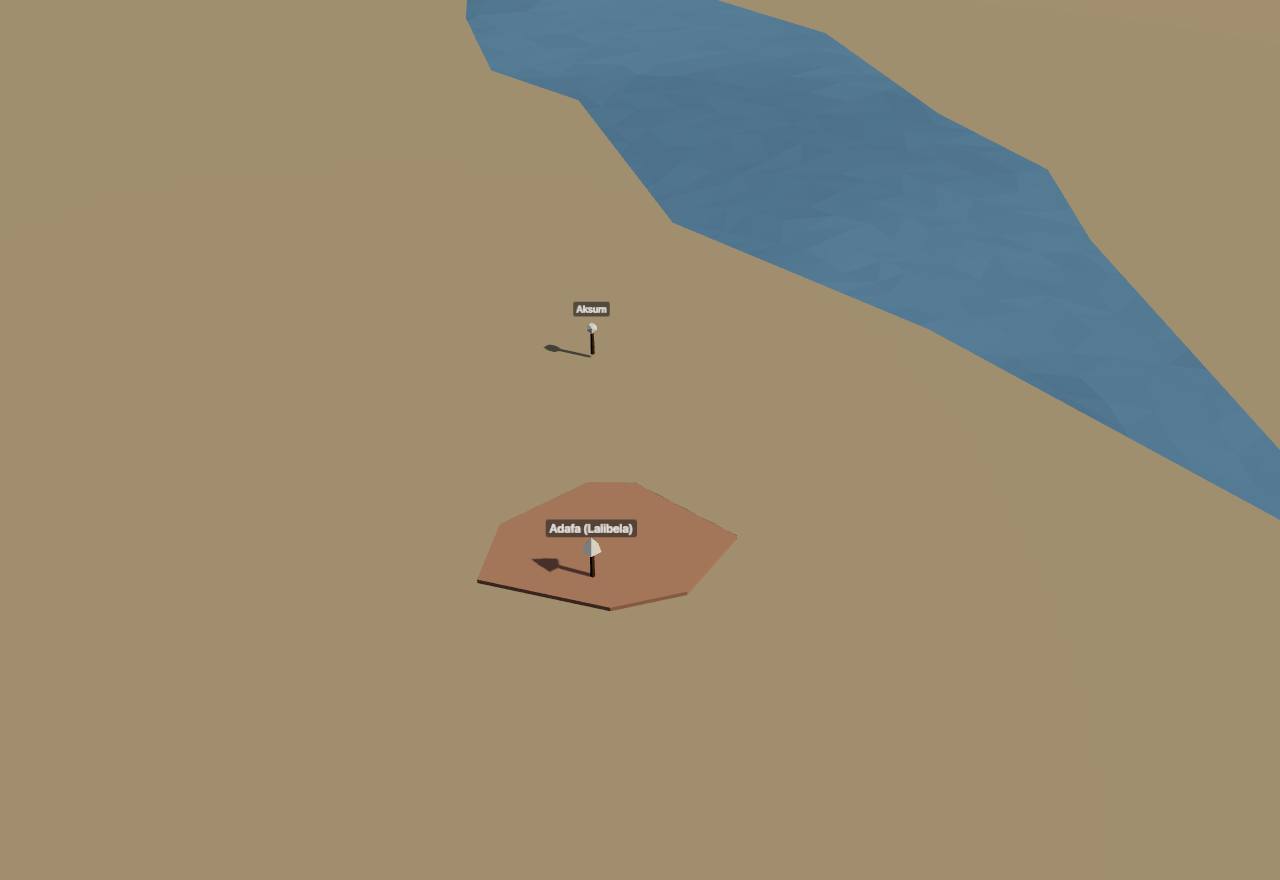
- Adafa the Zagwe capital, 'just outside the present site of the Lalibala churches' 6
- Agaw the people of Wag and Lasta, speakers of Agaw, from whom the Zagwe came; at a Zagwe coronation the crowd cried 'Hawisa', a word Taddesse finds in a Kimant vocabulary meaning 'to anoint' 6
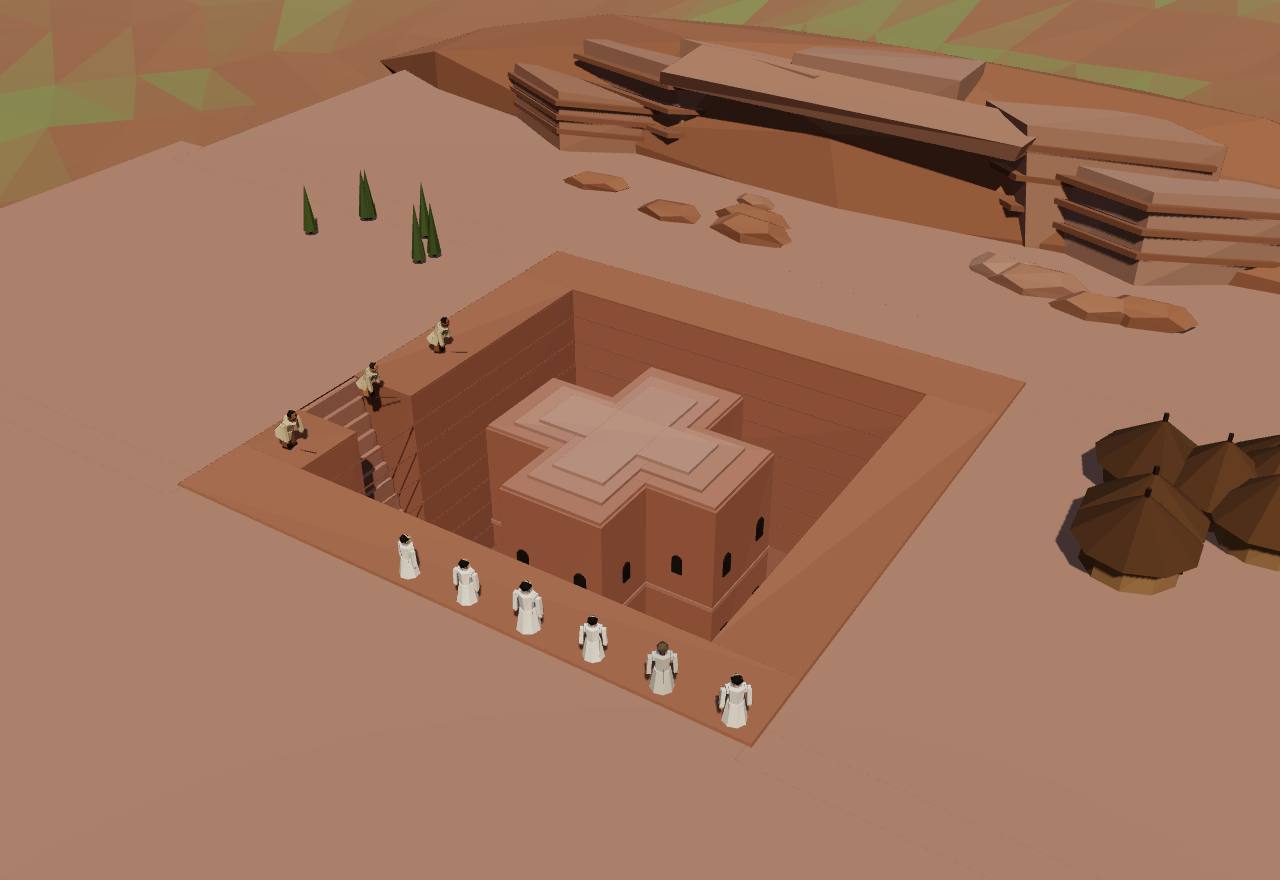
A rock-cut church at Lalibela (staged)
'The circumstances of the advent to power of the Zagwe kings are very uncertain.' A new Christian dynasty 'emerged in the first half of the twelfth century and took control of the whole kingdom, deriving much of its political support from Lasta'. One tradition has a general from Bugna in Lasta marry the last Aksumite king's daughter, rebel, kill his father-in-law and usurp the throne. 6 Debated Texts
Taddesse argues that 'the rise of the Zagwe dynasty did not represent a break in the Aksumite tradition' but 'the culmination of a natural political development'. Because they spoke Agaw, 'the Zagwe kings have been dismissed, in the dominant traditions of their political enemies, as an alien and impious group of adventurers', which 'has long obscured what is perhaps the richest and most artistic period of Ethiopian history since the conversion of Ezana'. 6 Debated Texts
The Zagwe's own documents are land grants copied into gospel books. In them Lalibela calls himself 'the hadāni Lālibalā whose regnal name is Gabra Masqal, a courageous man who remains undefeated by his enemies through the power of the Cross of Jesus Christ', and eighteen dignitaries witness each grant, priests and an archdeacon beside a perfume-bearer and a master of ceremonies. Derat concludes that the Zagwe 'were much closer to the Aksumite kings than to their successors'. 7 Consensus Texts
How many Zagwe kings there were is not settled. Taddesse's tentative genealogy has seven crowned princes, Marara to Yitbarak, and finds that 'the throne rarely passed from father to son, but either from brother to brother or from uncle to nephew', by the rules of 'inheritance of family property in Lasta'. The chronicle king-list Perruchon printed has eleven, most reigning a round 40 years, for 354 years in all. 6,8 Seshat DB Debated Texts
An Egyptian writer who lived through events of 1173–74, Abu Salih, reports that Ethiopia 'was ruled by kings who were also priests'; in Ethiopian tradition only Yimrha fits, 'ordained a priest before his coronation'. Taddesse credits Yimrha with beginning 'the Zagwe tradition of building rock-hewn churches'. 6 Debated Texts
Lalibela 'was certainly on the throne between 1205 and 1225' (his land grants show him 'ruling in 1225'); the king-lists give him 40 years. His hagiography has Christ tell King Harbe in a vision to hand him the kingdom 'afin qu'il construise des églises'; Taddesse, noting that Lalibela had lived as an outlaw in his brother's reign, thinks he took power 'probably … by force of arms'. Egyptian patriarchal envoys estimated his army at '60,000 mounted soldiers without counting the numerous servants'. 6,7,8 Debated Texts
Eleven monolithic churches were cut down into the rock at Lalibela. Bete Medhane Alem, with five aisles, 'is believed to be the largest monolithic church in the world'; Bete Giyorgis has a cross plan. Taddesse calls them 'a deliberate attempt to reproduce the Holy City of Jerusalem in the mountains of Wag and Lasta'. Alvares, there in the 1520s, swore 'by God, in whose power I am, that all that is written is the truth', for fear he would not be believed. 27,6,28 Consensus Excavation Texts
The Life of Lalibela, which Perruchon dates to the fourteenth century, tells how the churches were made 'sans charpente ni mortier': the king paid every workman the wage he asked and bought the ground 'à prix d'or', and 'les anges travaillaient avec eux pendant le jour et seuls pendant la nuit', so that a cubit cut by day was found four by morning. Tradition gave the work 24 years. 8 Consensus Texts
The Church's head was an Egyptian monk sent by the patriarch of Alexandria. Under Patriarch Gabriel (1131–45) the Ethiopian king asked the metropolitan to ordain more than the prescribed seven bishops: with ten, 'the Ethiopians would in future be able to appoint their own metropolitan, or even a patriarch'. Relations with Egypt held: an embassy to the Fatimid caliph was received in 1173 by Saladin, who in 1189 'is said to have given many sites to the Ethiopians' in Jerusalem. 6 Consensus Texts
The king's claim to the land was older than the Solomonic dynasty, Taddesse argues. Lalibela's hagiographer praises him for buying the ground for his churches, asking 'who would have forbidden the king if he had decided to take the land'. 6,8 Consensus Texts
After Lalibela the succession was fought over. His nephew Na'akuto-La'ab's hagiographers say Lalibela abdicated in his favour; Taddesse calls this 'an unlikely story' shaped to exclude 'Lalibala's own son, Yitbarak, from the official record', whose name was later 'systematically suppressed' as 'Za-Ilmaknun, "The Unknown, the hidden one"'. 6 Debated Texts
Seshat codes the Zagwe kingdom at only 40,000–50,000 km², 'landlocked', with its capital at Adefa (Roha), three to five administrative levels, no coins of its own and no ports. Its note on the king: the Zagwe 'seem to have followed the Agaw laws of inheritance, that implied a certain degree of matrilineality, with power passing to brothers and then to nephews'. Seshat DB Consensus Texts
Later writers judged the Zagwe by descent. A scribe's note in the Kebra Nagast says it was not put into Ge'ez under them 'because this book says: "Those who reign, not being Israelites, are transgressors of the Law"'; even Lalibela's own Life has him pray that God 'fasse revenir (à la maison) d'Israël' the royal office. Taddesse reads both as the work of the dynasty's enemies, written after 1270; Derat calls the Kebra Nagast 'the first historiography to circulate with negative undertones concerning the Zāgwē dynasty'. 6,8,7 Debated Texts
How power worked King · Heredity · Custom and kin
How power worked
- Who rules
- King Consensus
Why?
- How chosen
- Heredity Debated
Why?
- Limits on power
- Custom and kin Debated
Why?
- Scale
- Territorial state Consensus
Why?
- Claim to rule
- Divine mandate Debated
Why?
- Who has a say
- A narrow elite Debated
Why?
1270 CE – 1529 CE
The Solomonic kingdom
In 1270 an Amhara lord, Yekuno Amlak, killed the last Zagwe king and took the crown; his descendants claimed King Solomon as their ancestor. They ruled from a vast tent city that moved from province to province, held their brothers on a mountain prison, and pushed the kingdom's frontiers south until Imam Ahmad's army broke it in 1529.
Terms: Aksum, Zagwe and Solomonic Ethiopia: The Solomonic kingdom
- gult a royal grant of rights over the peasants on a piece of land, not the land itself: 'Gults were a medieval substitute for salaries' 6
- abunአቡነ 'our father': what the Ethiopic Homily calls Frumentius (Butts prints አቡነ፡ before his name); in Taddesse's period the title of the metropolitan, 'always conferred on an Egyptian monk' 4,6
- Aqabe Sa'at 'the most important ecclesiastical official in court', the abbot of the island monastery of Hayq 6
- Kebra Nagast 'the Glory of the Kings', in Budge's translation of the title: the book of Solomon, the Queen of Sheba and their son Menyelek; Taddesse spells it Kibra-Nagast 10,6
- Siyon Zion, 'a term figuratively applied to St. Mary', also 'used in reference to the kingdom as a symbol of the special identity of Christian Ethiopia' 6
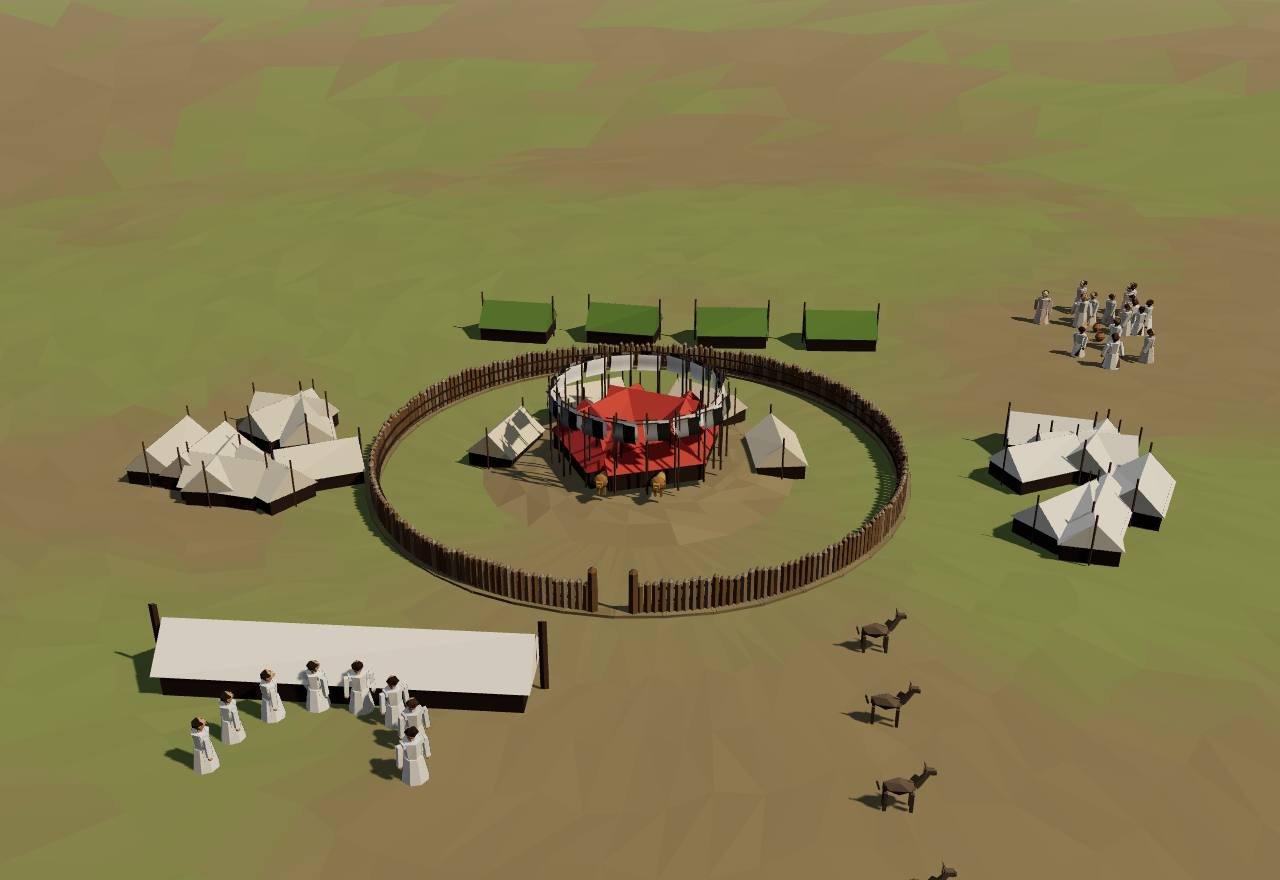
The king's moving camp, after Alvares (1520s; staged, distances shortened)
'The origins and early life of Yikunno-'Amlak still remain very obscure': tradition made him a descendant of the last Aksumite king, his mother 'one of the slaves' of an Amhara chief. Imprisoned by Yitbarak, he escaped, built a following in Amhara and Shawa, 'attacked the Zagwe king, killed him, and declared himself King of Ethiopia'. In 1268 the Zagwe had crowned another king, Dilanda; in 1270 a land grant is signed 'King Yikwinat'. Derat names the defeated king as Yetbarak, Lalibela's son, and notes that the victor 'had a monolithic church carved out of the rock' and his own portrait painted inside. 6,7 Consensus Texts
Later tradition called 1270 a restoration: the Zagwe king handed back 'le trône de ses pères' through the mediation of Takla-Haymanot, who received 'un tiers du royaume' for the Church. Perruchon repeated it from Bruce and Salt, noting that the saint's own commemoration is silent; Conti Rossini showed that Takla-Haymanot 'does not seem to have played this role'. Taddesse's verdict: an Agaw dynasty was replaced by 'a Semitic-speaking monarch. Only in this sense was the advent of Yikunno-'Amlak a restoration.' 8,6 Debated Texts
The new dynasty was not secure: after Yagba Seyon died in 1294, 'the throne was occupied by five successive kings' before his brother Widim Ra'ad took power in 1299, and only then did 'the new "Solomonic" dynasty' regain its strength. A manuscript note already calls Yagba Seyon 'whose regnal name is Solomon'. 6 Consensus Texts
Amda Seyon (1314–44) turned the kingdom into a conquering power. In 1332 Sabr ad-Din of Ifat proclaimed what Taddesse calls a jihad and attacked on three fronts; the king's army, 'numerous contingents recruited from the different provinces … each with its own commander', won, and the king made Sabr ad-Din's brother 'king of all the Muslims'. Al-ʿUmari, writing in the 1340s, reports that the Muslim rulers had no authority 'without being invested by the king of the Amhara'. 6 Consensus Texts
The king's power rested on 'the theory that all land within his dominions belonged to the king', which let him grant gult. A gult-holder had 'no rights on the land itself, but only on the peasants living and working on it', who owed him cloth, grain, honey, bars of salt, cattle and even axes and sickles. 'Gults were a medieval substitute for salaries', and many monasteries held large tracts as gult by the mid-fifteenth century. 6 Consensus Texts
The provinces had two layers of rulers: hereditary chiefs with the title Siyum, 'which clearly indicates a royal appointment at least in its origin', and the king's own governors, who 'were completely dependent on his power. He reshuffled them according to his wishes and his needs.' Taddesse calls the result 'a loose confederation of regional princedoms'. 6 Consensus Texts
'The Court itself appears to have been continuously moving from one province to another.' Al-ʿUmari heard that the king and his soldiers 'have tents which they carry with them'. The court shrank in the rainy season and swelled in the dry; its arrival in a region was 'a dramatic representation of the presence of the Christian kingdom', and it trained the kingdom's governors. 6 Consensus Texts
The camp kept one plan wherever it stopped: 'the concentric arrangement of the royal camp' expressed the monarch as 'the focal point of the vast Christian empire'. The king's quarters lay in two concentric enclosures with thirteen named exits; officials camped as the Right and the Left by the six gates on either side; it had 'exactly the same functions as a fixed city'. 6 Consensus Texts
Alvares lived in the camp in the 1520s. The king's tents stood on the highest ground, ringed by curtains 'woven like a chess-board, half white and half black'; the market lay half a league or more away, and the whole camp 'always occupies two large leagues'. The court moved with 'not … less than fifty thousand mules', its route kept secret: people followed 'until they find a white tent pitched, and there they settle down'. 28 Consensus Texts
Horvath, writing of the sixteenth and seventeenth centuries, argues that the 'roving capitals were large and densely populated enough to qualify for city status', and that 'capitals moved to food supplies rather than supplies being moved to the capital', impoverishing each hinterland in turn. 33 Debated Texts
The king was heard more than seen. At Alvares's first audience messages came 'from within the curtains'; when the curtains opened, Lebna Dengel sat on a dais of six steps with blue taffeta before his face. Lords held their lands at his pleasure: 'the Prester gives when he pleases, and takes away when he pleases', and none could leave court without leave. When Gojjam's tribute was presented Alvares saw 'three thousand mules, three thousand horses, and three thousand basutos', and the parade of dues took ten days. 28 Consensus Texts
'Of all the descendants of Yikunno-Amlak, in the male line, only the reigning monarch and his sons lived outside the Royal Prison of Mount Gishan.' Alvares heard that the mountain took fifteen days to go round and that a quarter of the court's people were its guards; a friar who carried a prince's letter was flogged every two days. When a king died without a son, a new one was brought down from it. 6,28 Consensus Texts
Zara Yaqob (1434–68), brought down from the mountain at about 35, was crowned at Aksum in 1436 on a stone throne and spent his last fourteen years behind the palisade of Debre Berhan. He set his daughters over the provinces, then took 'personal control of all the provinces through a new cadre of local appointees'; his chronicle speaks of 'une grande terreur' at 'la sévérité de sa justice', and Taddesse calls him 'a despot' and the one king who tried to create 'a nation out of the manifold communities'. 6,34 Consensus Texts
Church and crown argued over the Sabbath. A collection of Alexandrian canons of 1238 rejected keeping the Sabbath 'as a Jewish custom', and the Egyptian bishops held to that line; the followers of the monk Ewostatewos kept it. King Dawit protected them in 1404, and in 1450 Zara Yaqob presided over the Council of Dabra Mitmaq, where 'the bishops formally authorized the observance of the Sabbath in the Ethiopian Church'. 6 Consensus Texts
The Kebra Nagast tells how the Queen of Sheba bore Solomon a son, Menyelek, who brought the Ark of the Covenant to Aksum. Its translator Isaac, Budge writes, believed 'that the lawful kings of Ethiopia were descended from Solomon' and that God had moved 'His place of abode on earth from Jerusalem to Áksüm'. Taddesse dates 'the first compilation of the Kibra-Nagast' to the first years of Amda Seyon, while noting that the tradition was 'widely diffused' before it. 10,6 Consensus Texts
Where the Sheba legend came from is argued. Munro-Hay finds 'no trace of this legend in Aksumite times', when kings claimed descent from Mahrem, and no royal claim to Israelite descent before a report from Lalibela's reign; Derat notes that Egyptian sources made Ethiopia the Queen of Sheba's kingdom 'as early as the 11th century'; Beylot asks whether the story of Menelik itself 'ne s'est pas d'abord développée en Nubie', whose Christians may have taken the Queen of Sheba for one of their own sovereigns. 11,7,35 Debated Texts
From 1478 the average age of a new king was eleven, and 'the nation was ruled by a council of regents for the first part of each of the reigns'. Factions fetched rival princes from the mountain; Na'od lost his life marching against a Muslim invasion of Ifat. 'Half a century of political strife among the warlords of the Christian kingdom provided the immediate, favourable background for the swift Muslim conquest' under Imam Ahmad ibn Ibrahim. 6 Consensus Texts
Ahmad's own chronicler, Shihab ad-Din, presents him as 'imâm des musulmans', even 'l'imâm de la fin des temps', the man 'par qui Dieu très-haut mettra en ordre l'Abyssinie'; the king appears as Wanag Sagad, Lebna Dengel's throne name. The battle of Shimbra Kure came in 1529, and Ahmad's occupation of the highlands lasted from 1531 to 1543. 36,6 Consensus Texts
How power worked King · Heredity · Custom and kin
How power worked
- Who rules
- King Consensus
Why?
- How chosen
- Heredity Consensus
Why?
- Limits on power
- Custom and kin Debated
Why?
- Scale
- Empire Debated
Why?
- Claim to rule
- Divine mandate Debated
Why?
- Who has a say
- A narrow elite Consensus
Why?
The moving court: its plan, and where it stopped
Data: Taddesse Tamrat 1972, Alvares, Zara Yaqob's chronicle; UNESCO and Wikidata positions
The plan, wherever the camp stopped
"The Court itself appears to have been continuously moving from one province to another", and it kept the same layout at every stop. 6,28 The diagram follows Taddesse's reconstruction: the king at the centre, 13 exits in the outer enclosure, the principal one to the west with 6 on either side. It is a scheme, not a measured plan.
The king and his family. 'The private quarters of the king and his family consisted of two concentric enclosures at the heart of the huge conglomeration of people assembled at the court.' Alvares saw four or five royal tents pitched together and surrounded with curtains 'woven like a chess-board, half white and half black', on the highest ground of the plain. 6,28
Queens and the Queen Mother. Taddesse's plan places the Queen of the Right, the Queen of the Left, the junior Queen of the Right and the Queen Mother inside the outer enclosure; 'normally, the number of the king's wives was three.' 6
Thirteen exits. 'Thirteen separate exits, each with its own name, led to the outer enclosure. The principal exit, Widinash Daj, probably opened in a westerly direction', with six gates on either side. Alvares, who was not let behind the curtains, was told of 'twelve gates'. 6,28
The Right and the Left. 'The twin organization of the royal court, and of the king's officials, into those of the Right and of the Left is basically derived from this characteristic arrangement of the six gates on either side.' The two highest military officers were the Bihtwaddad of the Right and of the Left. 6
Churches, the abbot and the bishop. The Aqabe Sa'at, head of the island monastery of Hayq, was the court's leading churchman; the Egyptian bishop used the Masqal Daj and probably kept a tent near the Chapel of the Cross. 'The churches always travel with the Court, and there are thirteen of them', Alvares writes. 6,28
Guards and treasure. A partial list of the royal guards 'gives a total number of over 13,000'. Alvares saw the treasure tents, whose 'captains and factors' were eunuchs, and the king's four lions, which 'always bring them wherever Prester John goes'. 6,28
The court of justice. 'A long tent is always pitched there, which they call cacalla; this is the court of justice or tribunal.' The judges took each case to the king only as far as the curtain, 'and so return to the parties with the decision of the Prester'. 28,6
The market and the lords' camps. 'The least distance at which the market can be placed is half a league, and at times nearly a league, or even more.' Traders and lords camped further out, so that the whole camp 'always occupies two large leagues'. 28
Where the court stood
Places the sources put the king and his court, by period; faint rings mark the seats of other periods. Taddesse sees "a general southward movement of these sites" from the fourteenth century; Zara Yaqob was crowned at Aksum in the far north but spent his last fourteen years at Debre Berhan in Shawa. 6,34 Tegulet, Dago and Dabra Mitmaq, which the sources also name, are left off: no record read gives their position.
| Place | When | Who |
|---|---|---|
| Adafa (Lalibela)12.03° N, 38.82° E | 1205–1270 | The Zagwe kings 'had their capital at a place called Adafa, just outside the present site of the Lalibala churches'. 27,6 |
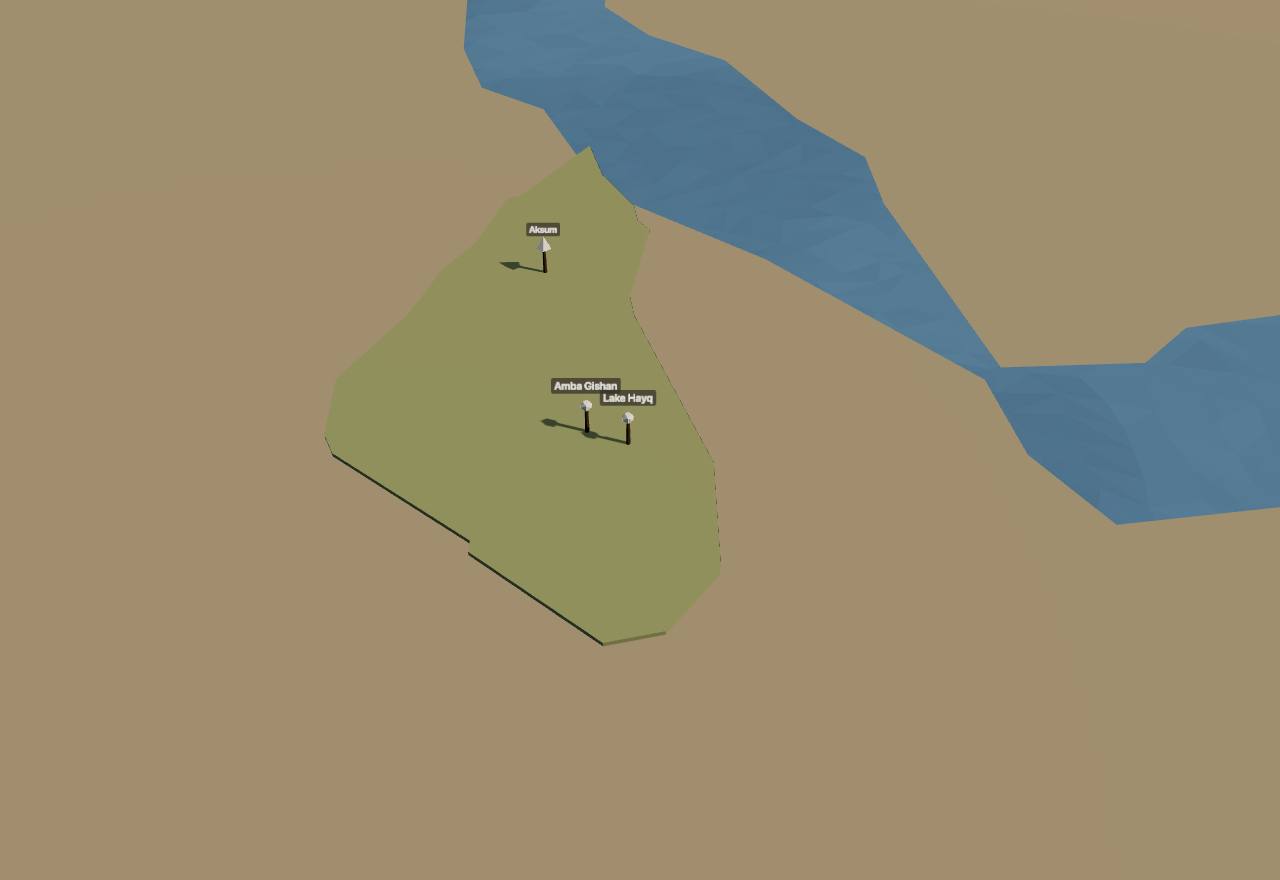
| Lake Hayq11.33° N, 39.72° E | 1248–1529 | Iyasus-Mo'a's school on the lake island from about 1248; tradition makes him Yekuno Amlak's ally in 1270, and his successors, the Aqabe Sa'at, the court's leading churchmen. 38,6 |
| Aksum14.13° N, 38.72° E | 1436–1439 | Zara Yaqob 'went to the ancient city of Aksum in 1436 for his formal coronation and stayed there for three years', seated on a stone throne. 16,6,34 |
| Debre Libanos9.71° N, 38.85° E | 1450–1529 | Takla-Haymanot's monastery, which Zara Yaqob renamed Dabra Libanos and granted 'all the revenues collected from the rich province of Shawa'. 39,6 |
| Debre Berhan9.68° N, 39.53° E | 1454–1468 | Zara Yaqob's palisaded residence: twelve years without leaving it, then two years of short trips, 'ce qui fait en tout quatorze ans'; Perruchon calls it 'un camp permanent'. 40,34 |
| Amba Gishan11.50° N, 39.32° E | 1285–1529 | The royal prison: 'only the reigning monarch and his sons lived outside' it. Its organisation 'probably dates from the troubled days following the death of Yikunno-Amlak'; Zara Yaqob came down from it in 1434, Na'od in 1494. 41,6 |
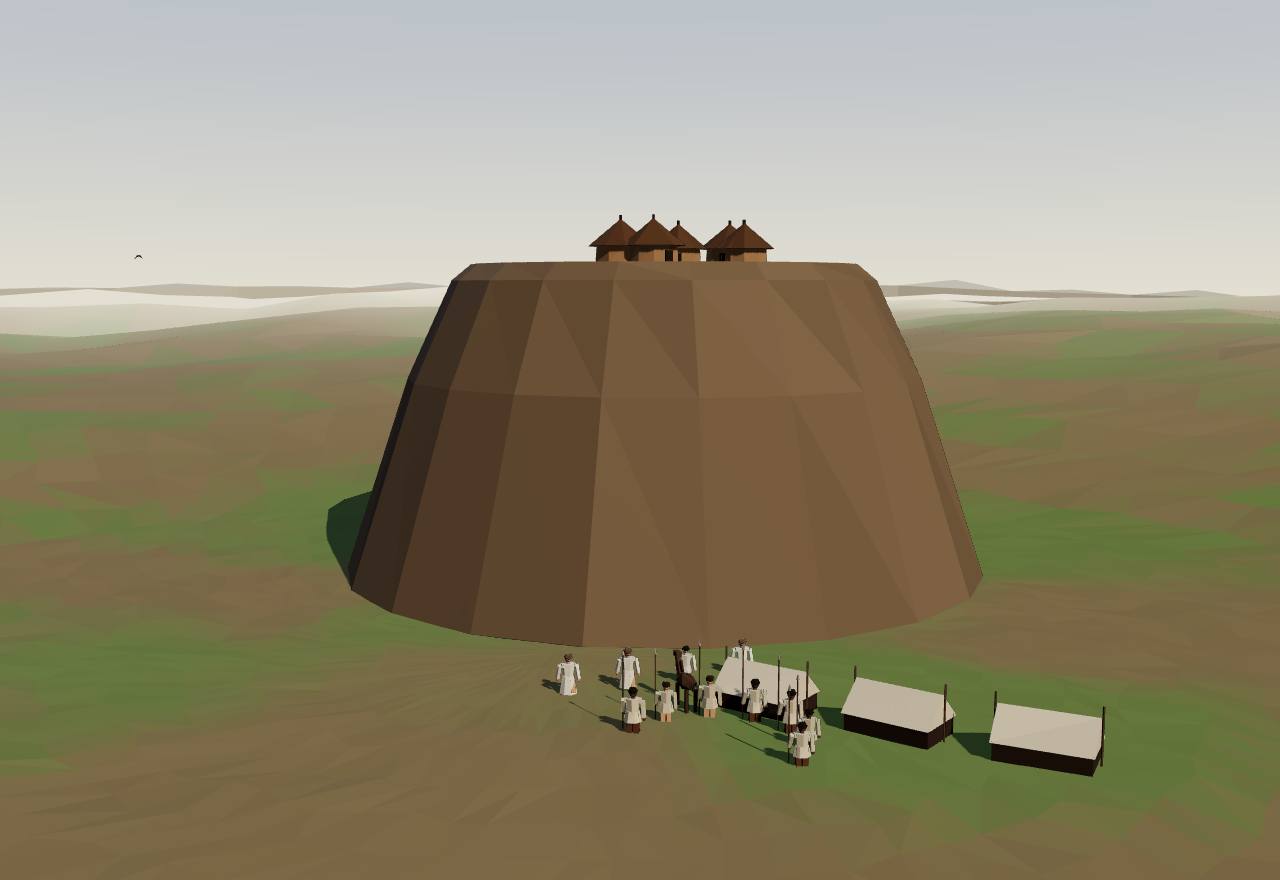
The royal prison on Amba Gishan (not to scale)
Artefacts
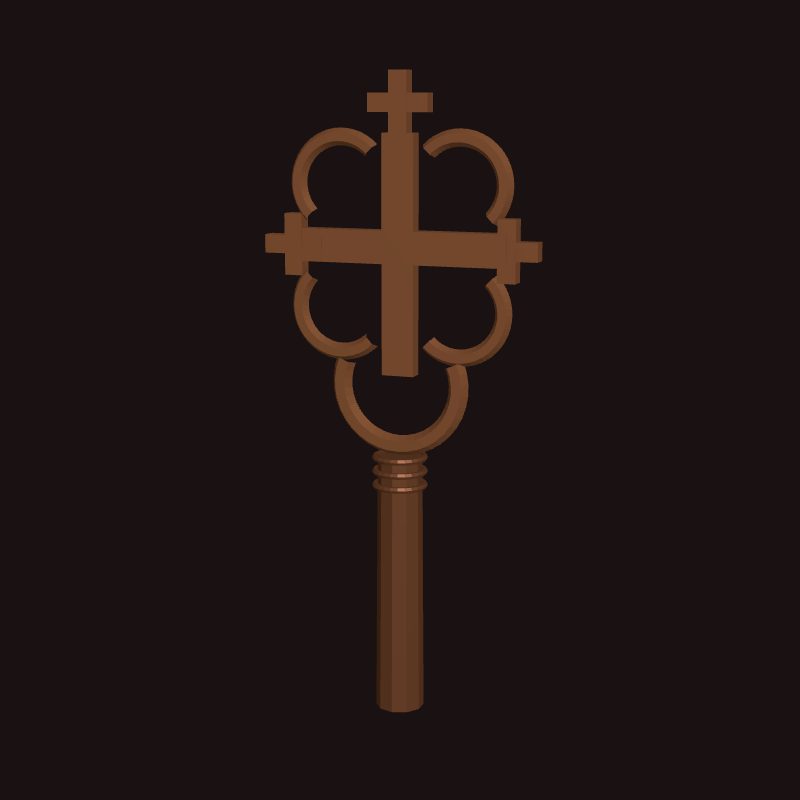 Model, not a scan
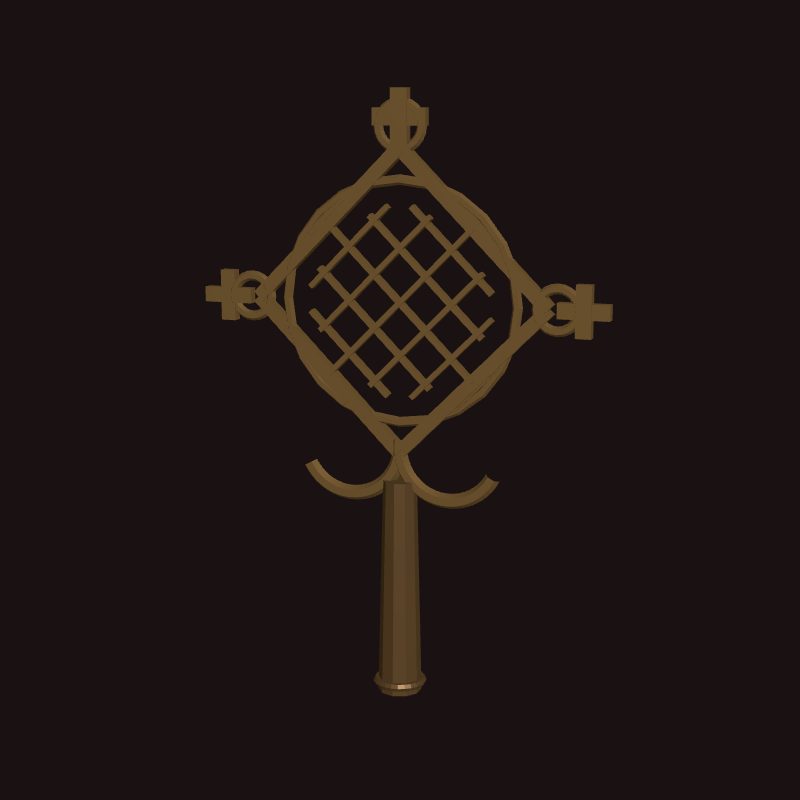 Model, not a scan
In numbers
How kings came to the throne, 1270–1529
Data: Taddesse Tamrat 1972; Perruchon's chronicles; Alvares
"A king was normally succeeded by one of his own sons", Taddesse writes, but only "after serious dynastic conflicts among the princes". Every male descendant of Yekuno Amlak except the king and his sons was held on Amba Gishan, so a change of branch meant fetching a prince from the mountain (3 of these 19 reigns), and from 1478 children were crowned for courtiers to rule through (4 reigns). 6 Five kings between 1294 and 1299 are not named in the source and have no bar.
The Zagwe kings, before 1270: order only
- Marara: 'elsewhere said to have been the first Zagwe king'.
- Tantawidim: second in Taddesse's tentative genealogy.
- Yimrha-Kristos: a priest before his coronation, who 'inaugurated the Zagwe tradition of building rock-hewn churches'.
- Harbe: deposed by his brother Lalibela, probably 'by force of arms'.
- Lalibela: 'certainly on the throne between 1205 and 1225'; the king-lists give him 40 years.
- Na'akuto-La'ab: 'probably the son of King Harbe'; perhaps briefly on the throne after Lalibela.
- Yitbarak: Lalibela's son, whose name 'had been systematically suppressed in the official hagiographical traditions'.
Taddesse's tentative genealogy, p. 56 n.; the chronicle king-list in Perruchon has eleven names. 6,8
Kings of Ethiopia, Yekuno Amlak to Lebna Dengel (1270–1529)
19 accessions: 8 son, 3 brother, 3 from prison, 4 child king, 1 force; median reign 12 years. Ended: 11 died in office, 2 killed, 6 not known.
Marks at the end of a bar: ○ died in office · × killed · ▽ deposed · | abdicated · □ conquered
Show the table: Kings of Ethiopia, Yekuno Amlak to Lebna Dengel (1270–1529)
| Ruler | Years | Came to power | Reign ended | Source |
|---|---|---|---|---|
| Yekuno Amlak | 1270 CE – 1285 CE | Force | not known (With his Amhara troops he 'attacked the Zagwe king, killed him, and declared himself King of Ethiopia' (p. 68); a land grant of 1270 is signed 'King Yikwinat'.) | 6 |
| Yagba Seyon | 1285 CE – 1294 CE | Son | died in office ('Probably his eldest son'; no succession struggle is recorded; a manuscript note calls him 'Yagba-Siyon, whose regnal name is Solomon' (pp. 69, 72). Five kings followed in five years, unnamed here.) | 6 |
| Widim Ra'ad | 1299 CE – 1314 CE | Brother | not known (Yagba Seyon's brother; 'It was only from this last date onwards that the new "Solomonic" dynasty regained its strength' (p. 72).) | 6 |
| Amda Seyon | 1314 CE – 1344 CE | Son | died in office (Widim Ra'ad's son; acceded in '498 Year of Grace' (1313/14); the conqueror died in 1344 (pp. 138, 146).) | 6 |
| Sayfa Ar'ad | 1344 CE – 1371 CE | Son | not known (Amda Seyon's son; with his father the only reign with no recorded sign of a succession struggle (p. 276 n. 1).) | 6 |
| Newaya Maryam | 1371 CE – 1380 CE | Son | not known (One of Sayfa Ar'ad's sons, who 'had both contested the succession' (p. 276 n. 1).) | 6 |
| Dawit | 1380 CE – 1412 CE | Brother | died in office (Newaya Maryam's brother; began to reign in '32 Year of Grace (= a.d. 1379/80)' (p. 279 n. 3).) | 6 |
| Tewodros | 1412 CE – 1413 CE | Son | died in office (Dawit's eldest son; ruled nine months, October 1412 to June 1413 (pp. 278, 280).) | 6 |
| Yishaq | 1413 CE – 1430 CE | Brother | killed (Tewodros's brother; killed in August 1430, as Maqrīzī reports (p. 279 n. 3).) | 6 |
| Indiryas | 1430 CE – 1430 CE | Son | died in office (Yishaq's son; 'died after a few months' (August to November 1430, pp. 278, 280).) | 6 |
| Hizba Nagn | 1430 CE – 1433 CE | From prison | died in office (Yishaq's brother: passing the crown to a brother meant 'selecting one of the princes detained at Amba Gishan' (p. 278).) | 6 |
| Mihrka Nagn | 1433 CE – 1434 CE | Son | died in office (Hizba Nagn's army 'raised one of his sons to the throne'; he 'died soon afterwards' (pp. 279–280).) | 6 |
| Badl Nagn | 1434 CE – 1434 CE | Child king | not known (His younger brother, 'only a very small child', crowned by Hizba Nagn's officials 'because they wanted to rule [the country] themselves' (p. 280); his fate is not recorded.) | 6 |
| Zara Yaqob | 1434 CE – 1468 CE | From prison | died in office (Dawit's youngest son, 'brought down from the mountain … where we were imprisoned', in his own words (p. 283); died at Debre Berhan on 26 August 1468 (Perruchon p. xxviii).) | 6,34 |
| Baeda Maryam | 1468 CE – 1478 CE | Son | died in office (Named by his father as successor (Perruchon p. xxviii); his throne name was drawn by lot from three slips of wood (chronicle p. 124).) | 6,34 |
| Iskindir | 1478 CE – 1494 CE | Child king | died in office ('Crowned at six years of age'; a council of regents ruled for the first part of his reign; died unexpectedly at 22 (pp. 285–286, 292).) | 6 |
| Amda Seyon II | 1494 CE – 1494 CE | Child king | died in office (Iskindir's son, 'a boy of only seven years of age or even younger', crowned by the courtier Takla-Kristos; reigned six months amid civil war (pp. 292–293).) | 6 |
| Na'od | 1494 CE – 1508 | From prison | killed (Taken from Mount Gishan and declared king by Zasillus, crowned in October 1494; lost his life marching against a Muslim invasion of Ifat (pp. 292–293, 296).) | 6 |
| Lebna Dengel | 1508 | Child king | not known (A boy of eleven: 'The Abima Martos told me that he and the Queen Helena made him king' (Alvares p. 143). Taddesse dates the reign 1508–40; this page ends in 1529.) | 6,28 |
- Marks, by Seshat polity:
- Aksum I
- Axum II
- Axum III
- Zagwe
- Background bands, by phase:
- Aksum
- The Zagwe kings
- The Solomonic kingdom
| Seshat polity | Years | Value |
|---|---|---|
| Aksum I | 149 BCE – 349 CE (whole period) | 300,000–400,000 |
| Axum II | 350 CE – 599 CE (whole period) | 600,000–700,000 |
| Axum III | 600 CE – 700 CE | 300,000–400,000 |
| Axum III | 800 CE | 50,000 |
| Zagwe | 1137 CE – 1269 CE (whole period) | 40,000–50,000 |
| Seshat polity | Years | Value |
|---|---|---|
| Aksum I | 149 BCE – 349 CE (whole period) | 500,000–600,000 |
| Axum II | 350 CE – 599 CE (whole period) | 500,000–600,000 |
| Axum III | 600 CE – 700 CE | 500,000 |
| Axum III | 800 CE | 100,000 |
| Seshat polity | Years | Value |
|---|---|---|
| Aksum I | 149 BCE – 349 CE (whole period) | 4,500–200,000 |
| Axum II | 350 CE – 599 CE (whole period) | 50,000–60,000 |
| Axum III | 600 CE – 700 CE | 50,000–60,000 |
| Axum III | 800 CE | 40,000–50,000 |
| Seshat polity | Years | Value |
|---|---|---|
| Aksum I | 149 BCE – 349 CE (whole period) | 4–5 |
| Axum II | 350 CE – 599 CE (whole period) | 4–5 |
| Axum III | 600 CE – 800 CE (whole period) | 4–5 |
| Zagwe | 1137 CE – 1269 CE (whole period) | 3–5 |
| Seshat polity | Years | Value |
|---|---|---|
| Aksum I | 149 BCE – 349 CE (whole period) | 4 |
| Axum II | 350 CE – 599 CE (whole period) | 4 |
| Axum III | 600 CE – 800 CE (whole period) | 4 |
| Seshat polity | Years | Value |
|---|---|---|
| Aksum I | 149 BCE – 349 CE (whole period) | 5 |
| Axum II | 350 CE – 599 CE (whole period) | 5 |
| Axum III | 600 CE – 800 CE (whole period) | 5 |
Values as Seshat codes them: bands are ranges, dots single values, flat bars values given for a whole period, hatching “unknown”; from one Seshat polity to the next, marks alternate between a light tone and a darker one with dashed joining lines (the key above names each polity). Source: Seshat Global History Databank (Equinox-2020), CC BY 4.0; and the Seshat Databank, seshat-db.com (no licence stated; attribution).
Governance fingerprint
Seshat's institutional variables, phase by phase. Hover or focus a cell for the values and years.
- Present
- Inferred present
- Absent
- Inferred absent
- Unknown
- Not coded in Seshat
- Mixed: present in one Seshat polity or period, absent in another
Not coded in Seshat: The Solomonic kingdom. The Seshat Databank has no polity for it, so its six axes rest on the cited scholarship alone.
Source: Seshat Global History Databank (Equinox-2020), CC BY 4.0; Seshat Databank, seshat-db.com (no licence stated; attribution).
Compare
| Axis | Aksum, Zagwe and Solomonic Ethiopia | Egypt: Unification and the first dynasties | Byzantium: After the West: Justinian's empire | Ghana, Mali and Songhai: Ghana (Wagadu) |
|---|---|---|---|---|
| Who rules | King | Divine king | Emperor | King |
| How chosen | Heredity | Heredity | Mixed | Heredity |
| Limits on power | Unknown | Unknown | Written law | Custom and kin |
| Scale | Empire | Territorial state | Empire | Territorial state |
| Claim to rule | Divine mandate | Divine mandate | Divine mandate | Divine mandate |
| Who has a say | A narrow elite | A narrow elite | A narrow elite | A narrow elite |
Legacy
'Long after its political decline in the 10th century, Ethiopian emperors continued to be crowned in Aksum', and its church of St Mary of Zion 'is believed to hold the Ark of the Covenant'. The great stelae still frame the town's festivals: the dämära of Mäsqäl and the feast of St Mary of Zion. 16,12 Consensus Ethnography
Lalibela 'is a high place of Ethiopian Christianity, still today a place of pilgrimage and devotion'; UNESCO inscribed the churches in 1978 and Aksum in 1980, among the first sites on the World Heritage List. 27,16 Consensus Ethnography
The war that ends this page left long damage: 'the amount of destruction brought about in these years can only be estimated in terms of centuries', and with the royal prison of Amba Gishan destroyed, succession was fought over again between 1559 and 1607. 6 Consensus Texts
The Solomonic claim outlived the medieval kingdom: 'Les rois d'Éthiopie prétendent descendre de Salomon par la reine de Saba', Perruchon noted in 1893, and Siyon, Zion, became 'a symbol of the special identity of Christian Ethiopia, surrounded by a hostile Muslim and pagan world in north-east Africa'. 34,6 Consensus Texts
See also forms of government.
Sources
Bibliography
43 sources, numbered as cited: 17 papers · 1 book · 14 datasets · 11 primary sources
- Paper Bard, K. A., Fattovich, R., Manzo, A., Perlingieri, C. (2014). The chronology of Aksum (Tigrai, Ethiopia): a view from Bieta Giyorgis. Azania: Archaeological Research in Africa 49. Abstract read (OpenAlex): five phases from Proto-Aksumite '360 BC (?) – 120/40 BC' to Late Aksumite 'AD 550/610–800/850'; Classic Aksumite 'AD 130/190–360/400'.
- Paper Harrower, M. J., Dumitru, I. A., Perlingieri, C., et al. (2019). Beta Samati: discovery and excavation of an Aksumite town. Antiquity 93 (372), 1534–1552. Read in full (CC BY): a 20 ha town near Yeha occupied from the 8th century BC to the 7th AD; a basilica first used in the 4th century AD; coins of Ezana (pre-Christian, c. 300–330), MHDYS and Armah; Table 1 reproduces Bard et al. 2014's chronology; the Aksumite king's refuge for early Muslims in 615.
- Paper Butzer, K. W. (1981). Rise and Fall of Axum, Ethiopia: A Geo-Archaeological Interpretation. American Antiquity 46. Abstract read (Crossref): Axum 'began A.D. 100 as a ceremonial center'; trade declined after 600, 'essentially landlocked by 715'; soil destruction in the 7th–8th centuries; 'Largely abandoned by 800'.
- Paper Butts, A. M. (2026). Ezana of Aksum: The First Christian African King. Aethiopica 28 (2025), 7–38. Read in full (open PDF): Ezana's Greek trinitarian inscription (RIÉ 271) and its Ethiopic counterpart (RIÉ 190), the 'son of the invincible god Ares' series (RIÉ 270, 185), the coin types with disc and crescent, without symbol and with cross, Constantius's letter in Athanasius, the Frumentius story as a literary narrative stemming from Rufinus, and the argument that Ezana addressed different audiences differently. Prints the Ethiopic of RIÉ 189 (n. 80).
- Primary Athanasius, trans. M. Atkinson and A. Robertson (1892). Apologia ad Constantium (Apology to the Emperor Constantius). Nicene and Post-Nicene Fathers, 2nd series, vol. 4 (Buffalo: Christian Literature Publishing); New Advent edition. Read § 31, the 'Letter of Constantius to the Ethiopians against Frumentius', addressed 'to Æzanes and Sazanes'. Athanasius wrote the Apology in 356 (Butts 2026).
- Book Taddesse Tamrat (1972). Church and state in Ethiopia, 1270-1527. Oxford: Clarendon Press; archive.org scan. Read chs. II (pp. 30–41, 53–68: Aksum's decline, the Zagwe, Yekuno Amlak), III (pp. 69–117: the early Solomonic kings, army, administration, gult, the court), IV (pp. 132–146: Amda Seyon), VI (pp. 206–247: Ewostatewos, Zara Yaqob), VII (pp. 248–250: Aksum, Siyon, the Kebra Nagast), VIII–IX (pp. 268–302: the royal camp, Amba Gishan, the succession, the decline). The scan is marked public domain by its uploader but is probably in copyright: linked and quoted briefly, never copied (spec § 8).
- Paper Derat, M.-L. (2010). The Zāgʷē dynasty (11-13th centuries) and King Yemreḥanna Krestos. Annales d'Ethiopie 25, 157–196. Read in full (Persée): the 133-year tradition and 1137; Lalibela's land grants and title; the eighteen dignitaries; Zagwe continuity with Aksum; Yekuno Amlak's victory over Yetbarak in 1270; the colophon of the Kebra Nagast quoted after Bezold.
- Primary Perruchon, J. (ed. and trans.) (1892). Vie de Lalibala, roi d'Éthiopie : texte éthiopien publié d'apres un manuscrit du Musée britannique et traduction française avec un résumé de l'histoire des Zagüés et la description des églises monolithes de Lalibala. Paris: Leroux; archive.org scan. Read Perruchon's introduction pp. i–xlvii (the Zagwe king-list, the tradition of 1270, the churches) and the translation of the Gadla Lalibala pp. 107–127 (the vision, the building of the churches, the angels). Perruchon dates the Life to the 14th century (p. xli).
- Dataset Bennett, J. S., Mutch, E., Tollefson, A., et al. (2025). Cliopatria - A geospatial database of world-wide political entities from 3400BCE to 2024CE. Scientific Data 12. Cliopatria: open geospatial dataset of over 1600 political entities, 3400 BCE–2024 CE.
- Primary Budge, E. A. W. (trans.) (1922). The Queen of Sheba and her only son Menyelek (Kebra Nagast). London: Medici Society; archive.org scan. Read the preface pp. vii–ix and introduction p. xxix (Budge's sixth-century dating, the colophon, Isaac's beliefs). The Kebra Nagast is a 14th-century text in the form it survives; Budge's dating is his own.
- Paper Munro-Hay, S. (2001). A Sixth Century Kebra Nagast?. Annales d'Ethiopie 17. Read in full (Persée), pp. 43–58: against redating the Kebra Nagast before the 14th century; no trace of the Sheba legend in Aksumite times; Ezana's change of title, conversion 'c. 340 AD' and Christian coins.
- Paper Manzo, A. (2021). The Great Aksumite Decorated Stelae: Architectural Characteristics, Functions, and Meanings. Aethiopica 23 (2020), 7–30. Read in full (open PDF): the May Ḥǝǧǧa stelae 'up to 30 m high, weighing up to 520 tons', carved as multi-storeyed palaces marking royal multiple tombs, plaques on their tops, Mäḥrǝm and Ares, the spear and shield as royal emblems.
- Primary Bent, J. T., with a chapter by D. H. Müller (1896). The sacred city of the Ethiopians, being a record of travel and research in Abyssinia in 1893. London: Longmans, Green (new edition); archive.org scan. Read ch. X pp. 175–193 (the stelae of Aksum, measured in 1893) and ch. XIII pp. 231–272, D. H. Müller's translations of the Aksum inscriptions (the bilingual of 'Aizan, king of Aksum … king of kings, son of Mahrem'; Zana son of Ela-Amida). Müller's 1896 readings of the later inscriptions as pagan are outdated (Butts 2026) and are not used as fact.
- Primary Schoff, W. H. (tr.) (1912). The Periplus of the Erythraean Sea: Travel and Trade in the Indian Ocean. Longmans, Green, New York (Internet Archive scan). Sections 53–60 and Schoff's notes on Cerobothra, the Pandian kingdom, the Coast Country and Argaru read, with his dating of the text (c. 54–60 CE, his view in 1912). For the Ethiopia page, §§ 3–6, pp. 22–24 (Ptolemais of the Hunts, Adulis, Coloe, 'the city of the people called Auxumites', Zoscales, the imports and exports) and Schoff's notes pp. 60–67 (his own identifications, used only as his), read in another scan of the same edition (archive.org cu31924030139236).
- Primary Cosmas Indicopleustes, trans. J. W. McCrindle (1897). The Christian Topography of Cosmas, an Egyptian Monk. London: Hakluyt Society (no. 98); archive.org scan. Read Book II pp. 50–67 (the gold trade with Sasu; Adule, the marble chair and its inscription as copied for King Elesbaan, the Adulis governor Abbas), Book III p. 120 (churches in 'Ethiopia and Axom') and Book XI pp. 358–361, 372 (the king's palace, giraffes, the four bronze unicorns, elephants). Cosmas wrote in the 540s of a visit about 525.
- Dataset UNESCO World Heritage Centre (1980). Aksum (World Heritage List no. 15). UNESCO open data, World Heritage List dataset whc001. Record read 16 Nov 2026: description and justification (the standing stela 'over 23 meters', the fallen one 'some 33 meters long', the stela returned from Rome, coronations, St Mary of Zion); position 14.13019 N, 38.71861 E.
- Paper Poissonnier, B. (2012). The Giant Stelae of Aksum in the Light of the 1999 Excavations. Palethnologie. Abstract read (OpenAlex; the OpenEdition full text refused scripts): Stela 2's foundation excavated in 1999; the stela taken to Rome in 1937, returned in 2005 and re-erected in 2008 where it stood 'in the 3rd or 4th century AD'.
- Primary Procopius, trans. H. B. Dewing (1914). History of the Wars, Books I and II: The Persian War. London: Heinemann (Loeb); Project Gutenberg e-text 16764. Read I.19–20: Auxomis and Adulis, sewn boats, Hellestheaeus's war on the Homeritae, Esimiphaeus and Abramus, Justinian's embassy of Julianus and the silk plan. The e-text prints no section numbers; chapters are cited.
- Primary Socrates Scholasticus, trans. A. C. Zenos (1890). Church History, Book I. Nicene and Post-Nicene Fathers, 2nd series, vol. 2 (Buffalo: Christian Literature Publishing); New Advent edition. Read ch. 19, the story of Meropius, Edesius and Frumentius, which Socrates says Rufinus heard from Edesius; it speaks of 'India' and never names Aksum.
- Paper French, C., Sulas, F., Madella, M. (2009). New geoarchaeological investigations of the valley systems in the Aksum area of northern Ethiopia. CATENA 78. Abstract read (OpenAlex, Aarhus repository page): 'considerable landscape stability and resilience' during and before the Aksumite period; aggradation increased only 'in the last four to five centuries'.
- Paper Sernicola, L. (2014). David W. Phillipson, Foundations of an African Civilisation: Aksum & the Northern Horn 1000 BC–AD 1300. Aethiopica 17 (review). Read in full: Phillipson's ch. 16 on Aksum's decline and 'a progressive shift in eastern Tigray'; ch. 17 on the Zagwe; favourable climate 500 BC–AD 500. Used only for what the review reports of Phillipson's book, which was not read.
- Dataset Pleiades gazetteer (2026). A(u)xoume (Pleiades place 39303). Pleiades: a gazetteer of past places. Place record read 16 Nov 2026 (JSON): representative point 14.1339 N, 38.7213 E.
- Dataset Pleiades gazetteer (2026). Adouli (Pleiades place 39271). Pleiades: a gazetteer of past places. Place record read 16 Nov 2026 (JSON): 'near modern Zula in Eritrea'; representative point 15.2617 N, 39.6591 E.
- Dataset Pleiades gazetteer (2026). Matara (Pleiades place 403627899). Pleiades: a gazetteer of past places. Place record read 16 Nov 2026 (JSON): 'along the coast road to Adulis'; representative point 14.6753 N, 39.4257 E.
- Dataset Pleiades gazetteer (2026). Qohaito (Pleiades place 698596572). Pleiades: a gazetteer of past places. Place record read 16 Nov 2026 (JSON): 'possibly to be identified as the Koloe' of the sources; representative point 14.8688 N, 39.4229 E.
- Dataset Pleiades gazetteer (2026). Yeha (Pleiades place 269070833). Pleiades: a gazetteer of past places. Place record read 16 Nov 2026 (JSON): 'likely a capital of the pre-Aksumite kingdom of D'mt'; representative point 14.2860 N, 39.0190 E.
- Dataset UNESCO World Heritage Centre (1978). Rock-Hewn Churches, Lalibela (World Heritage List no. 18). UNESCO open data, World Heritage List dataset whc001. Record read 16 Nov 2026: the eleven churches, Bete Medhane Alem and Bete Giyorgis, the 'New Jerusalem'; dated '13th-century' in the description and '12th century' in the justification. Position 12.0333 N, 38.8167 E.
- Primary Alvares, F., trans. Lord Stanley of Alderley (1881). Narrative of the Portuguese embassy to Abyssinia during the years 1520-1527. London: Hakluyt Society (1st series 64); archive.org scan. Read chs. xxxvi–xxxvii pp. 78–86 (Aksum), liii–lx pp. 122–145 (Lalibela's churches, the princes' mountain, Lebna Dengel's accession), lxxx–lxxxviii pp. 181–219 (audience, the court on the march), cxvii–cxxv pp. 321–339 (tribute, the camp, lords and governors).
- Paper Fauvelle-Aymar, F.-X., Bruxelles, L., Mensan, R., et al. (2010). Rock-cut stratigraphy: sequencing the Lalibela churches. Antiquity 84 (326), 1135–1150. Abstract read: 'one grand ceremonial monastic plan, or a long-lived ritual centre, continually refashioned over time?'; the stratigraphic sequence read from cuts, openings and spoil.
- Paper Gnisci, J. (2026). Review of Claire Bosc-Tiessé and Marie-Laure Derat, Lalibela: site rupestre chrétien d’Éthiopie. Aethiopica 28 (2025), 286–291. Read in full (open PDF): the excavators' four phases at Lalibela, from 'troglodyte' caves to two monumental phases.
- Paper Derat, M.-L., Bosc-Tiessé, C., Garric, A., et al. (2021). The rock-cut churches of Lalibela and the cave church of Washa Mika'el: troglodytism and the Christianisation of the Ethiopian Highlands. Antiquity 95 (380), 467–486. Abstract read (OpenAlex): the rock-cut churches 'were not created ex nihilo'; an earlier local troglodytic culture.
- Paper Muehlbauer, M. (2021). A Rock-Hewn Yǝmrǝḥannä Krǝstos? An Investigation into Possible ‘Northern’ Zagwe Churches near ʿAddigrat, Tǝgray. Aethiopica 23 (2020), 31–56. Read pp. 31–35 (open PDF): Lalibela 'a largely thirteenth-century, multiphase cluster'; radiocarbon dates for Yemrehanna Krestos's wood in the late 12th century.
- Paper Horvath, R. J. (1969). The Wandering Capitals of Ethiopia. The Journal of African History 10. Abstract read (Crossref): roving capitals of the 16th–17th centuries as cities that 'moved to food supplies'.
- Primary Perruchon, J. (ed. and trans.) (1893). Les chroniques de Zar'a Yâ'eqôb et de Ba'eda Mâryâm, rois d'Éthiopie de 1434 à 1478 (texte éthiopien et traduction). Paris: Bouillon (Bibliothèque de l'École des Hautes Études 93); archive.org scan. Read the introduction pp. xx–xxxvii and the chronicles pp. 3–27 (the king's justice, his daughters as governors, the Debre Berhan palisade), 49–52 (the coronation at Aksum), 78–79 (fourteen years at Debre Berhan) and 124–125 (Baeda Maryam's coronation, the throne-name drawn by lot). The chronicle was written under Lebna Dengel (p. xxxvii).
- Paper Beylot, R. (2012). Du Kebra Nagast. Aethiopica 7 (2004), 74–83. Read pp. 74–82 (open PDF; p. 83 missing from the file): the Nubian background of traditions later applied to Ethiopia. Crossref dates the online deposit 2012.
- Primary Shihab ad-Din Ahmad, trans. R. Basset (1897). Histoire de la conquête de l'Abyssinie (XVIe siècle) par Chihab eddin Ahmed ben 'Abd el Qader surnommé Arab-Faqih. Paris: Leroux, fascicule I; archive.org scan. Read fascicule I, pp. 1–79 (the only one scanned): how the chronicle presents Imam Ahmad and King Wanag Sagad (Lebna Dengel). The account of Shimbra Kure is in a later fascicule, not found online.
- Paper Piovanelli, P. (2014). ‘Orthodox’ Faith and Political Legitimization of a ‘Solomonic’ Dynasty of Rulers in the Ethiopic Kebra Nagast. The Armenian Apocalyptic Tradition (Brill). Abstract read (OpenAlex): the Himyarite wars at the end of the book do not show a sixth-century first edition; apocalyptic rhetoric used 'to legitimate a new elite'.
- Dataset Wikidata (2026). Lake Hayq (Q1550316). Wikidata (CC0). Coordinate read 16 Nov 2026: 11.3333 N, 39.7167 E (imported from Wikipedia); the lake of the island monastery of Dabra Hayq.
- Dataset Wikidata (2026). Debre Libanos (Q2511832). Wikidata (CC0). Coordinate read 16 Nov 2026: 9.7119 N, 38.8475 E (imported from Wikipedia); the monastery Zara Yaqob renamed Dabra Libanos.
- Dataset Wikidata (2026). Debre Berhan (Q1181637). Wikidata (CC0). Coordinate read 16 Nov 2026: 9.6786 N, 39.5333 E (imported from Wikipedia); the modern town keeps the name of Zara Yaqob's foundation of 1454.
- Dataset Wikidata (2026). Amba Geshen (Q456561). Wikidata (CC0). Coordinate read 16 Nov 2026: 11.4986 N, 39.3184 E (imported from Wikipedia); Taddesse's Amba Gishan.
- Dataset The Metropolitan Museum of Art (2026). Mäsqälä qǝddase (liturgical cross), 12th–13th century, Lasta region (2008.502). The Met Collection API, object 320341 (Open Access, public domain). Record read 16 Nov 2026: bronze, 31.6 × 13.8 × 2.5 cm, isPublicDomain true; its CC0 photograph is the reference for the outline of this page's model.
- Dataset The Metropolitan Museum of Art (2026). Processional Cross, early 15th century, Ethiopia, Lasta region (2015.254). The Met Collection API, object 677838 (Open Access, public domain). Record read 16 Nov 2026: copper alloy, 35.6 × 24.8 × 2.7 cm, isPublicDomain true; its CC0 photograph is the reference for the outline of this page's model.
Quantitative values from the Seshat Global History Databank (Equinox-2020), licensed CC BY 4.0. Dataset: Seshat Equinox Packaged Data (v.1). See also Seshat: The Global History Databank (Turchin et al. 2015).
Values for polities Equinox-2020 does not cover come from the Seshat Databank at seshat-db.com (Seshat: Global History Databank), snapshotted from its API on 2026-11-16. No licence is stated on seshat-db.com; used with attribution. Snapshot: Seshat Databank API (seshat-db.com), social-complexity and general variables.