An empire that chose its officials by written examination, and the birthright it wore down
Sui, Tang and Song China
581 CE – 1279 CE
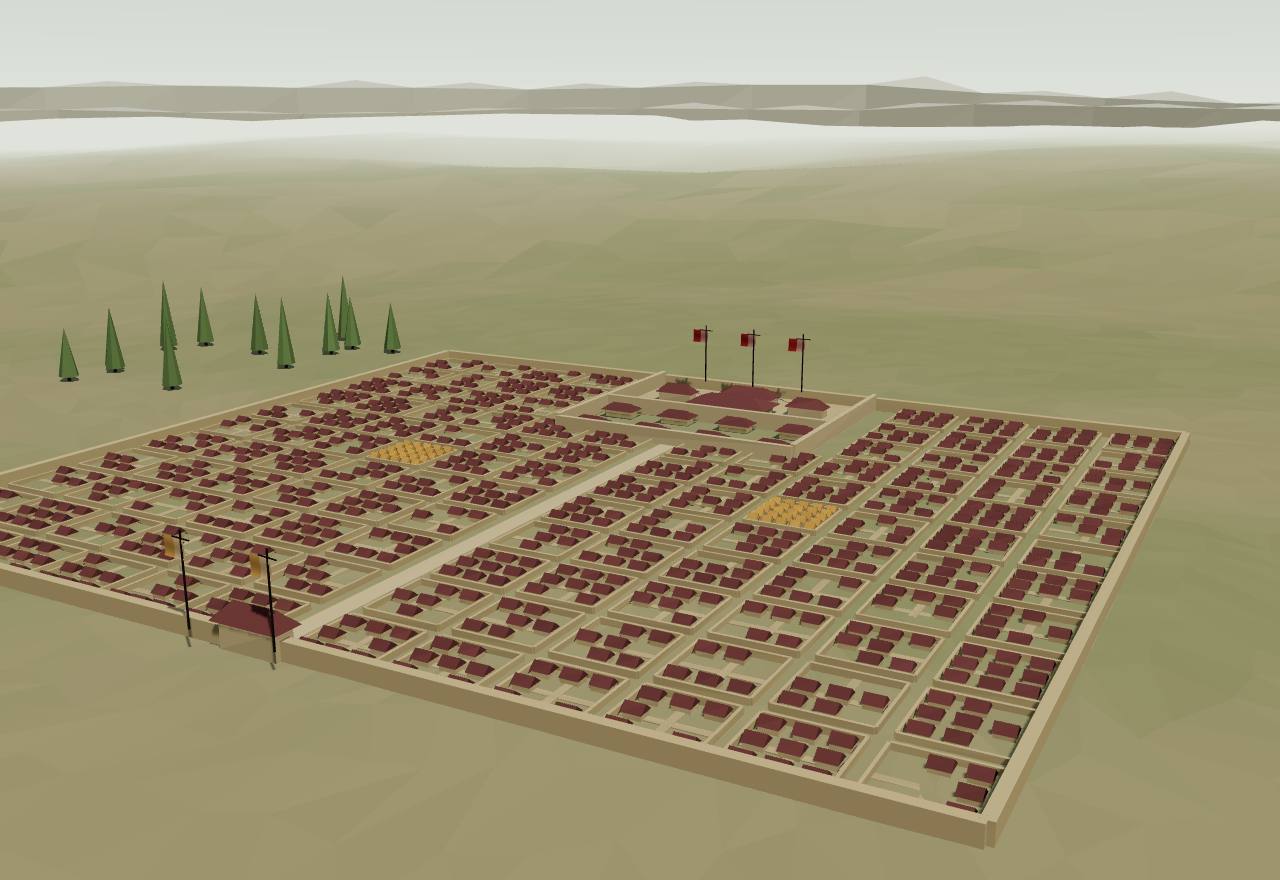
Chang'an, the city of walled wards
581 CE – 755 CE
Reunification and the early Tang
After nearly three hundred years of division, the Sui reunited China and the Tang built on its work: a planned capital of walled wards at Chang'an, a written code, three central departments, land allotted by statute, and an examination that a few men a year passed to enter office. Birth still counted for more than the examination until the end of the seventh century.
Terms: Sui, Tang and Song China: Reunification and the early Tang
- jinshi進士 'presented scholar': the examination degree in letters and policy that the Xin Tang shu calls the most prized of all the subjects 14
- mingjing明經 'understanding the classics': the examination on the canonical texts, by recitation and set questions 14
- sansheng三省 the three departments (Secretariat, Chancellery, Department of State Affairs), whose heads deliberated state affairs together 15
- lü, ling, ge, shi律令格式 the four forms of Tang law: the penal code, statutes, regulations and ordinances (Xin Tang shu, juan 56) 16
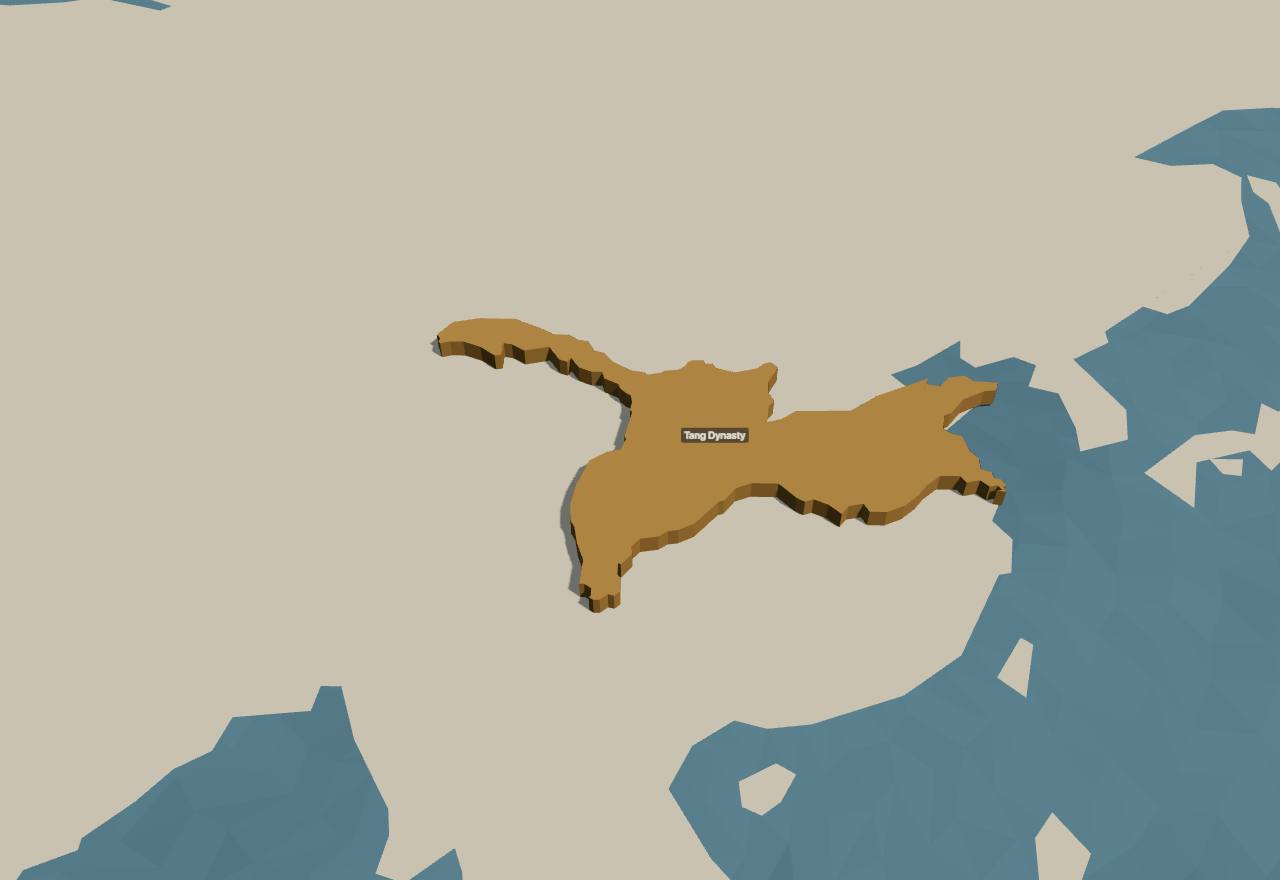
The early Tang on Cliopatria's map, 625–751
Territory: Cliopatria (CC BY 4.0), simplified. Height: Seshat population, log scale; darker, fixed-height slices are not coded.
When the Sui came to power, Arthur Wright writes, China “had been politically fragmented for nearly three hundred years – the longest period of disunion in Chinese history”. The Sui ended it and laid the foundations of a new unified state, and “the immediate beneficiary” was the Tang (618–907), which built on them. 1 Consensus Texts
Seshat codes the Sui around 600 at 3.0–3.1 million km² and 46 million people, with five levels of administration, an examination system and merit promotion. For the early Tang it codes 6.2–6.5 million km² in the 620s–640s, falling to 3.6 million in 650 and recovering to about 5.4 million in 720; 37 million people in 700 and 52.8 million in 754; seven administrative levels; and a largest city of about a million. Seshat Consensus Survey Texts
Chang'an, capital of the Sui and Tang, was planned by the architect Yuwen Kai: an outer wall 9,721 m east–west by 8,651 m north–south enclosed 108 walled wards (fang) laid out like a chessboard, with the palace city in the middle of the north side, the administrative city south of it, and Zhuque Avenue, 150 m wide, running to the main south gate. At the palace's Xuanwu Gate in 626, Li Shimin killed his brothers and then came to the throne. 17,18 Consensus Excavation Texts
UNESCO's record of the Grand Canal says it was “conceived as a unified means of communication for the Empire for the first time in the 7th century AD (Sui dynasty)”, carrying grain and raw materials north; by the thirteenth century it had more than 2,000 km of artificial waterways linking five river basins. 19 Consensus Survey Texts
The Xin Tang shu opens its treatise on offices: “The Tang followed the Sui system: the heads of the three departments, the Director of the Secretariat, the Director of the Chancellery and the Director of the Department of State Affairs, deliberated state affairs together; this was the chief ministers' office.” Because Taizong had once held the last post, no subject dared take it, and other officials were made chief ministers under borrowed titles. 15 Consensus Texts
Tang law came in four forms, the penal code, statutes, regulations and ordinances; the code itself followed the Sui's in twelve sections, from general principles to trials. Its five punishments were the light stick, the heavy stick, penal labour, exile and death, and the Tang kept the Sui's procedures by which a sentence could be deliberated, reduced, redeemed or remitted. Taizong ordered every death sentence re-submitted to him three times, and later five times over two days, because “the dead cannot live again”. 16 Consensus Texts
On paper the Tang allotted land: every adult man was to receive 100 mu, 80 as a personal share returned at death and 20 held in perpetuity, with smaller grants to the old, the disabled and widows heading households, and owed grain, cloth and twenty days' labour a year. Yang Jiping argues that this was never the whole picture: Tang statutes recognised land in private ownership, and some 140 tenancy contracts from Turfan and Dunhuang show that tenancy was the leading form of farming outside subsistence. 20,5 Debated Texts
A memorial of 763 in the Xin Tang shu dates the jinshi examination to the Sui's Daye era (605–618). Wang and Yang find that the examination took shape under the Sui for men nominated by officials, and that an edict of the first Tang emperor in 622 opened it to most adult men, a change that no Tang source records anyone resisting. 14,4 Consensus Texts
The schools of the Directorate of Education were graded by fathers' rank: the School for the Sons of the State took 300 sons and grandsons of officials of the third rank and above, the Imperial School 500 of the fifth rank and above, and the School of the Four Gates 1,300, of whom 800 places were for “talented commoners”. Students were fourteen to nineteen years old. 14 Consensus Texts
Few passed. Recalling the Tang in the eleventh century, the official Wang Gui wrote that from the Zhenguan to the Kaiyuan eras (627–741) “more than a thousand competed each year, and few were taken”, and that even when the numbers were raised in the 670s “they did not reach a hundred”. 9 Consensus Texts
Wen, Wang and Hout's 3,640 Tang epitaphs show the change around Empress Wu Zetian, who took the throne in 690: among men who died before 690, 6.7 % had passed the examination and a prominent ancestral branch lifted a man about two points on their 0–19 rank scale, while the degree made no difference; after 690, 16.7 % had passed, the branch no longer helped, and the degree was worth about two points. A Song minister credited Empress Wu with the first palace examination, and the Xin Tang shu dates her military examination to 702. 2,9,14 Consensus Texts Model
How power worked Emperor · Heredity · Written law
How power worked
- Who rules
- Emperor Consensus
Why?
- How chosen
- Heredity Debated
Why?
- Limits on power
- Written law Consensus
Why?
- Scale
- Empire Consensus
Why?
- Claim to rule
- Divine mandate Consensus
Why?
- Who has a say
- A narrow elite Consensus
Why?
Birth or the examination? Tang careers before and after 690
Data: Wen, Wang and Hout 2024, Tables 1 and 2
Wen, Wang and Hout coded 3,640 epitaphs of Tang elite men and asked what predicted the highest office rank a man reached, on a scale from 0 (no office) to 19. Before 690, 6.7 % of the men had passed the examination; after, 16.7 %. Bars show their estimates in rank points; hollow bars are not statistically significant. 2
| Factor | Died before 690 (n = 389) | Died 690–907 (n = 2,247) |
|---|---|---|
| From a prominent ancestral branch | +2.0 | −0.4 (not significant) |
| Passed the examination | −0.2 (not significant) | +1.9 |
| Each rank of the father's office (×10 shown) | +2.7 | +2.7 |
For men who passed, a father's rank barely mattered: 0.08 of a point per rank against 0.28 for those who did not (all years). 2
Arithmetic on the model: an imaginary man
Died before 690: +3.4 rank points; Died 690–907: +1.3 rank points (significant estimates only, against a man with none of these).
755 CE – 960 CE
Rebellion, governors and Five Dynasties
An Lushan's rebellion (755–763) broke the early Tang order. Military governors ruled whole provinces with their own armies, the court rebuilt its revenue on a new tax, and a narrow capital elite kept its grip on office until rebels sacked both capitals in the 880s. After 907 five short dynasties held the north in turn.
Terms: Sui, Tang and Song China: Rebellion, governors and Five Dynasties
- jiedushi節度使 military commissioner: a governor over several prefectures commanding his own army (as printed in Hoeckelmann's review) 11
- yin蔭 'protection': the privilege by which an official could place sons or grandsons in office without examination 11
- liangshui兩稅 the 'two-tax' system that in 780 replaced the fixed dues in grain, cloth and labour owed by each registered taxpayer 20,5
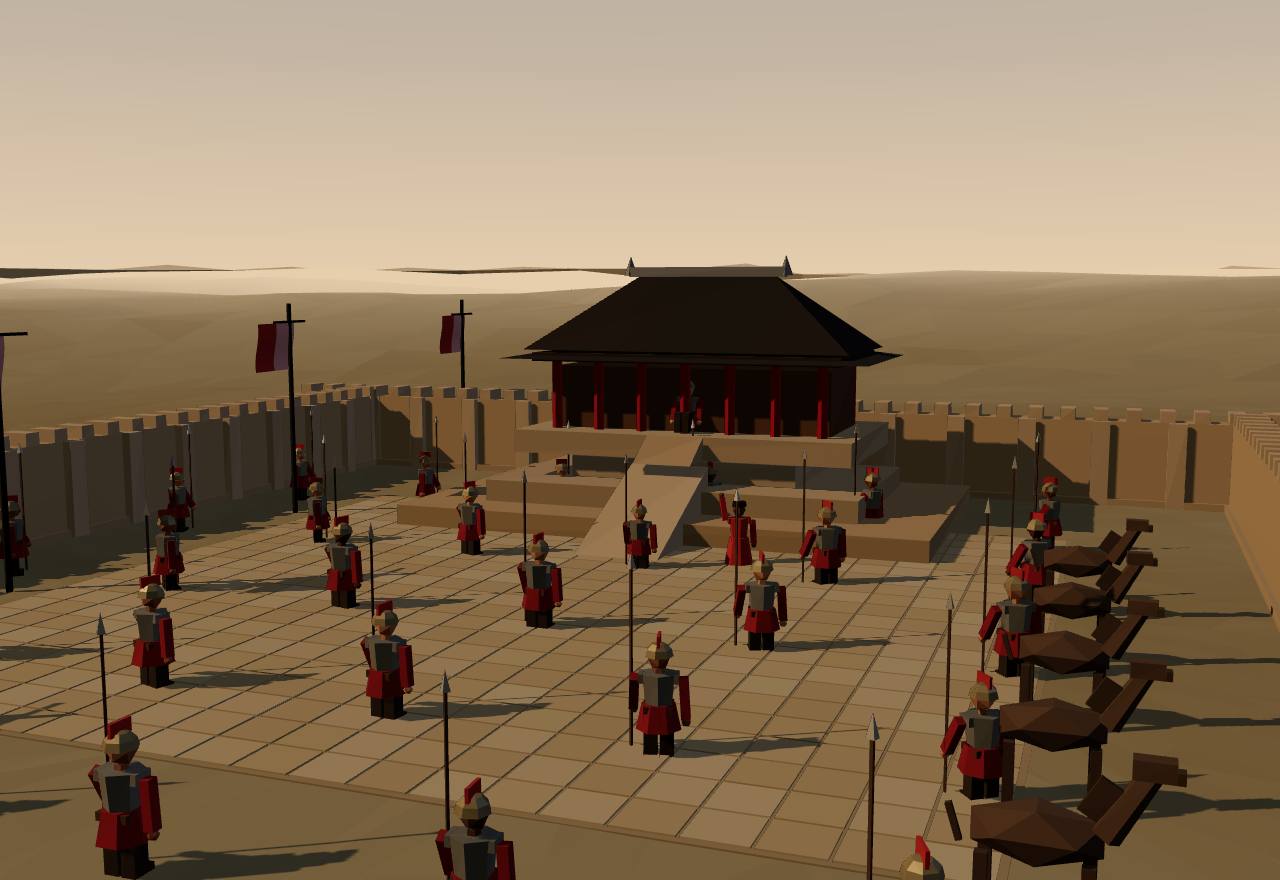
A military governor's compound, ninth century
C. A. Peterson calls the An Lushan rebellion of 755–763 “without doubt the most significant event in the history of the dynasty” after its founding: it turned “a centralized, rich, stable and far-flung empire into a struggling, insecure and divided one”, and the decentralised provincial order that followed was its direct result. He adds that the change had roots in institutional developments long under way. 21 Consensus Texts
In the standard account, Michael Hoeckelmann writes, most of China slipped from the court's grasp after An Lushan: military commissioners (jiedushi) ruled “by wielding charismatic leadership over their armies” and kept tax money the capital needed. Nicolas Tackett argues instead that by 820 the court had regained control of most of the realm, except the three Hebei provinces of Chengde, Weibo and Youzhou. 11,22 Debated Texts
One Hebei appointment shows the balance. In 841 the court, persuaded by the chief minister Li Deyu, installed Zhang Zhongwu as military commissioner of Youzhou against two rivals from the Lulong army, because he was trusted by its soldiers; yet Zhang “could not be forced to do anything against his will”, and he put off acting against the Uighurs until 845. 11 Consensus Texts
The Xin Tang shu traces the fiscal side: allotted holdings “broke down into accumulation” and the grain, cloth and labour dues “broke down into the two taxes”. Yang Jiping dates the change to 780, when the double-tax system replaced dues “paid in grain, cloth, and labor by each registered taxpayer”. 20,5 Consensus Texts
Tackett's ninth-century aristocracy, as Song Chen summarises it, was a “capital elite”: a small subgroup of the families claiming great ancestry, set apart by its monopoly of government office, its homes in and around Chang'an and Luoyang and its marriages within the capital. Tackett estimates its adult men at roughly 19,700 at any one time, about the number of serving officials in the early eighth century. 8,11,22 Debated Texts Model
Some at court defended birth openly. In the 830s Emperor Wenzong ordered the Ministry of Rites to pass thirty men a year, and fewer if there were not enough worthy ones. Under his successor Wuzong the chief minister Li Deyu, who held no degree himself, argued that “the high offices of the court must be filled by the sons of ministers”, because they had grown up knowing court business, which a poor scholar, however able, could not learn. 14 Consensus Texts
The rebellion of Huang Chao (875–884) sacked Chang'an and Luoyang and ravaged the corridor between them, where the capital elite lived. Hoeckelmann notes that the records of the last fifty years of the Tang were largely destroyed by the rebels, so much of what is known comes through accounts compiled under the Song. 11,8 Consensus Texts
Naomi Standen describes the north after 907: for fifty-three years control of the central Yellow River valley “would be seized and relinquished by several successive claimants, each trying, and for the most part failing, to construct a sustainable base of power”: the Later Liang, Later Tang, Later Jin, Later Han and Later Zhou. Other claimants ruled the regions outside the valley. 3 Consensus Texts
Seshat codes the later Tang at about 3.6 million km² in 770, recovering to 4.1 million by 860, then shrinking to 1.5 million in 900 and 0.8 million in 907; its population at 40–55 million in 766; and the capital at about a million people until 800. Seshat Consensus Survey Texts
How power worked Emperor · Heredity · None in practice
How power worked
- Who rules
- Emperor Debated
Why?
- How chosen
- Heredity Debated
Why?
- Limits on power
- None in practice Debated
Why?
- Scale
- Territorial state Debated
Why?
- Claim to rule
- Divine mandate Consensus
Why?
- Who has a say
- A narrow elite Consensus
Why?
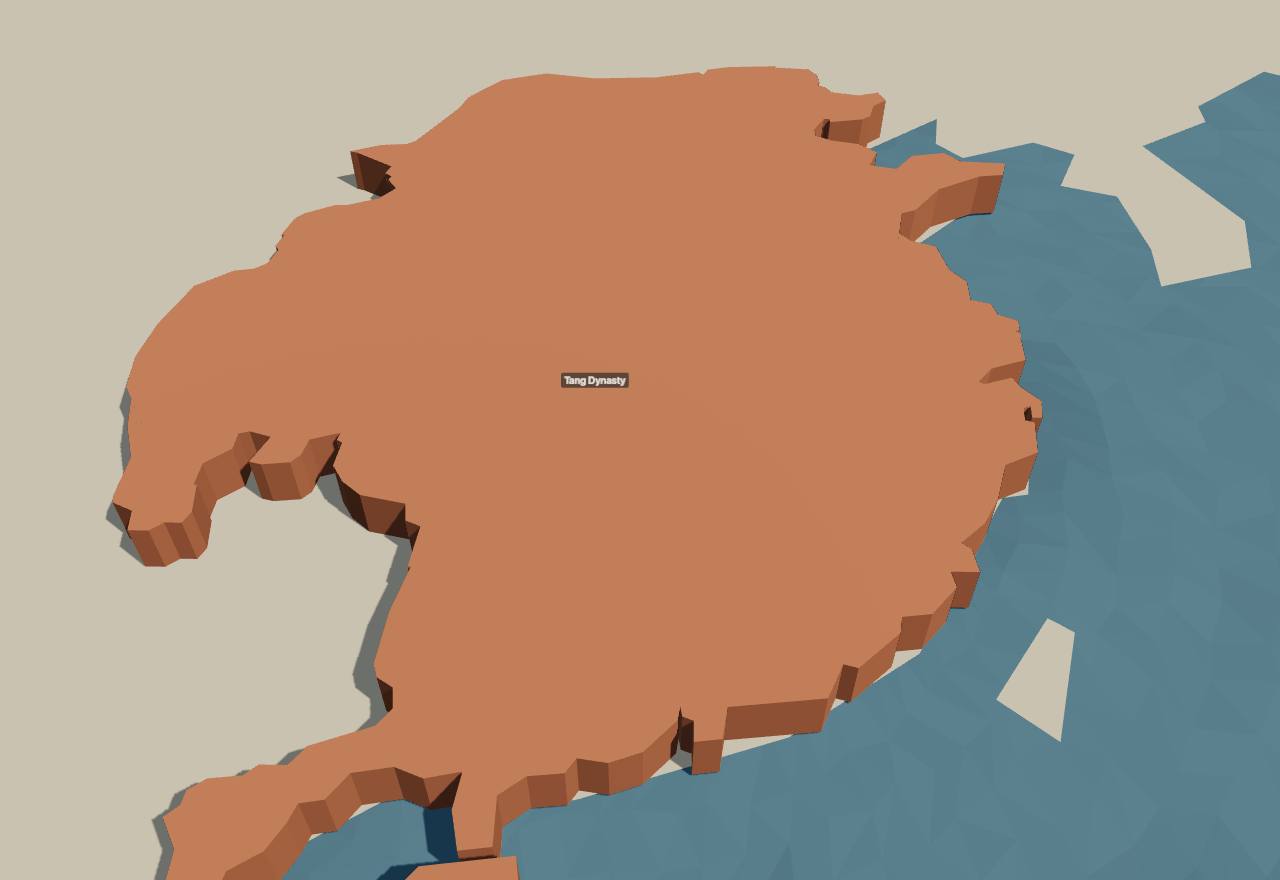
The later Tang on Cliopatria's map, 770–900
Territory: Cliopatria (CC BY 4.0), simplified. Height: Seshat population, log scale.
960 CE – 1127 CE
The Northern Song and its neighbours
The Song reunited most of China in 960 and staffed its government through written examinations, graded unseen and in the end set by the emperor himself. It shared the old Tang lands with two empires founded by peoples of the north and west, the Khitan Liao and the Tangut Xia, each of which ran one administration for its own people and another for its Chinese subjects.
The founding of the Liao, Denis Twitchett and Klaus-Peter Tietze write, opened a period in which “the surviving Chinese regimes were forced to acknowledge these conquest dynasties on Chinese soil as equal if not superior powers”, to keep permanent diplomatic relations with them as equals “and to pay them annual subsidies or tribute”, against the traditional view of China as the centre of the civilised world. 23 Consensus Texts
The Song's war with the Tangut Xi Xia in 1038–1044, Paul Jakov Smith writes, exposed weaknesses in the army, the finances and the bureaucracy: the Song mustered some 1.25 million men against 826,000 Tangut troops, and its hired soldiers were “likely to scatter at their first sight of a Tangut soldier”. 24 Consensus Texts
The territory stage draws the three states from the Cliopatria dataset, which dates the Western Xia from 990 and the Northern Song from 961: the years sampled lie inside its slices, so the map shows its borders at those dates, not the moment each state was founded. 25,26 Consensus Survey
The Song empire960 CE – 1127 CE
The Song took over the Tang examinations and changed what they meant. Papers were copied and graded under numbers, the emperor set the last test himself, and degree holders, not the sons of great houses, came to fill the government; whether that made it a meritocracy is the question below.
Terms: Sui, Tang and Song China: The Northern Song and its neighbours, The Song empire
- keju科舉 the examinations by subject, the system as a whole (as the Song shi uses the word) 9,4
- gongju貢舉 'tribute selection': candidates sent up by the prefectures to the capital 9
- dianshi殿試 the palace examination, set and ranked in the emperor's name, a regular stage from 973 9
- huming糊名 'pasting over the name': grading papers with the candidate's name covered 9
- tezouming特奏名 'specially presented names': degrees by grace for men who had failed many times, by age and number of attempts 9
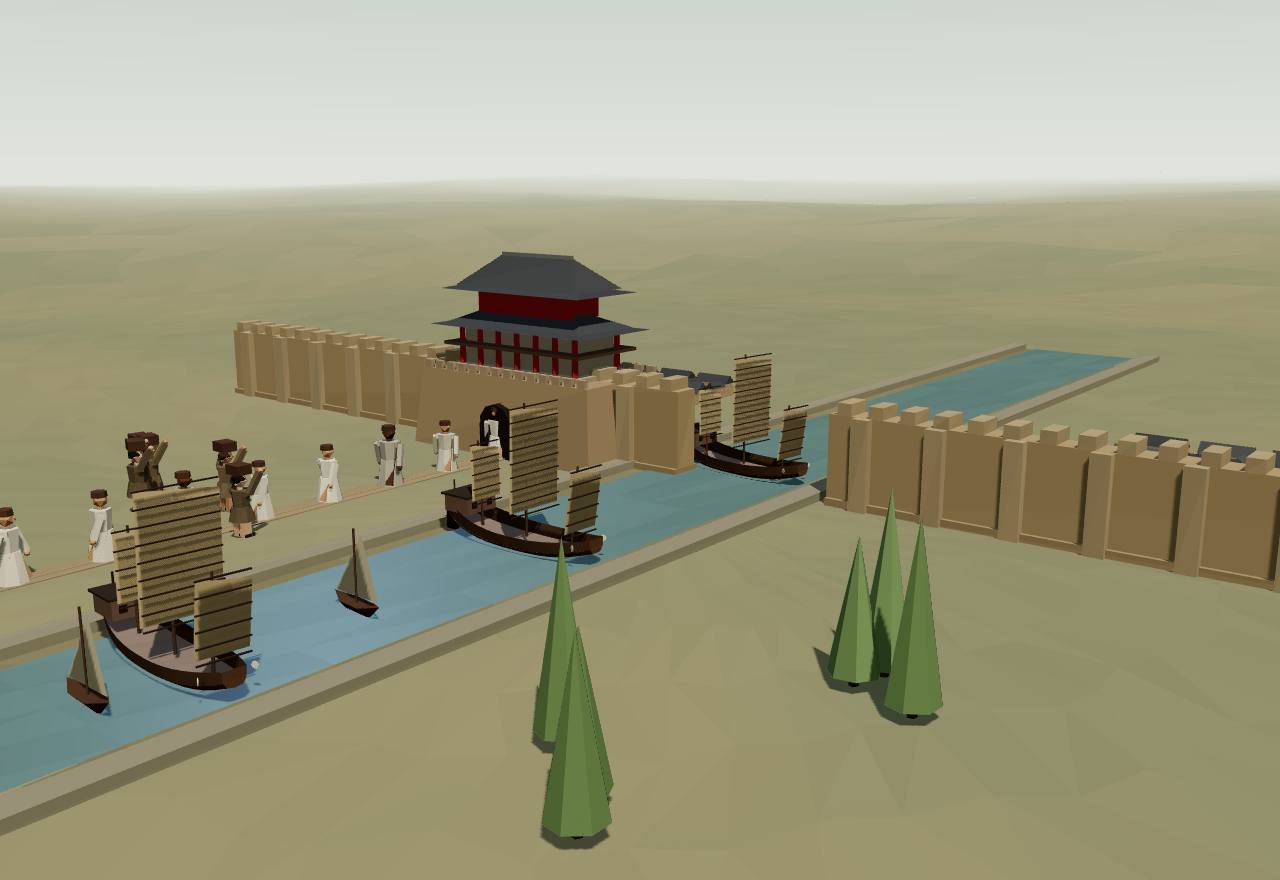
Kaifeng: the Bian canal at the city wall
The Song shi's treatise on selection begins: “At the start of the Song, the Tang system was continued: of all the routes of tribute selection, none counted more than the jinshi and the decree examinations.” There were the jinshi, the “various fields” of classical memory work and a military examination; over three hundred years, the treatise says, the leading ministers, great scholars and upright officials “all came out of this”. 9 Consensus Texts
In 973, after a complaint that the examiner Li Fang had favoured a man from his home district, the first emperor called the 360 failed candidates before him, chose 195 to be tested again with the passed men, and gave degrees to 127 in eight subjects, 26 of them jinshi; “from this the palace examination became the rule”. The emperor told his ministers that degrees had once been taken mostly by powerful families, and that by examining in person he had ended the abuse. 9 Consensus Texts
Papers were then graded unseen. In 992, the Song shi records, over 17,000 candidates came up from the circuits and the examiner Su Yijian “pasted over the names” to grade them, which became the rule; a copying office was set up in 1015. After Chaffee, Wang and Yang date name-covering to 992 for the palace examination, 1007 for the metropolitan and 1033 for the prefectural, and copying out every paper (so that handwriting would not betray the candidate) to 1015 and 1037. The Tang custom of sending examiners samples of one's writing beforehand was banned. 9,4,27,8 Consensus Texts
The numbers grew. In 1000 the emperor examined 840 men in person, with more than 900 others on the special list of long-failed candidates; in Renzong's reign (to 1063) thirteen examinations passed 4,570 jinshi, of whom 39 had been placed in the top three and all but five reached high office; in 1057 some 6,000–7,000 candidates were always waiting in the capital; and in 1124, 15,000 sat the Ministry of Rites examination and more than 800 were given degrees. 9 Consensus Texts
By recruiting “a few hundred scholars into the civil service every three years”, Song Chen writes, the examinations made a literati class many times larger, but they did not give every region equal access: they rewarded the rich, culturally strong prefectures. Mingzhou (Ningbo) produced 15 jinshi from 960 to 1040 and 107 in the next eighty-seven years, while Kaifeng and the capital's Directorate of Education still produced a third to half of each class in 1059–1063. 8 Consensus Texts
Emperor Shenzong took the throne in 1067, aged nineteen, with “an acute sense of shame for his country's foreign humiliations”. With Wang Anshi he dropped poetry and memory work from the examinations, tested each man on one classic, the Analects and Mencius, an essay and policy questions, and added an examination in law. Su Shi objected that rewarding virtue by examination teaches people to fake it: “if the ruler takes men for filial piety, the brave will cut flesh from their thighs, the timid will live in huts by their parents' graves”. 24,9 Consensus Texts
In 1104 the court abolished the prefectural examinations and promised all recruitment through government schools. The Song shi notes that those admitted to the schools without a test were mostly officials' sons, and that the poor and the old suffered; prefectural examinations came back in 1121. In 1110 a censor, after a portent in the stars, argued for restoring them: “Heaven sees and hears through the people … I fear Heaven too is angered.” 9 Consensus Texts
The Song kept its capital at Kaifeng, where the Later Zhou had built an outer wall in 956. The Song shi gives the old inner city a circuit of 20 li and 155 paces and the enlarged outer city 50 li and 165 paces, with water gates where the Bian canal entered and left; the prefecture registered 261,117 households in the Chongning years (1102–1106). Seshat codes the largest city at about half a million people in 1000 and a million in 1100. 28 Seshat Consensus Texts Survey
Seshat codes the Northern Song as a unitary state of 2.9–3.0 million km² in 1000 and 2.2–2.4 million in 1100, with 60–100 million people, seven or eight administrative levels, paper currency and gunpowder siege weapons, and marks its rulers' divine legitimation “suspected unknown”. Seshat Consensus Survey Texts
Robert Hartwell saw a “semi-hereditary professional bureaucratic elite” give way to “a multitude of local elite gentry families” in the early twelfth century; Song Chen, comparing residence and burial, places the turn around the mid-eleventh century, when newly successful jinshi stopped moving their families to the capital region and stayed in their home prefectures. 8,29 Debated Texts
How power worked Emperor · Heredity · Council
How power worked
- Who rules
- Emperor Consensus
Why?
- How chosen
- Heredity Consensus
Why?
- Limits on power
- Council Debated
Why?
- Scale
- Empire Consensus
Why?
- Claim to rule
- Divine mandate Debated
Why?
- Who has a say
- A narrow elite Debated
Why?
How many sat, how many passed?
Data: Song shi 155, Xin Tang shu 44; Chaffee as quoted by Wang and Yang 2025
The sources count different stages in different years, and none counts every stage of one examination. Each bar below is a number a source gives; a stage it does not count is left out. Scale is logarithmic. 9,14
In Renzong's reign, 13 examinations passed 4,570 jinshi, about 352 a sitting. 9 In 1124 the capital examination passed about one man in 19.
Arithmetic, not a record: from the prefecture to a degree
John Chaffee estimated that about one prefectural candidate in 2 passed in 1009, and one in 200 in 1275 (as Wang and Yang quote him, his p. 35); the share of adult men sitting rose from below 0.5 % in the eleventh century to above 2 % in the thirteenth (p. 38). 4,27 Chaining either rate with the capital stage of 1124 gives a rough sense of the odds; the two figures come from different years and different sources.
Of 10,000 men sitting the prefectural examination at the rate of 1275, about 50 would go to the capital and about 3 would be given a degree: one in 3,750.
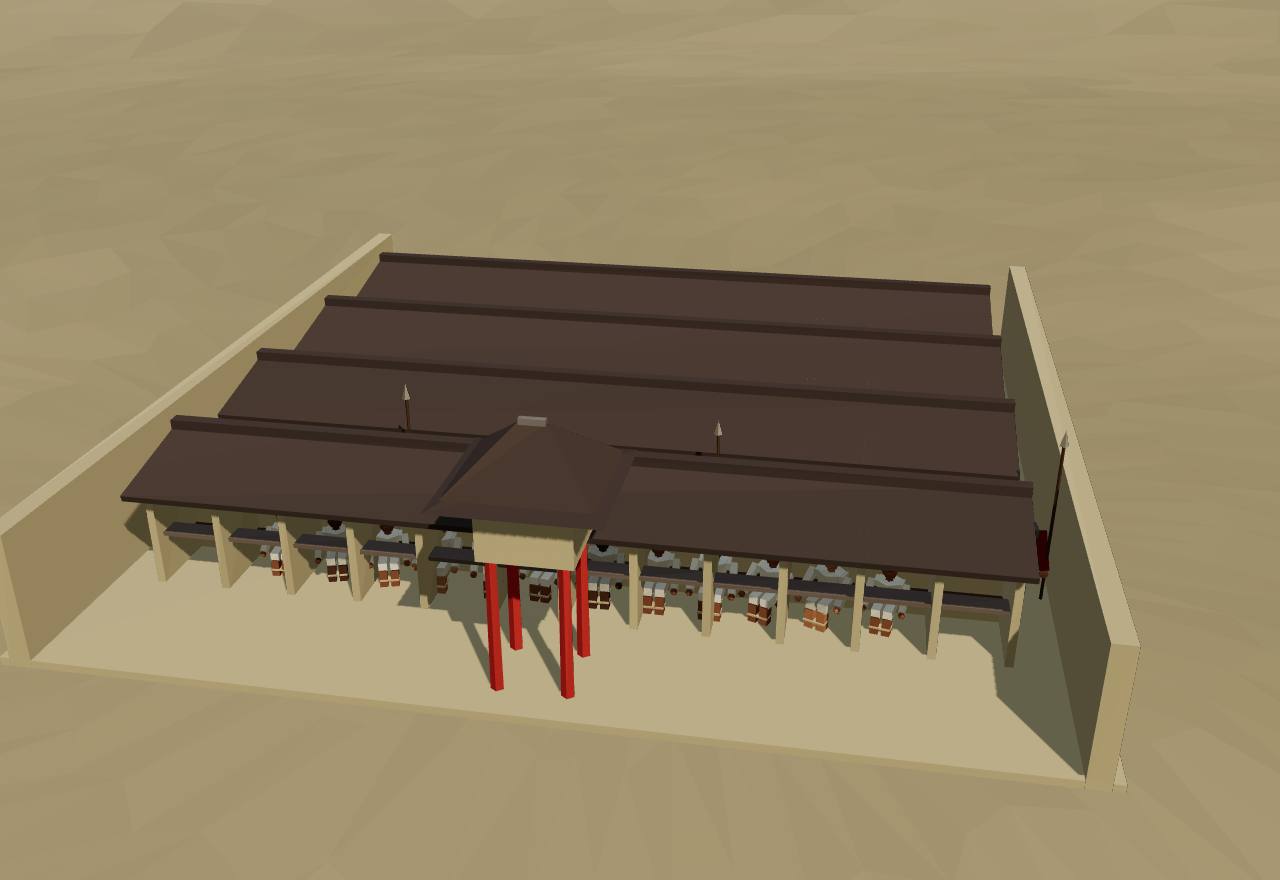
Examination cells (the later layout)
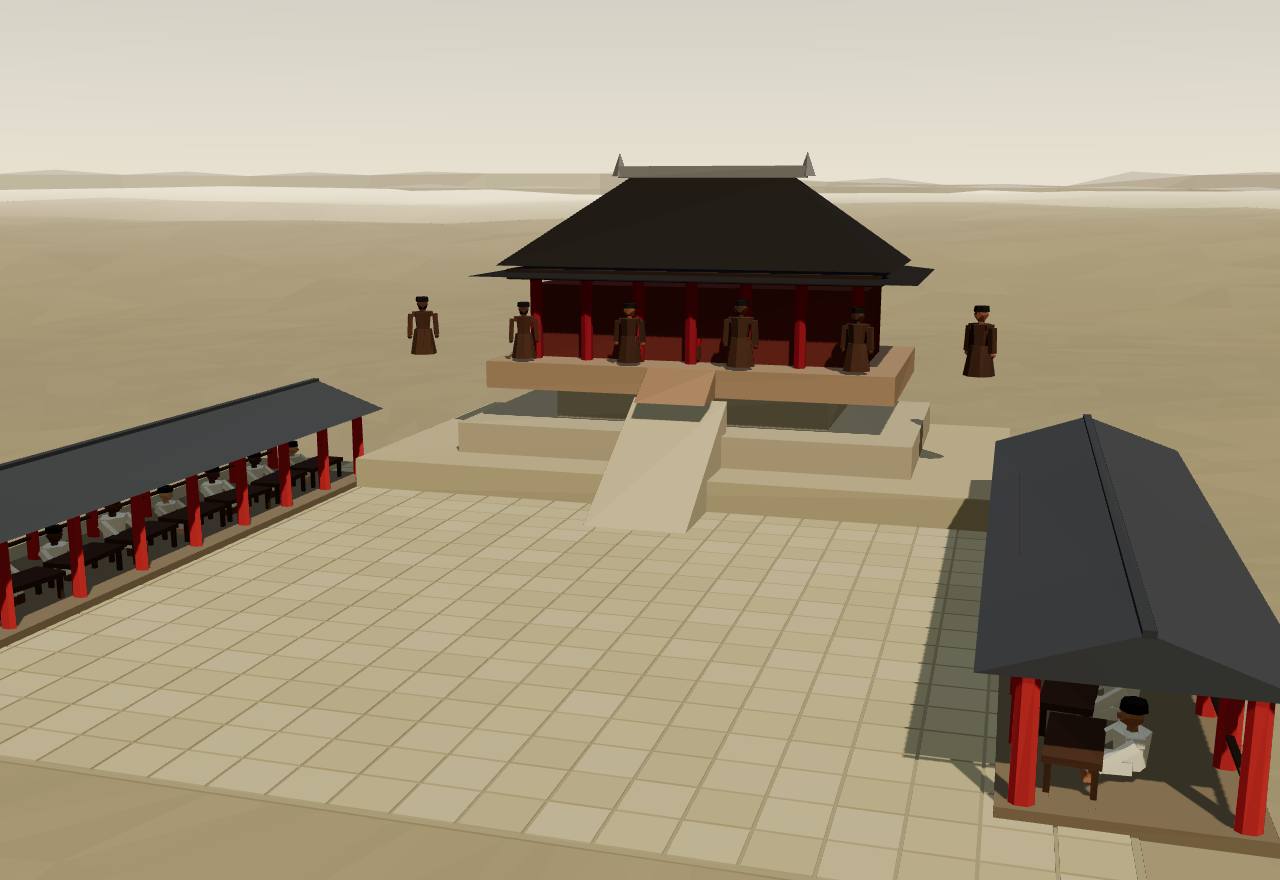
The palace examination
The Khitan Liao960 CE – 1125 CE
The Khitan Liao ruled the steppe and a strip of northern China from the early tenth century to 1125. Its government was split in two, a northern administration for the Khitan and their tribes and a southern one for the Chinese prefectures, “each ruled by its own custom”.
Terms: Sui, Tang and Song China: The Northern Song and its neighbours, The Khitan Liao
- yin su er zhi因俗而治 'to govern according to custom': the Liao shi's phrase for the two administrations 12
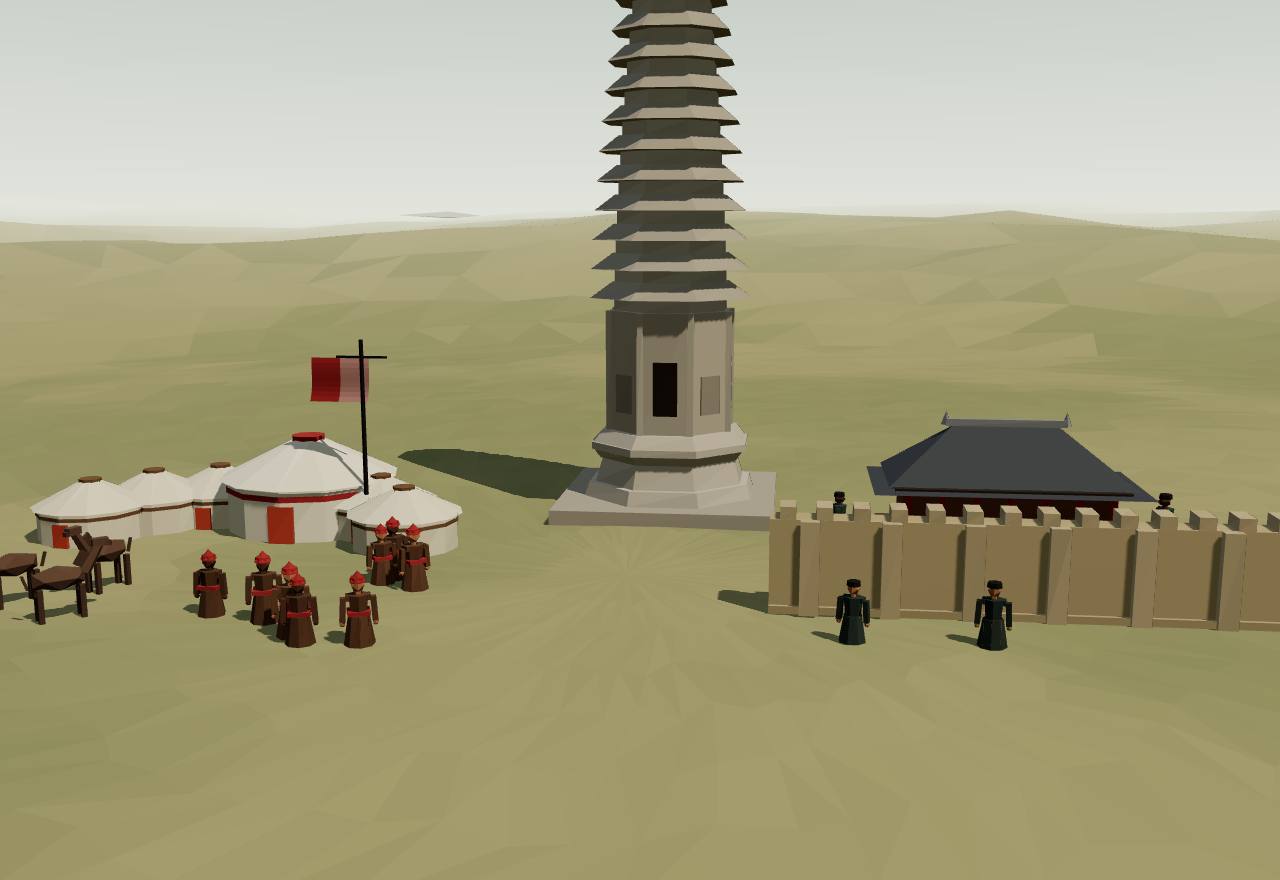
Two courts: the Liao's north and south
Twitchett and Tietze note that throughout Eurasia the name of the Khitan, “in such forms as Kitaia, Cathaia, or Cathay, became a synonym for China”, and in Russia and the Slavonic world it remains the standard name for China. 23 Consensus Texts
The Liao shi's treatise on offices explains the split: from the reign of Taizong, who also ruled Chinese lands, “offices were divided north and south: the state's own system governed the Khitan, the Han system served the Han”. The northern side ran the palace tents, the tribes and the dependent states; the southern side the Chinese prefectures and counties, their taxes and troops. “Governing each by its custom,” it concludes, “they got it right.” 12 Consensus Texts
Even the Khitan side was doubled. Its Northern Bureau of Military Affairs handled war, military appointments and herds and commanded all Khitan troops and horses, and was so named because its tent stood north of the great imperial tent; the Southern Bureau handled civil appointments, the tribes and the labour and taxes of the Khitan people. 12 Consensus Texts
High office ran in families. The chief ministers of the Northern Chancellery were chosen by hereditary right from the four tents of the imperial lineage, and those of the Southern Chancellery from the five tents of the empress's lineage. 12 Consensus Texts
The treatise credits the founder, Taizu, with an edict on ranks in 921 and with dividing the chieftainship of the Diela tribe into a Northern and a Southern Great King, the origin of the paired north and south offices. 12 Consensus Texts
The Liao held examinations too. The Jin shi's treatise on selection says that the Liao “made some use of the Tang jinshi method to take men, but of those who served in that state, if one looks at how they rose, jinshi were only two or three in ten”. 10 Consensus Texts
The Seshat Databank has no polity for the Liao, so this case has no Seshat chart or fingerprint; its map comes from Cliopatria, whose Liao Dynasty slices run from 911 to 1125. 13,25,26 Consensus Survey
How power worked Emperor · Heredity · Custom and kin · 1 unknown
How power worked
- Who rules
- Emperor Consensus
Why?
- How chosen
- Heredity Consensus
Why?
- Limits on power
- Custom and kin Debated
Why?
- Scale
- Empire Consensus
Why?
- Claim to rule
- Unknown
Why?
No source read for this page says how the Liao emperors justified their rule to the Khitan or to their Chinese subjects.
- Who has a say
- A narrow elite Consensus
Why?
The Tangut Xia (Xi Xia)1038 CE – 1127 CEXixia Imperial Tombs, Helan Mountains
The Tanguts of the Ordos and the Gansu corridor declared an empire, the Great Xia, in 1038. Its founder gave it a script of its own and an administration staffed by Tanguts and Chinese side by side, with a Tangut school and a Chinese school.
Terms: Sui, Tang and Song China: The Northern Song and its neighbours, The Tangut Xia (Xi Xia)
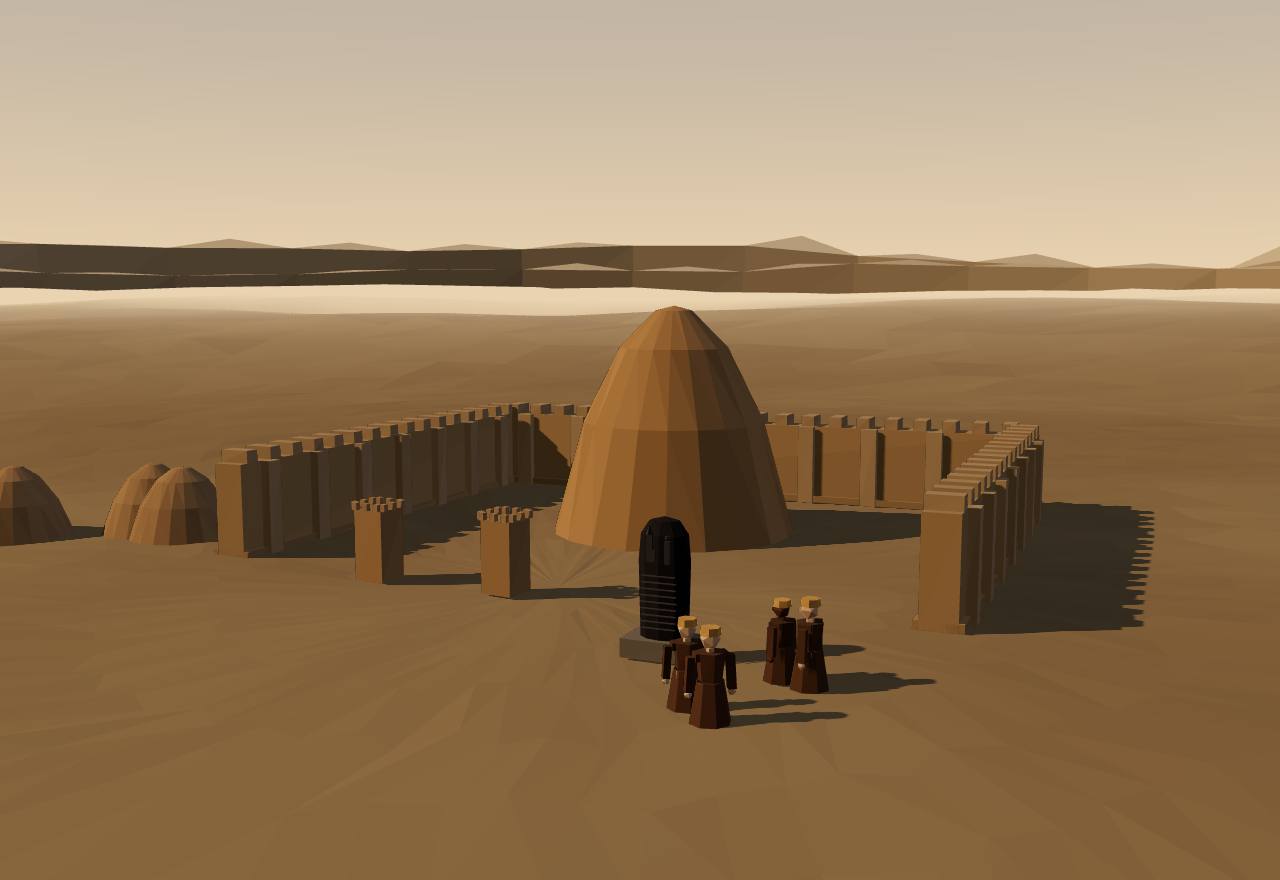
The Xia royal tombs below the Helan Mountains
Ruth Dunnell dates an independent Tangut state to 982, “formally proclaimed a 'dynasty' in 1038” and destroyed by the Mongols in 1227, 245 years after its founding; at its height in the mid-twelfth century it held the Ordos and the Gansu corridor. UNESCO's record of the royal tombs calls it “a multicultural civilization modelled on Chinese imperial traditions, with Buddhism at its core”. 7,6 Consensus Texts Excavation
In 1038 Yuanhao built an altar, received investiture and took the title of emperor. His memorial to the Song the next year claimed descent from the imperial house of the Northern Wei, and said: “I have made a small script for the Tanguts and changed the robes and caps of the Han”; the state was called the Great Xia. The Song stripped him of his titles and closed the border markets. 32 Consensus Texts
Yuanhao “himself made the Tangut script”, the Song shi says, and had his minister Yeli Renrong set it out in twelve chapters: the characters were square, like clerical script, with many strokes. The people were taught to keep records in it, and the Classic of Filial Piety and the Erya were translated into Tangut. 32 Consensus Texts
The Xia offices were divided into civil and military ranks, among them a Secretariat, a Bureau of Military Affairs, a Censorate, a Tangut school and a Chinese school, and every post from the chief minister down “was given to Tangut and Han men alike”. Twelve military commands were entrusted to powerful clans, and the Song shi totals the troops at over 500,000. 32 Consensus Texts
In the foothills of the Helan Mountains the dynasty's cemetery holds nine imperial mausoleums, 271 subordinate tombs, a northern architectural complex and 32 flood-control structures; UNESCO inscribed it in 2025. 6 Consensus Excavation
The seshat-db record for Xixia codes a territory of 600,000–650,000 km² and four levels of administration, quotes the view that the Liao and the Xia both had “a dual administrative structure”, half Chinese and half tribal, and records Xia's relation to its neighbours as vassalage from 1038 to 1227. Seshat DB Consensus Survey Texts
How power worked Emperor · Heredity · Territorial state · 1 unknown
How power worked
- Who rules
- Emperor Consensus
Why?
- How chosen
- Heredity Consensus
Why?
- Limits on power
- Unknown
Why?
The sources read for this page describe the Xia offices but nothing that could check the ruler.
- Scale
- Territorial state Consensus
Why?
- Claim to rule
- Kinship and descent Debated
Why?
- Who has a say
- A narrow elite Consensus
Why?
1127 CE – 1279 CE
The Southern Song and the Jin
In 1127 the Jurchen Jin took the north and the Song court re-formed in the south, at Hangzhou. Both states recruited officials by examination: the Song from a booming literati class in the southern prefectures, the Jin from Chinese and, in a separate examination written in their own script, Jurchen candidates. The Mongols ended the Jin in 1234 and the Song in 1276–1279.
Song Chen dates “the Jurchen occupation of North China” to 1127; scholars in the north then took the examinations of a different state, while “well-established Kaifeng families had fled south”. Herbert Franke's chapter on the Jin treats its relations with the Song before and after the treaty of 1142. 8,33 Consensus Texts
Early in 1276, with Mongol armies at the gates, the court of the child emperor first asked to be treated as a nephew paying tribute, and was refused; then it sent the seal of state with a memorial of surrender that said “now Heaven's mandate has found its home”. 34 Consensus Texts
The loyalists fought on in the south. At Yamen in 1279, the Song shi records, Zhang Shijie chained more than a thousand great ships together as a floating fortress; when the line broke, the minister Lu Xiufu took the last boy emperor on his back and leapt into the sea, and after seven days “more than a hundred thousand bodies” floated up. The figure is the Song history's. 34 Consensus Texts
The Southern Song1127 CE – 1279 CELin'an (Hangzhou), West Lake
Ruling only the south, the Song kept the examinations and grew richer, more crowded with degree-seekers and more dependent on the families who ran local life. Whether that made the state weaker or simply different is still argued.
Terms: Sui, Tang and Song China: The Southern Song and the Jin, The Southern Song
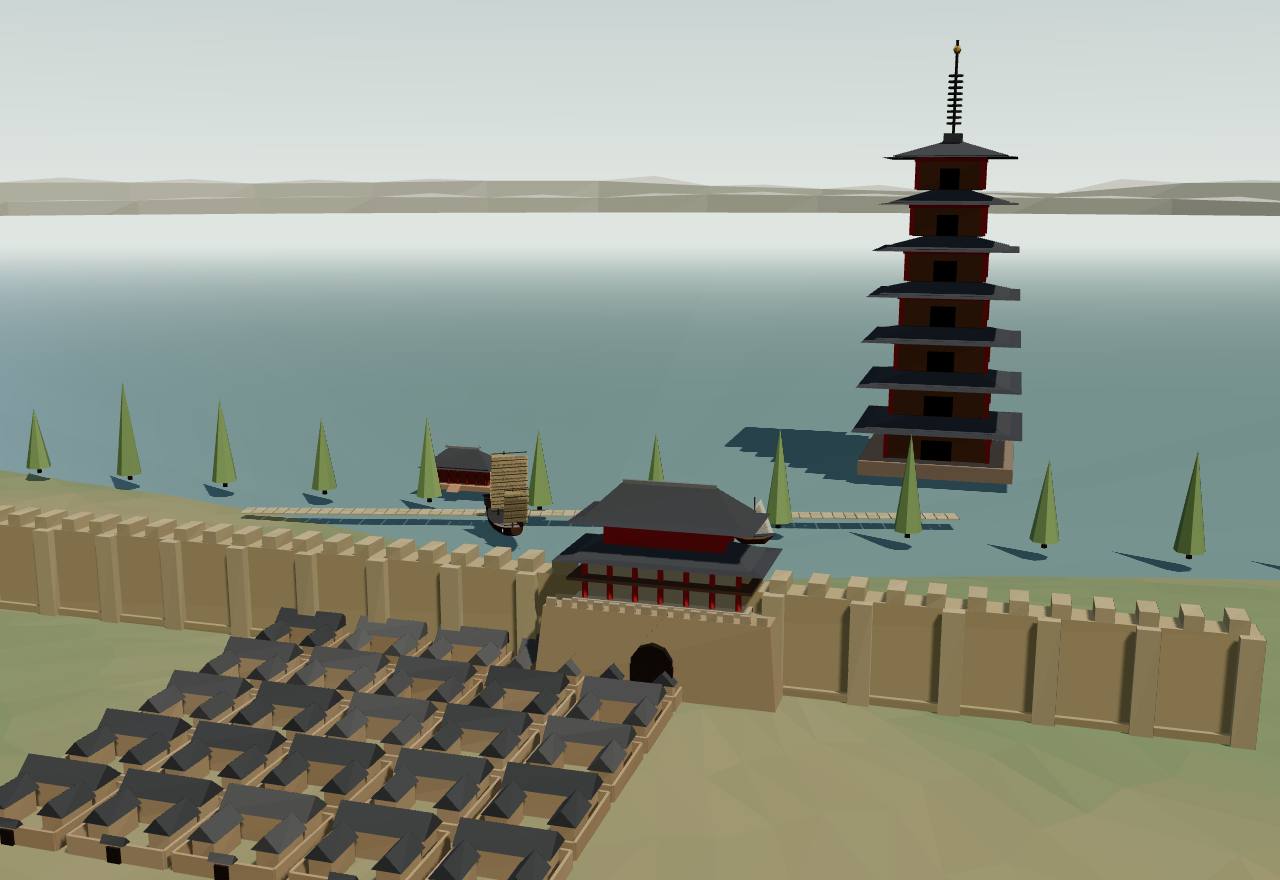
Lin'an and the West Lake
The court settled at Hangzhou, raised to the prefecture (fu) of Lin'an in 1129; in the Chongning years before the move it had registered 203,574 households. UNESCO's record of the West Lake describes temples, pagodas, causeways and islands added over centuries to improve the landscape west of the city. 35,36 Consensus Texts Survey
Succession stayed in the imperial family even at the end: in 1274 the four-year-old Gong emperor was enthroned beside his father's coffin by his father's will, and the Grand Empress Dowager Xie held court and issued edicts in his name. 34 Consensus Texts
Competition sharpened. On Chaffee's estimates, as Wang and Yang quote them, the share of prefectural candidates who passed fell from about one in two in 1009 to one in 200 in 1275, and in most regions the men sitting the prefectural examination rose from under 0.5 % of adult males in the eleventh century to over 2 % in the thirteenth. Mingzhou alone produced 747 jinshi between 1128 and 1279, third among the Southern Song prefectures. 4,27,8 Consensus Texts
Robert Hymes found that after 1127 not one prominent family of Fuzhou (Jiangxi) moved away, that they married almost only within the prefecture and turned to local defence, works and charity: a “localist” strategy. Sukhee Lee's Mingzhou shows the opposite in marriage, about half of elite marriages within the county in both halves of the Song. 8 Debated Texts
Lee argues that the Southern Song state saw itself “not simply [as] its ruler” but “as a participant in and caretaker of local society”, seeking the “mutual convenience of the public and the private”. Iiyama Tomoyasu reads the same period as one in which a state “weakened by the constant threat from the Jurchens” bought the literati's support with customary privileges. 8 Debated Texts
Local degree holders claimed a public role. In Southern Song Mingzhou they revived the community drinking ceremony and limited it to “local officeholders and literati”, and government schools, which Wang Anshi had meant as training grounds for officials, were praised as places for local literati to “deliberate on governing”. 8 Consensus Texts
The south looked to the sea. UNESCO's record of Quanzhou describes a maritime emporium of the Song and Yuan, with administrative buildings, stone docks, ceramic and iron works and the eleventh-century Qingjing Mosque, in the city Arabic and Western writers called Zayton. The seshat-db record for the Southern Song codes paper currency, five levels of administration and trading emporia. 37 Seshat DB Consensus Excavation Survey
How power worked Emperor · Heredity · Council
How power worked
- Who rules
- Emperor Consensus
Why?
- How chosen
- Heredity Consensus
Why?
- Limits on power
- Council Debated
Why?
- Scale
- Territorial state Debated
Why?
- Claim to rule
- Divine mandate Consensus
Why?
- Who has a say
- A narrow elite Consensus
Why?
The Jurchen Jin1127 CE – 1234 CE
The Jurchen Jin ruled north China from 1127 to 1234. Its emperors kept the Song and Liao examinations, staffed the lower government with Chinese degree holders, and in 1171 added a jinshi examination for Jurchen candidates written in the Jurchen script.
Terms: Sui, Tang and Song China: The Southern Song and the Jin, The Jurchen Jin
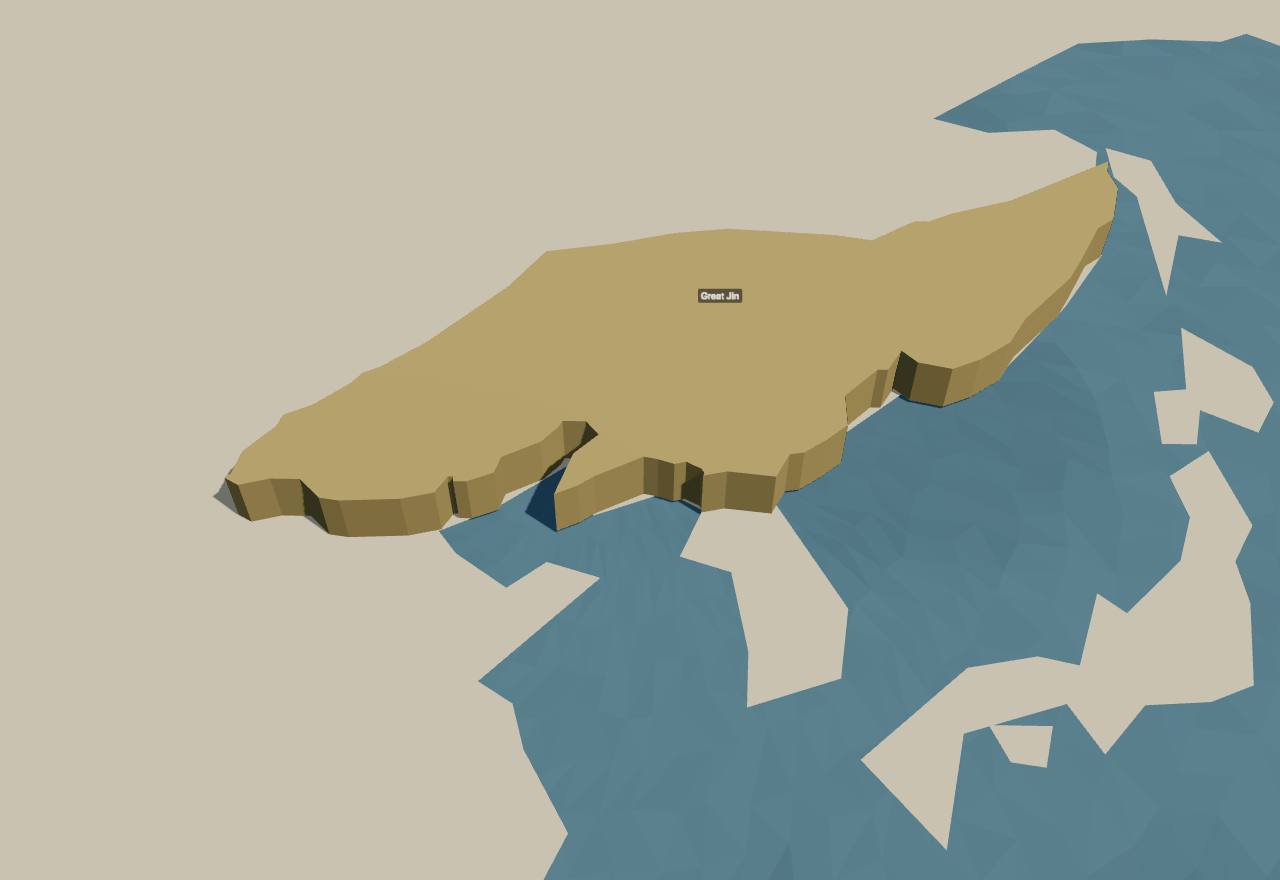
The Jin on Cliopatria's map, 1130–1230
Territory: Cliopatria (CC BY 4.0), simplified. Height: Seshat population, log scale.
Herbert Franke sees in Jin government “the complex interplay between native Jurchen traditions, features inherited from the Liao state and Chinese (Sung) influence”. The Jin shi says the same of its examinations: they “followed the Liao and Song systems”, in seven categories of degree. 33,10 Consensus Texts
In 1171, the Jin shi records, the emperor Shizong created a jinshi examination for Jurchen candidates, at first in policy essays only, written in the Jurchen script: a way, the compilers thought, to use the Jurchens' own strengths and to keep their script in use. 10 Consensus Texts
The Jin built schools for candidates: a Directorate of Education in 1151; an Imperial School in 1166 that grew from 160 to 400 students, 150 of them relatives of officials of the fifth rank and above; seventeen prefectural schools with 1,000 places in 1176, and later sixty more with another thousand. 10 Consensus Texts
Song Chen, after Iiyama Tomoyasu, writes that the imperial Wanyan clan “nearly monopolized” the high policy offices while Chinese degree holders staffed the lower ranks; of the 10,000 or more degrees awarded under the Jin, most came in its second half, and by the 1190s the capital circuit's share of graduates had fallen to 15 %. 8 Consensus Texts
Iiyama argues that Jurchen students of the classics stayed a group apart from their Han neighbours throughout the Jin, and that the Jin, unlike the Southern Song, refused the literati any fiscal, legal or social privileges that might build them a local power base. 8 Debated Texts
The Jin shi's compilers blamed the decline on the late reigns: after Xuanzong moved the court south, clerks' ways spread, routes to office multiplied, men placed by hereditary protection and army service crowded the court, “and the examinations too overflowed”. 10 Consensus Texts
The seshat-db record dates the Jin to 1115–1234 with a peak in 1207, a territory of 3.6 million km² and 45–54 million people around 1200, and five levels of administration: the emperor, the Central Secretariat, the circuit or superior-prefecture governors, the prefecture and the county. Seshat DB Consensus Survey Texts
How power worked Emperor · Written law · Empire · 2 unknown
How power worked
- Who rules
- Emperor Consensus
Why?
- How chosen
- Unknown
Why?
No source read for this page describes how the Jin emperors were chosen; the page leaves it uncoded rather than assume Song practice.
- Limits on power
- Written law Consensus
Why?
- Scale
- Empire Consensus
Why?
- Claim to rule
- Unknown
Why?
The sources read here discuss Jin institutions and identity, not the grounds on which its emperors claimed to rule.
- Who has a say
- A narrow elite Consensus
Why?
Artefacts
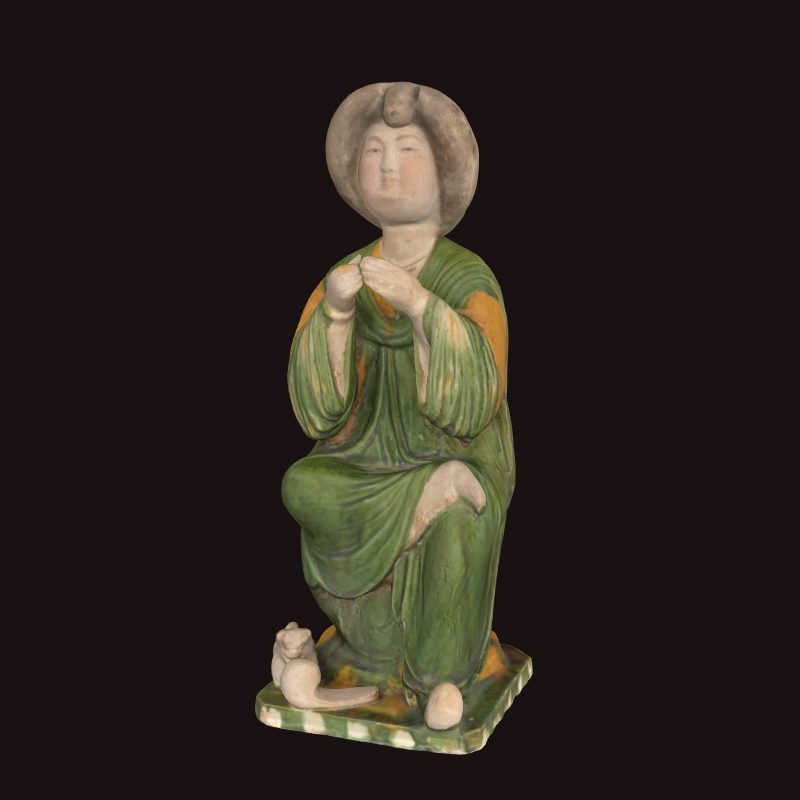
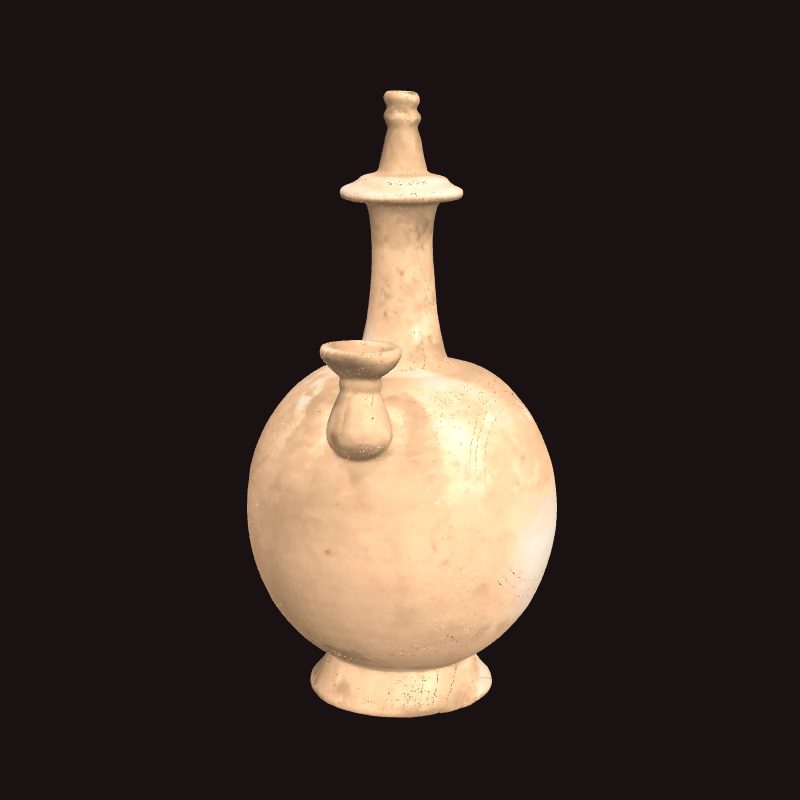
 Model, not a scan
In numbers
- Marks, by Seshat polity:
- Sui Dynasty
- Early Tang Dynasty
- Later Tang Dynasty
- Northern Song
- Xixia
- Southern Song
- Jin Dynasty
- Background bands, by phase:
- Reunification and the early Tang
- Rebellion, governors and Five Dynasties
- The Northern Song and its neighbours
- The Southern Song and the Jin
| Seshat polity | Years | Value |
|---|---|---|
| Sui Dynasty | 600 CE | 3,000,000–3,100,000 |
| Early Tang Dynasty | 620 CE | 6,225,000 |
| Early Tang Dynasty | 630 CE | 6,350,000 |
| Early Tang Dynasty | 640 CE | 6,475,000 |
| Early Tang Dynasty | 650 CE | 3,600,000 |
| Early Tang Dynasty | 660 CE | 4,900,000 |
| Early Tang Dynasty | 670 CE | 3,900,000 |
| Early Tang Dynasty | 680 CE | 4,400,000 |
| Early Tang Dynasty | 690 CE | 4,900,000 |
| Early Tang Dynasty | 700 CE | 5,067,000 |
| Early Tang Dynasty | 710 CE | 5,233,000 |
| Early Tang Dynasty | 720 CE | 5,400,000 |
| Early Tang Dynasty | 730 CE | 5,133,000 |
| Early Tang Dynasty | 740 CE | 4,867,000 |
| Early Tang Dynasty | 750 CE | 4,600,000 |
| Early Tang Dynasty | 760 CE | 4,100,000 |
| Later Tang Dynasty | 770 CE | 3,600,000 |
| Later Tang Dynasty | 780 CE | 3,350,000 |
| Later Tang Dynasty | 790 CE | 3,100,000 |
| Later Tang Dynasty | 800 CE | 3,243,000 |
| Later Tang Dynasty | 810 CE | 3,386,000 |
| Later Tang Dynasty | 820 CE | 3,529,000 |
| Later Tang Dynasty | 830 CE | 3,671,000 |
| Later Tang Dynasty | 840 CE | 3,814,000 |
| Later Tang Dynasty | 850 CE | 3,957,000 |
| Later Tang Dynasty | 860 CE | 4,100,000 |
| Later Tang Dynasty | 870 CE | 3,600,000 |
| Later Tang Dynasty | 880 CE | 3,100,000 |
| Later Tang Dynasty | 890 CE | 2,600,000 |
| Later Tang Dynasty | 900 CE | 1,500,000 |
| Later Tang Dynasty | 907 CE | 800,000 |
| Northern Song | 1000 CE | 3,033,000–2,900,000 |
| Xixia | 1032 CE – 1227 CE (whole period) | 600,000–650,000 |
| Northern Song | 1100 CE | 2,367,000–2,233,000 |
| Jin Dynasty | 1115 CE – 1234 CE (whole period) | 3,600,000 |
| Seshat polity | Years | Value |
|---|---|---|
| Sui Dynasty | 600 CE | 46,000,000 |
| Early Tang Dynasty | 700 CE | 37,000,000 |
| Early Tang Dynasty | 705 CE | 37,000,000 |
| Early Tang Dynasty | 726 CE | 41,400,000 |
| Early Tang Dynasty | 740 CE | 48,000,000 |
| Early Tang Dynasty | 754 CE | 52,800,000 |
| Later Tang Dynasty | 766 CE | 40,000,000–55,000,000 |
| Later Tang Dynasty | 900 CE | 60,000,000–80,000,000 |
| Northern Song | 960 CE – 1127 CE (whole period) | 60,000,000–100,000,000 |
| Jin Dynasty | 1200 CE | 45,000,000–54,000,000 |
| Seshat polity | Years | Value |
|---|---|---|
| Sui Dynasty | 600 CE | 500,000 |
| Early Tang Dynasty | 700 CE – 763 CE | 1,000,000 |
| Later Tang Dynasty | 764 CE – 800 CE | 1,000,000 |
| Northern Song | 1000 CE | 500,000 |
| Northern Song | 1100 CE | 1,000,000 |
| Seshat polity | Years | Value |
|---|---|---|
| Sui Dynasty | 581 CE – 618 CE (whole period) | 5 |
| Early Tang Dynasty | 617 CE – 763 CE (whole period) | 7 |
| Later Tang Dynasty | 763 CE – 907 CE (whole period) | 7 |
| Northern Song | 960 CE – 1127 CE (whole period) | 7–8 |
| Xixia | 1032 CE – 1227 CE (whole period) | 4 |
| Jin Dynasty | 1115 CE – 1234 CE (whole period) | 5 |
| Southern Song | 1127 CE – 1279 CE (whole period) | 5 |
| Seshat polity | Years | Value |
|---|---|---|
| Sui Dynasty | 581 CE – 618 CE (whole period) | 3–5 |
| Early Tang Dynasty | 617 CE – 763 CE (whole period) | 6 |
| Later Tang Dynasty | 763 CE – 907 CE (whole period) | 3–6 |
| Northern Song | 960 CE – 1127 CE (whole period) | 7 |
| Seshat polity | Years | Value |
|---|---|---|
| Sui Dynasty | 581 CE – 618 CE (whole period) | 6 |
| Early Tang Dynasty | 617 CE – 763 CE (whole period) | 8 |
| Later Tang Dynasty | 763 CE – 907 CE (whole period) | 5 |
| Northern Song | 960 CE – 1127 CE (whole period) | 8–10 |
Values as Seshat codes them: bands are ranges, dots single values, flat bars values given for a whole period, hatching “unknown”; from one Seshat polity to the next, marks alternate between a light tone and a darker one with dashed joining lines (the key above names each polity). Source: Seshat Global History Databank (Equinox-2020), CC BY 4.0; and the Seshat Databank, seshat-db.com (no licence stated; attribution).
Governance fingerprint
Seshat's institutional variables, phase by phase. Hover or focus a cell for the values and years.
- Present
- Inferred present
- Absent
- Inferred absent
- Unknown
- Not coded in Seshat
- Mixed: present in one Seshat polity or period, absent in another
Not coded in Seshat: The Northern Song and its neighbours: The Khitan Liao. The Seshat Databank has no polity for it, so its six axes rest on the cited scholarship alone.
The axes against Seshat
8 agree, 0 disagree.
Show the 8 pairs that agree
- Agree Reunification and the early Tang: claim to rule coded “Divine mandate”, which implies rulers legitimated by gods present; Seshat has it present.
- Agree Reunification and the early Tang: limits on power coded “Written law”, which implies formal legal code present; Seshat has it present.
- Agree Reunification and the early Tang: how chosen coded “Heredity”, which implies elite status hereditary present; Seshat has it present.
- Agree Rebellion, governors and Five Dynasties: claim to rule coded “Divine mandate”, which implies rulers legitimated by gods present; Seshat has it present.
- Agree Rebellion, governors and Five Dynasties: limits on power coded “None in practice”, which implies executive checked by government absent; Seshat has it absent.
- Agree Rebellion, governors and Five Dynasties: how chosen coded “Heredity”, which implies elite status hereditary present; Seshat has it present.
- Agree The Northern Song and its neighbours: The Song empire: how chosen coded “Heredity”, which implies elite status hereditary present; Seshat has it present.
- Agree The Southern Song and the Jin: The Jurchen Jin: limits on power coded “Written law”, which implies formal legal code present; Seshat has it present.
Only pairs where an axis value on its own implies a Seshat variable are compared; the rest is not counted as disagreement. 6 more pairs have no Seshat value.
Source: Seshat Global History Databank (Equinox-2020), CC BY 4.0; Seshat Databank, seshat-db.com (no licence stated; attribution).
Compare
| Axis | Sui, Tang and Song China | China: Shang | Japan: The ritsuryō state | The steppe empires: The Türk and Uyghur khaganates |
|---|---|---|---|---|
| Who rules | Emperor | King | King | King |
| How chosen | Heredity | Heredity | Heredity | Heredity |
| Limits on power | Written law | None in practice | Written law | Custom and kin |
| Scale | Empire | Territorial state | Territorial state | Empire |
| Claim to rule | Divine mandate | Divine mandate | Divine mandate | Divine mandate |
| Who has a say | A narrow elite | A narrow elite | A narrow elite | A narrow elite |
Legacy
The examinations outlived every dynasty on this page. After the Mongol interruption the Yuan restored them in 1315 on the Song model; the Ming and Qing kept the Song's three levels and regional quotas, holding eighty-nine regular examinations under the Ming alone, until the Qing abolished the system in 1905. 4 Consensus Texts
Song Chen traces the gentry of late imperial China, locally rooted families with degrees, titles or places in government schools, to the Song, though it was only after 1450 that they spread beyond a few culturally ascendant prefectures. 8 Debated Texts
Benjamin Elman calls the late imperial examinations, “carefully balanced, constantly contested”, an early harbinger of the entrance examinations that govern higher education in much of the world today; Wang and Yang compare the examinations' place in Chinese government to that of councils and assemblies in Europe. 30,4 Debated Texts
The Khitan Liao gave China one of its names: Cathay, and in Russian the standard name for China still. 23 Consensus Texts
See also forms of government and the country edition.
Sources
Bibliography
40 sources, numbered as cited: 6 papers · 11 books · 11 datasets · 11 primary sources · 1 popular
- Book Wright, A. F. (1979). The Sui dynasty (581–617). The Cambridge History of China, vol. 3, Sui and T'ang China, 589–906, Part I. Chapter summary (opening) read on Cambridge Core.
- Paper Wen, F., Wang, E. H. and Hout, M. (2024). Social mobility in the Tang Dynasty as the Imperial Examination rose and aristocratic family pedigree declined, 618–907 CE. Proceedings of the National Academy of Sciences 121(4), e2305564121. Full text read (PMC10823257): Tables 1 and 2, Fig. 3 and the discussion of the 'chronic decline' and 'persistence' schools.
- Book Standen, N. (2009). The Five Dynasties. The Cambridge History of China, vol. 5, Part One. Chapter abstract read (OpenAlex and Cambridge Core).
- Book Wang, E. H. and Yang, C. Z. (2025). The Political Economy of China's Imperial Examination System. Cambridge University Press (Elements in Political Economy), open access. Full open-access PDF read (90 pp.): §§ 1.4, 2.1, 4.1–4.2, Table 1; quotes Chaffee (1995) pp. 35, 38, 51 and Elman (2013).
- Paper Yang, J. (Broughton, M., trans.) (2021). Dispelling the Myth of the “Tang-Song Transition Theory”. Journal of Chinese Humanities 6(2–3), 129–152 (diamond open access). Full text read on brill.com: Naitō's 1922 thesis, the Tang Code and restored Tang Statutes on private land, the Dunhuang and Turfan tenancy contracts, the 780 tax reform.
- Dataset UNESCO World Heritage Centre (2025). Xixia Imperial Tombs (World Heritage List no. 1736). UNESCO open data, World Heritage List dataset whc001. Record read 16 Nov 2026: nine imperial mausoleums and 271 subordinate tombs in the Helan foothills; the dynasty 'Founded by the Tanguts in 1038' and destroyed by the Mongols in 1227; 38.4158 N, 105.9711 E.
- Book Dunnell, R. (1994). The Hsi Hsia. The Cambridge History of China, vol. 6 (Crossref spells the author 'Dunnel'). Chapter abstract read.
- Paper Chen, S. (2017). The state, the gentry, and local institutions: the song dynasty and long-term trends from tang to qing. Journal of Chinese History 1, 141–182 (review essay). Full PDF read (Cambridge Core, free). Summarises Tackett, Hartwell, Hymes, Lee, Iiyama, McDermott and Du; quotes Chaffee's Mingzhou counts.
- Primary Toqto'a (脫脫) et al., compilers (1345). Song shi 宋史, juan 155, Treatise on selection (選舉志) 1: examination subjects. Chinese Wikisource (維基文庫), classical Chinese text, no translation.
- Primary Toqto'a (脫脫) et al., compilers (1344). Jin shi 金史, juan 51, Treatise on selection (選舉志) 1: the jinshi and other degrees. Chinese Wikisource (維基文庫), classical Chinese text, no translation.
- Paper Hoeckelmann, M. (2015). Review of 'The Destruction of the Medieval Chinese Aristocracy'. Reviews in History, review no. 1807 (with the author's response). Read through the Internet Archive copy of 25 Jan 2025; the live site answers 403 to scripts.
- Primary Toqto'a (脫脫) et al., compilers (1344). Liao shi 遼史, juan 45, Treatise on offices (百官志) 1: the northern and southern administrations. Chinese Wikisource (維基文庫), classical Chinese text, no translation.
- Dataset Seshat: Global History Databank (2026). Seshat Databank API (seshat-db.com), social-complexity and general variables. Snapshot of the API responses taken 15 Nov 2026; the site states no licence. Used where Equinox-2020 has no polity for a page's period.
- Primary Ouyang Xiu (歐陽修), Song Qi (宋祁) et al. (1060). Xin Tang shu 新唐書, juan 44, Treatise on selection (選舉志) 1. Chinese Wikisource (維基文庫), classical Chinese text, no translation.
- Primary Ouyang Xiu (歐陽修), Song Qi (宋祁) et al. (1060). Xin Tang shu 新唐書, juan 46, Treatise on offices (百官志) 1: the chief ministers. Chinese Wikisource (維基文庫), classical Chinese text, no translation.
- Primary Ouyang Xiu (歐陽修), Song Qi (宋祁) et al. (1060). Xin Tang shu 新唐書, juan 56, Treatise on punishments and law (刑法志). Chinese Wikisource (維基文庫), classical Chinese text, no translation.
- Popular Shaanxi Provincial People's Government (2017). Chang’an, Capital of the Tang Dynasty. Shaanxi Provincial Government English portal (History and Culture). Read 16 Nov 2026: outer city 9,721 m east–west by 8,651 m north–south, 108 wards (fang), the palace and administrative cities at the north centre, Zhuque Avenue 150 m wide, architect Yuwen Kai.
- Dataset UNESCO World Heritage Centre (2014). Silk Roads: the Routes Network of Chang'an-Tianshan Corridor (World Heritage List no. 1442). UNESCO open data, World Heritage List dataset whc001. Record read 16 Nov 2026: 'Chang’an/Luoyang, the central capital of China in the Han and Tang dynasties'; its 33 components include capital cities and palace complexes.
- Dataset UNESCO World Heritage Centre (2014). The Grand Canal (World Heritage List no. 1443). UNESCO open data, World Heritage List dataset whc001. Record read 16 Nov 2026: 'conceived as a unified means of communication for the Empire for the first time in the 7th century AD (Sui dynasty)'; over 2,000 km of artificial waterways by the 13th century.
- Primary Ouyang Xiu (歐陽修), Song Qi (宋祁) et al. (1060). Xin Tang shu 新唐書, juan 51, Treatise on food and money (食貨志) 1: land allotment and taxes. Chinese Wikisource (維基文庫), classical Chinese text, no translation.
- Book Peterson, C. A. (1979). Court and province in mid- and late T'ang. The Cambridge History of China, vol. 3, Part I. Chapter summary (opening) read on Cambridge Core.
- Book Tackett, N. (2014). The Destruction of the Medieval Chinese Aristocracy. Harvard University Asia Center. Publisher description read; the argument is described on the page through hoeckelmann2015, chen2017 and wen2024.
- Book Twitchett, D. and Tietze, K.-P. (1994). The Liao. The Cambridge History of China, vol. 6, Alien Regimes and Border States, 907–1368. Chapter introduction read on Cambridge Core.
- Book Smith, P. J. (2009). Shen-tsung’s Reign and the New Policies of Wang An-shih, 1067–1085. The Cambridge History of China, vol. 5, Part One. Chapter opening read on Cambridge Core (the mid-century crisis, the Tangut war figures).
- Dataset Seshat Global History Databank (2025). Cliopatria: a geospatial database of political entities (release v0.2.1). GitHub; CC BY 4.0 (the page reads its slices with scripts/history/cliopatria.ts).
- Dataset Bennett, J. S., Mutch, E., Tollefson, A., et al. (2025). Cliopatria - A geospatial database of world-wide political entities from 3400BCE to 2024CE. Scientific Data 12. Cliopatria: open geospatial dataset of over 1600 political entities, 3400 BCE–2024 CE.
- Book Chaffee, J. W. (1995). The Thorny Gates of Learning in Sung China: A Social History of Examinations. State University of New York Press, new edition (first published Cambridge University Press, 1985; the linked copy is the 1985 edition). Not read: the Internet Archive copy is lending-only. Its figures appear on this page only as wang2025 (pp. 35, 38, 51) and chen2017 (p. 196) quote them.
- Primary Toqto'a (脫脫) et al., compilers (1345). Song shi 宋史, juan 85, Treatise on geography (地理志) 1: the Eastern Capital (Kaifeng). Chinese Wikisource (維基文庫), classical Chinese text, no translation.
- Paper Hartwell, R. M. (1982). Demographic, Political, and Social Transformations of China, 750-1550. Harvard Journal of Asiatic Studies 42(2), 365–442. Not read (JSTOR); quoted only as chen2017 quotes it (pp. 147–148).
- Book Elman, B. A. (2013). Civil Examinations and Meritocracy in Late Imperial China. Harvard University Press. Publisher description read (c. 1400–1900, 'only one percent of candidates'); later figures quoted through wang2025.
- Paper Elman, B. A. (1991). Political, Social, and Cultural Reproduction via Civil Service Examinations in Late Imperial China. The Journal of Asian Studies 50(1), 7–28. Abstract read. Ming and Qing, not Song.
- Primary Toqto'a (脫脫) et al., compilers (1345). Song shi 宋史, juan 485, Foreign states 1: Xia (夏國) part 1. Chinese Wikisource (維基文庫), classical Chinese text, no translation.
- Book Franke, H. (1994). The Chin dynasty. The Cambridge History of China, vol. 6. Chapter abstract read.
- Primary Toqto'a (脫脫) et al., compilers (1345). Song shi 宋史, juan 47, Annals: the Duke of Ying and the two princes (1274–1279). Chinese Wikisource (維基文庫), classical Chinese text, no translation.
- Primary Toqto'a (脫脫) et al., compilers (1345). Song shi 宋史, juan 88, Treatise on geography 4: Lin'an prefecture (Hangzhou). Chinese Wikisource (維基文庫), classical Chinese text, no translation.
- Dataset UNESCO World Heritage Centre (2011). West Lake Cultural Landscape of Hangzhou (World Heritage List no. 1334). UNESCO open data, World Heritage List dataset whc001. Record read 16 Nov 2026: temples, pagodas, causeways and islands; coordinates 30.2375 N, 120.1408 E.
- Dataset UNESCO World Heritage Centre (2021). Quanzhou: Emporium of the World in Song-Yuan China (World Heritage List no. 1561). UNESCO open data, World Heritage List dataset whc001. Record read 16 Nov 2026: a maritime emporium of the Song and Yuan (10th–14th c.) with administrative buildings, stone docks and the 11th-century Qingjing Mosque; 24.8070 N, 118.7154 E.
- Dataset The Cleveland Museum of Art (1995). Mirror Featuring Dading Coins (大定通寶花紋鏡), c. 1178–1234 (1995.381). Cleveland Museum of Art Open Access (share_license_status CC0). Read 16 Nov 2026: Jin dynasty, bronze, diameter 11.9 cm, overall 0.8 cm, rim 0.4 cm.
- Dataset The Metropolitan Museum of Art (2010). Seated court lady (2010.120). The Met Collection API, object 75765 (isPublicDomain: true). Read 16 Nov 2026: Tang dynasty, 8th century, earthenware with tri-color (sancai) glaze, H. 37.5 cm.
- Dataset The Hunt Museum (2026). Ceramic Kundika (or ritual ewer), MG 138. Zenodo record 18948907 (CC BY 4.0). Record read 16 Nov 2026: licence cc-by-4.0, dcterms:created '618–907 AD'.
Quantitative values from the Seshat Global History Databank (Equinox-2020), licensed CC BY 4.0. Dataset: Seshat Equinox Packaged Data (v.1). See also Seshat: The Global History Databank (Turchin et al. 2015).
Values for polities Equinox-2020 does not cover come from the Seshat Databank at seshat-db.com (Seshat: Global History Databank), snapshotted from its API on 2026-11-16. No licence is stated on seshat-db.com; used with attribution. Snapshot: Seshat Databank API (seshat-db.com), social-complexity and general variables.