A court that kept its throne while regents, retired emperors and warriors took the power
Japan: from the ritsuryō state to the shogunates
645 CE – 1573 CE
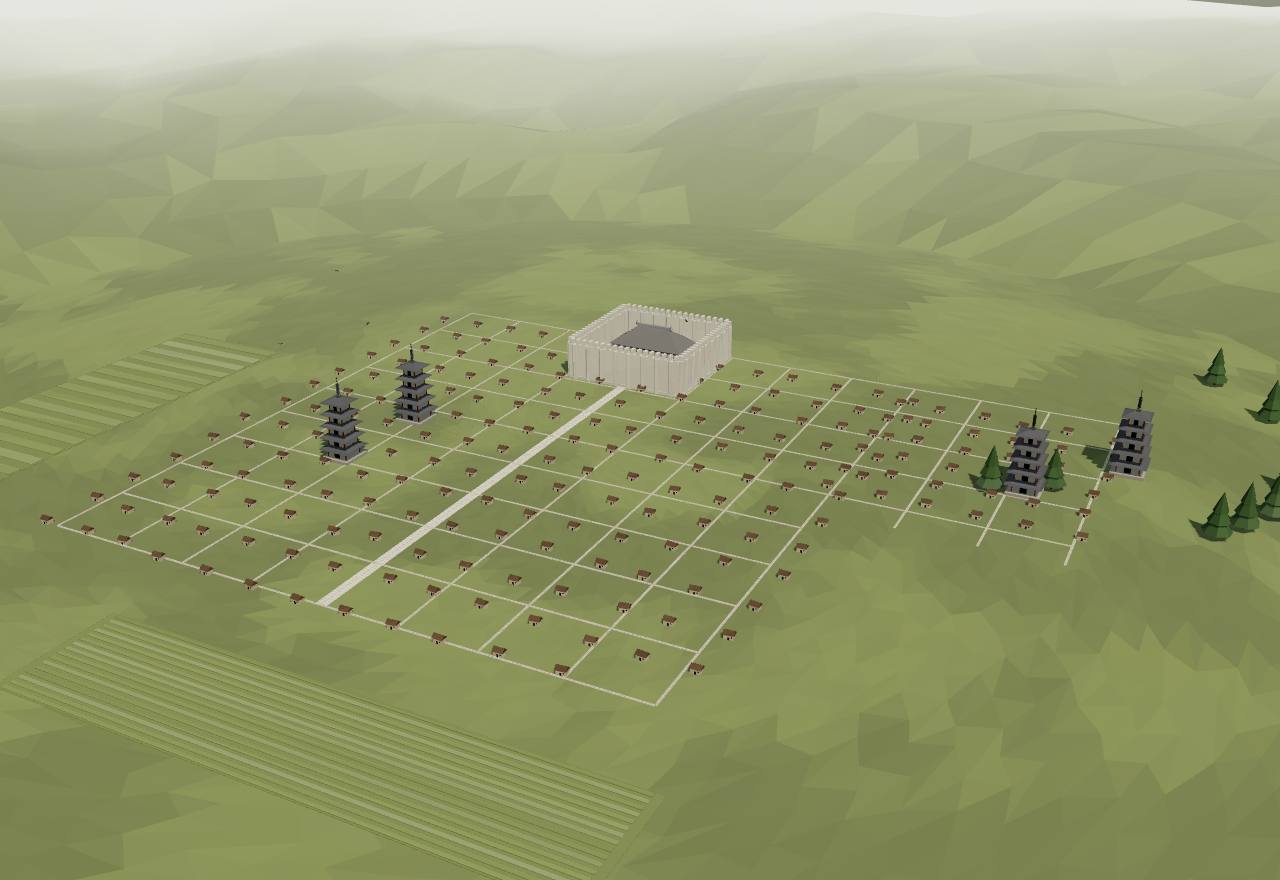
Heijō-kyō: the grid capital at Nara
645 CE – 794 CE
The ritsuryō state
From 645 the court of Yamato set out to govern as the Tang did: households registered, rice land allotted by head and taken back, taxes in grain, cloth and labour, provinces under governors sent from the capital, and written codes of penal and administrative law (ritsu and ryō). How much of it worked outside the capital is the question every historian of the period asks.
Terms: Japan: from the ritsuryō state to the shogunates: The ritsuryō state
- ritsuryō律令 penal (ritsu) and administrative (ryō) codes: the name historians give the Nara state, “a ‘penal and administrative legal’ (ritsuryō) order” 8,9
- Daigokuden大極殿 the imperial audience hall, where the great state ceremonies took place 10,11
- Dajōkan the Great Council of State over the eight ministries (Murdoch: “Dajō-Kwan”) 3
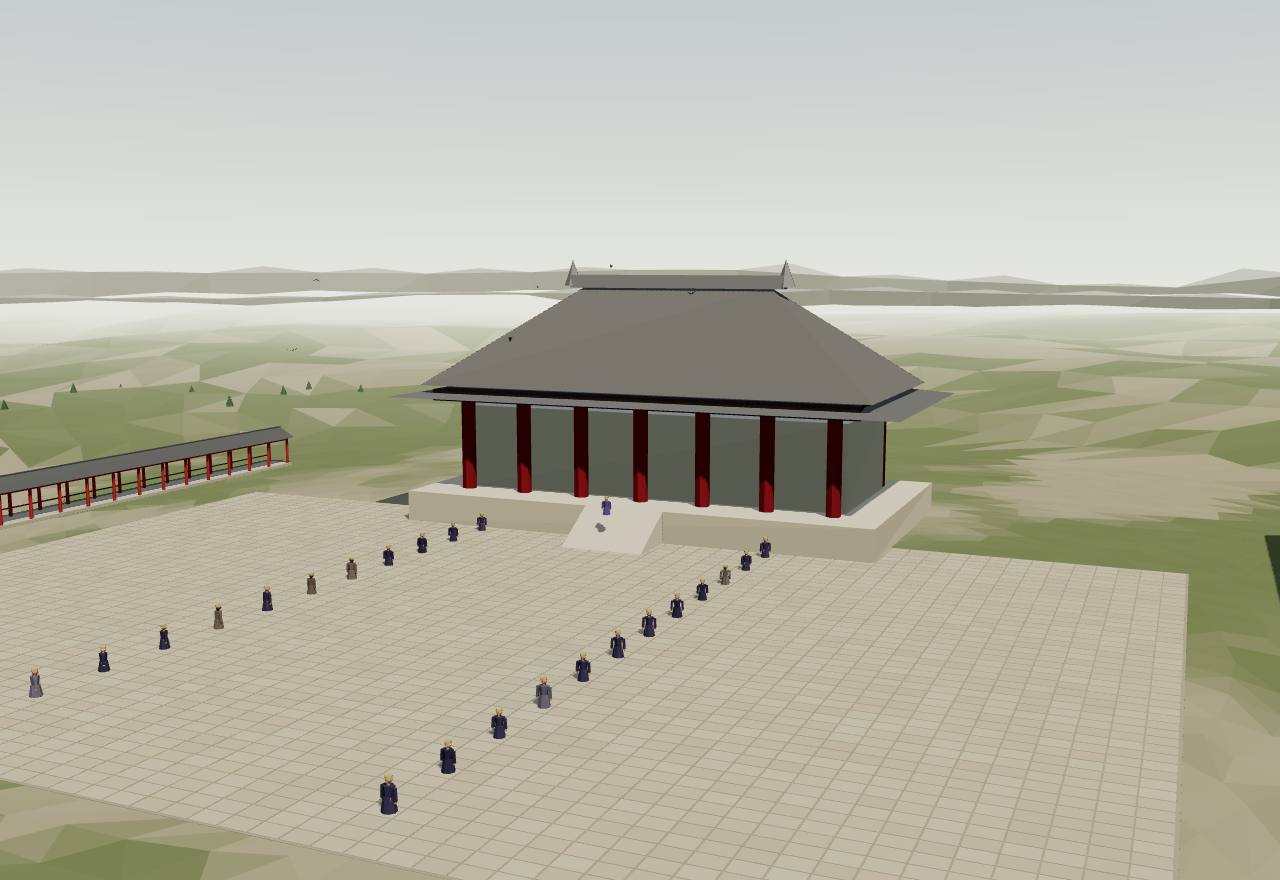
The audience hall of the Heijō palace, Nara
In the eighth month of 645, the Nihongi says, governors were appointed to the eastern provinces and told to “prepare registers of all the free subjects of the State and of the people under the control of others” and to take account of the cultivated land; they were not to try criminal cases or take bribes. Aston, its translator, read this as the start of “a more centralized character” in local government, adding that “the change was not made all at once”. 2 Consensus Texts
On the first day of 646, after the New Year greetings, the emperor Kōtoku issued an edict of reform in four articles, as the Nihongi gives it: the people and granaries held privately by the great houses were abolished; the capital was to be regulated, with governors for the home provinces and districts, barriers, post-horses and bell-tokens; registers of population and a system of granting and taking back allotted land were set up “for the first time”; and the old taxes and forced labour gave way to commuted taxes in silk and cloth, with two sheaves and two bundles of rice from each tan of land. 2 Consensus Texts
The model was Tang China. Murdoch calls the new land and tax system “simply that of contemporary China transferred to Yamato”, and Asakawa finds the reformers’ words for the census, the tax register and the allotment “precisely the same” as the Chinese ones. Asakawa’s verdict is that the reform was “Chinese in its organization of the State, and Japanese in its theory of sovereignty”: the ruler was not a Son of Heaven who could lose his mandate. Naoki Kōjirō describes the aim as “a bureaucratic system (like the one in T’ang China) that would increase state control over all lands and peoples”, and Inoue Mitsusada traces the reforms back to about 587, when Soga no Umako seized the central government and made “extensive use of Chinese techniques for expanding state power”. 3,1,9,12 Consensus Texts Read more: The Tang codes and land allotment the reformers copied
The codes came in stages. In 681 the emperor Temmu ordered the laws reformed, and in 689 “a book of legal enactments in twenty-two volumes” was sent to the provincial governors. The code of the Taihō era followed (Asakawa dates it 701, Murdoch 702). It does not survive whole: the penal code “exists to-day only in scattered quotations”, and the administrative code is known from an edition of 833 that mixes the text with commentaries of 718 and 833. 2,1,3 Consensus Texts
On paper every man received two tan of rice land and every woman a third less (the code of 701 as Asakawa reads it: two tan for a man, four-thirds for a woman, none under the age of five), re-allotted every six years. Asakawa warns that it is “unsafe to infer the laws of 645 from the Code of 701”: the Nihongi says the first allotment was completed in 652, and records only one re-allotment, in 692, before the code. 1,2 Consensus Texts
In 649 the scholar Takamuko no Kuromaro and the priest Bin were ordered to set up “Eight Departments of State and one hundred bureaus”; the Great Council of State (Dajōkan) stood over them. Ranks multiplied and were reordered: Murdoch counts nineteen grades in 649, forty-eight under Temmu and thirty, in ten classes, in the Taihō code. 2,3 Consensus Texts
The court moved to a planned capital. The empress Jitō moved her residence to the palace of Fujiwara at the end of 694, and in 710 Nara (Heijō-kyō) “was laid out as a replica of the Chinese capital” at Chang’an, with seven great temples, shrines, a palace and public buildings; apart from a short interval it was the seat of the court until 784. UNESCO’s record of Ancient Nara describes the city as the capital of Japan from 710 to 784. 2,3,11 Consensus Texts Excavation
The city was a grid: a rectangle about 4.3 km east–west by 4.8 km north–south, with an eastern extension of about 1.6 by 2.4 km facing Tōdai-ji, its blocks laid out like a chessboard. Suzaku avenue, about 74 m wide, ran north to the palace, roughly 1 km square with an annex on the east and twelve gates, whose Suzaku gate the JAANUS dictionary describes as five bays by two, each 5.1 m wide. The audience hall rebuilt on its site in 2010 measures 44.0 by 19.5 m on a podium 3.4 m high. 13,14,15,11 Consensus Excavation Texts
Before coins, cloth served as money: Aston notes that textiles “served the purpose of currency in this period”. In 708 copper found in Musashi gave the era its name, Wadō, and allowed the court to open a mint and strike coins of its own; in 712 an edict fixed the price of rice at six shō for one copper cash, according to Murdoch. 2,3 Consensus Texts
How far it worked is doubtful. Murdoch, mindful of the “wide gap between the enactment and the enforcement of law”, says the Taihō code set out many provisions more honoured in the breach than the observance. Asakawa finds outlaws who had fled the registers by 670 and a serious problem by 677 and 679, and laws against the great men’s enclosure of hills and fields from 675, “frequently re-enacted with evidently little effect”. 3,1 Debated Texts
Seshat codes the Asuka state (to 710) at 100,000–150,000 km² and two to three million people in the seventh century, with five or six levels of administration, a formal legal code, full-time officials and an examination system; for Nara it codes 5.8–6.4 million people from 700 and a largest city of 100,000–250,000. The two population ranges do not join up, a sign of how uncertain early Japanese numbers are. Seshat Debated Survey
One family rose with the new state. In 669 Nakatomi no Kamatari, whom Murdoch credits with the land system of 645, was given the cap of “Great Woven Stuff”, the rank of Oho-omi and a new surname: the house of Fujiwara. Its heirs would marry their daughters to emperors and rule as regents in the next phase. 2,3 Consensus Texts
How power worked King · Heredity · Written law
How power worked
- Who rules
- King Consensus
Why?
- How chosen
- Heredity Consensus
Why?
- Limits on power
- Written law Consensus
Why?
- Scale
- Territorial state Consensus
Why?
- Claim to rule
- Divine mandate Consensus
Why?
- Who has a say
- A narrow elite Consensus
Why?
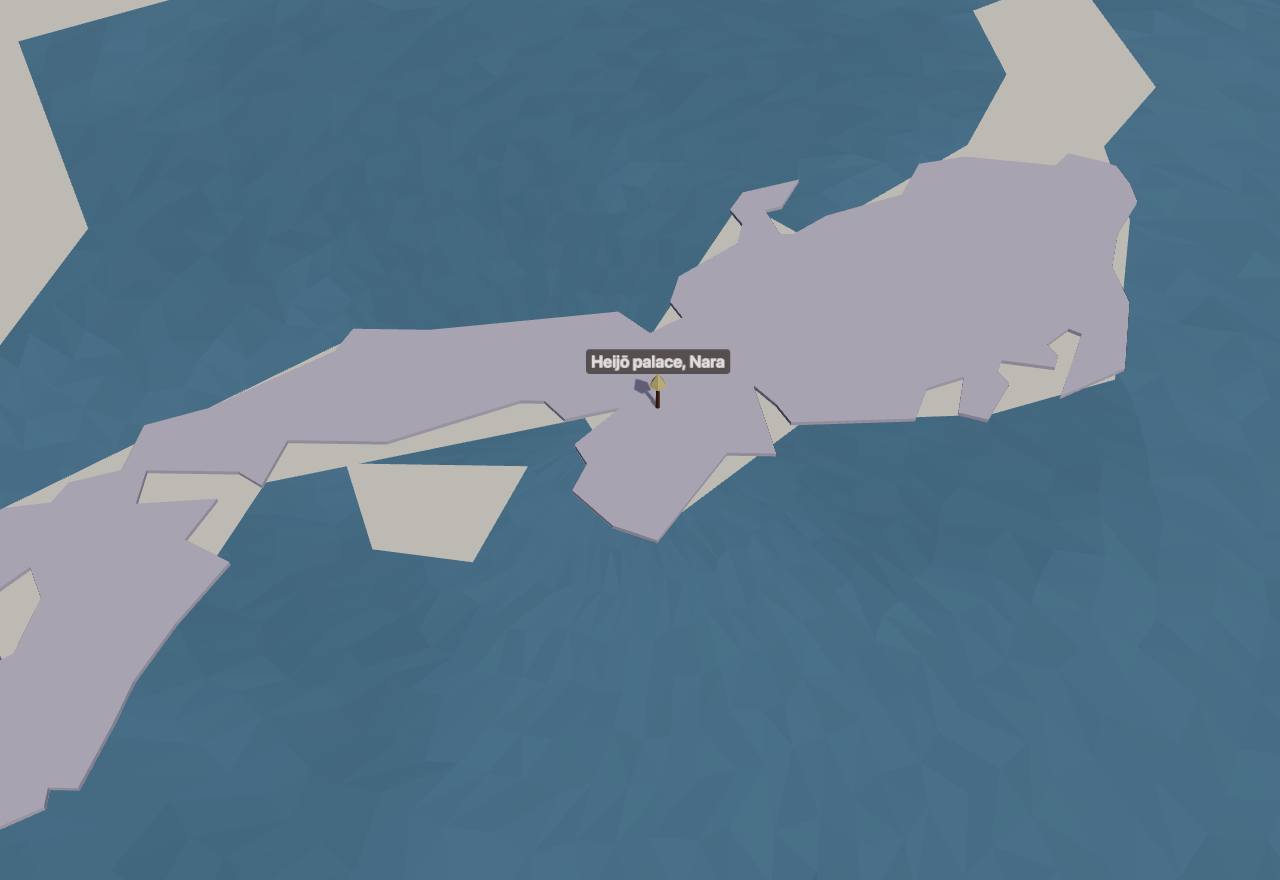
Nara Japan, 750
Places: 1 cited site over Cliopatria (CC BY 4.0) territories, drawn flat and low. Heijō palace, Nara 11
794 CE – 1185 CE
Heian: regents and retired emperors
In 794 the court settled at Heian-kyō, the later Kyoto, and stayed. The codes stayed on the books, but power moved: first to the Fujiwara, who married their daughters to emperors and governed as regents, then to emperors who abdicated and ruled from their own households, while estates exempt from tax spread across the provinces and warriors rose in them.
Terms: Japan: from the ritsuryō state to the shogunates: Heian: regents and retired emperors
- sekkan摂関 the imperial regents: sesshō (regent for a child emperor) and kampaku (regent for an adult one), held by the Fujiwara 16
- shōen荘園 a private estate, often exempt from the provincial governor’s taxes and entry: Murdoch’s “non-taxpaying manors” 17,3
- insei院政 “cloistered rule”: government by a retired emperor from his own household, 1086–1185 in the usual dating 18,4
- shinden-zukuri寝殿造 the style of aristocratic mansion of Heian-kyō: a main hall facing a garden, side halls joined by corridors, on a plot about 120 m square 19
- kenmon taisei権門体制 Kuroda Toshio’s “system of ruling elites”: court nobles, great temples and shrines, and warriors ruling together 16
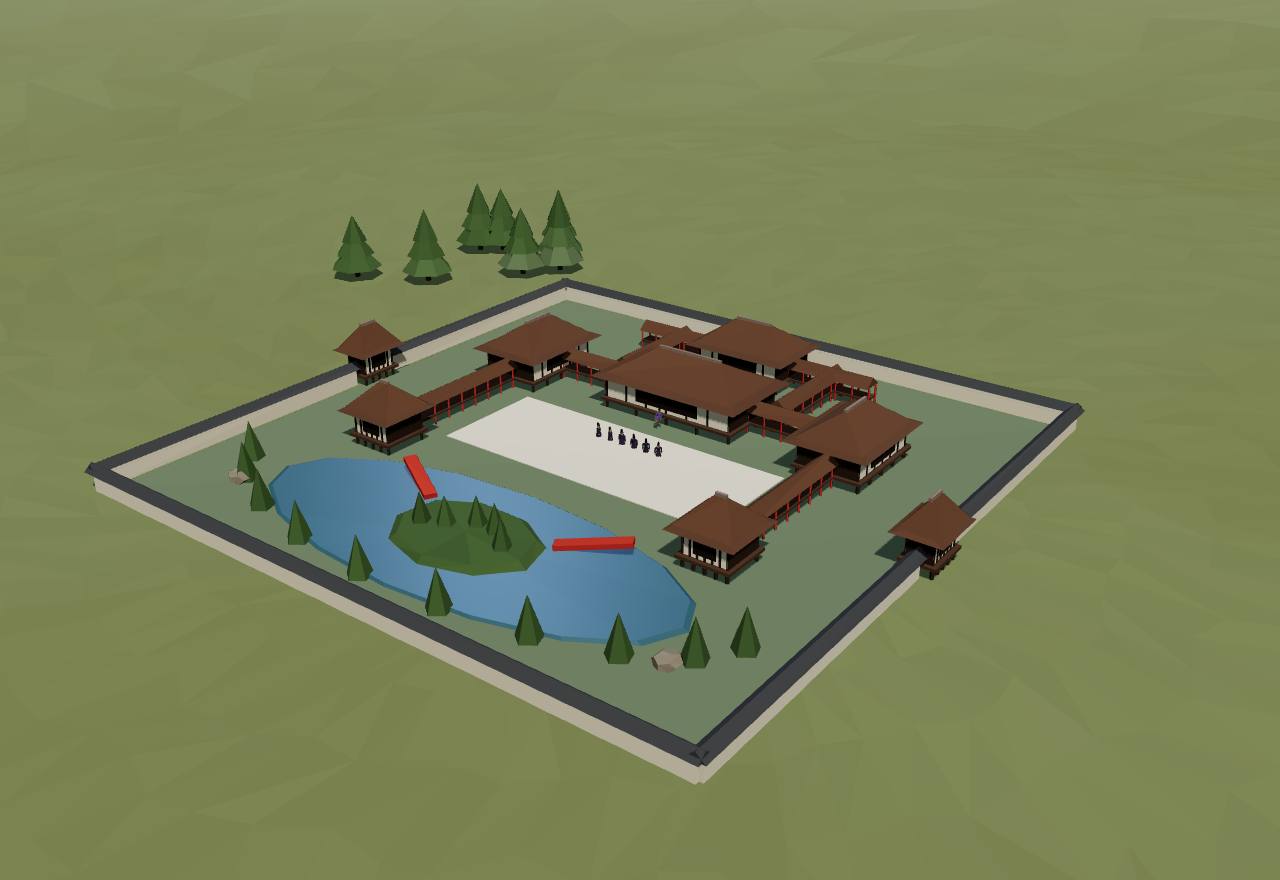
A regent’s mansion in Heian-kyō
After putting down a plot against the throne in 782, the emperor Kammu and his advisers decided to leave Nara. In the spring of 793 he sent two courtiers to read the auspices of a new site, the first step, William McCullough writes, in “one of the longer continuous urban traditions in world history”: Heian-kyō, Kyoto, the capital from 794. UNESCO’s record dates Kyoto as the imperial capital from 794. 20,21,22 Consensus Texts
The Fujiwara turned kinship with the throne into office. Fujiwara no Yoshifusa took the regency in 858 for his grandson, the nine-year-old emperor Seiwa, and when Seiwa came of age in 866 was confirmed by decree with the formal title of Regent (sesshō); his heir Mototsune became the first kampaku, regent for an adult emperor, an appointment Murdoch says made him “the real ruler of Japan” (the year is given as 880, 882 or 887–888: the sources differ). 3 Consensus Texts
Fujiwara no Michinaga is the regency at its height: “For more than thirty years (995–1027) his word was law, if not in Japan, at least in the capital”, Murdoch writes, and he became “the father-in-law of four Emperors and the grandfather of as many”. Murdoch also judges that disorder and popular misery had never been so great since the reform as under Michinaga and his son Yorimichi. 3 Debated Texts
Estates grew outside the tax registers. In 902 an edict complained that land had not been allotted for fifty or sixty years and that the registers showed “few or no men and many women” in taxable households; in 914 Miyoshi Kiyotsura reported a district of Bitchū that had furnished 20,000 soldiers in 660 and had no resident left by 911, and claimed that of about 300,000 taxable people outside the home provinces no more than 100,000 were actually taxed. Asakawa calls the district “probably … an extreme case”. 1 Consensus Texts
Recent work reads the change differently. Cornelius Kiley agrees that Heian saw “a progressive weakening of centralized control”, but argues that in the ninth and tenth centuries it came “in large part from movement from below” and had “little to do with warriors or shōen”, and that provincial government became a bargaining ground between capital and countryside. Nagahara Keiji dates the breakdown of the allotment system to “early in the tenth century”. Dana Morris describes taxes by then managed by local and provincial notables whose often “quasi-official status” a Nara official would have found bewildering. 23,24,25 Debated Texts
From 1086 power moved to retired emperors. Shirakawa reigned for only fourteen years (1072–1086), but, Murdoch writes, “he was the real ruler of the Empire down to his death” in 1129, governing through the retired emperor’s own office rather than the old Council of State. G. Cameron Hurst writes that retired emperors “so dominated the Heian court that historians call the period 1086–1185 … the Insei period”, from in (cloister) and sei (rule). 3,4 Consensus Texts
Kuroda Toshio described the same centuries as rule by several blocs, kenmon: the court nobles, the great temples and shrines, and the warriors, which “tended to rule Japan interdependently, sometimes in a competing manner but other times collaboratively”, in James Dobbins’s summary. In Kuroda’s words, these parties “as a whole formed the ruling power of the country … from the Insei period on”. 26,27,16 Debated Texts
Warriors became a political force of their own, Takeuchi Rizō writes, with the revolt of Taira no Masakado in the mid-tenth century. In the twelfth century the Taira and Minamoto houses fought for control of the court; the war ended with the Taira defeat at Dan-no-ura in the spring of 1185, and in the same year the court gave the Minamoto leader Yoritomo the right, taken from the estate holders, to appoint land stewards (jitō). 28,3 Consensus Texts
Seshat codes Heian Japan at 250,000–300,000 km² and four million people around 800, rising to 5.5–6.3 million by 1100, with the capital at Kyoto shrinking from about 200,000 people in the ninth century to 150,000 in the twelfth. It still codes a formal legal code, five levels of administration, an examination system and hereditary elite status. Seshat Consensus Survey
How power worked King · Heredity · Custom and kin
How power worked
- Who rules
- King Debated
Why?
- How chosen
- Heredity Consensus
Why?
- Limits on power
- Custom and kin Debated
Why?
- Scale
- Territorial state Consensus
Why?
- Claim to rule
- Divine mandate Consensus
Why?
- Who has a say
- A narrow elite Consensus
Why?
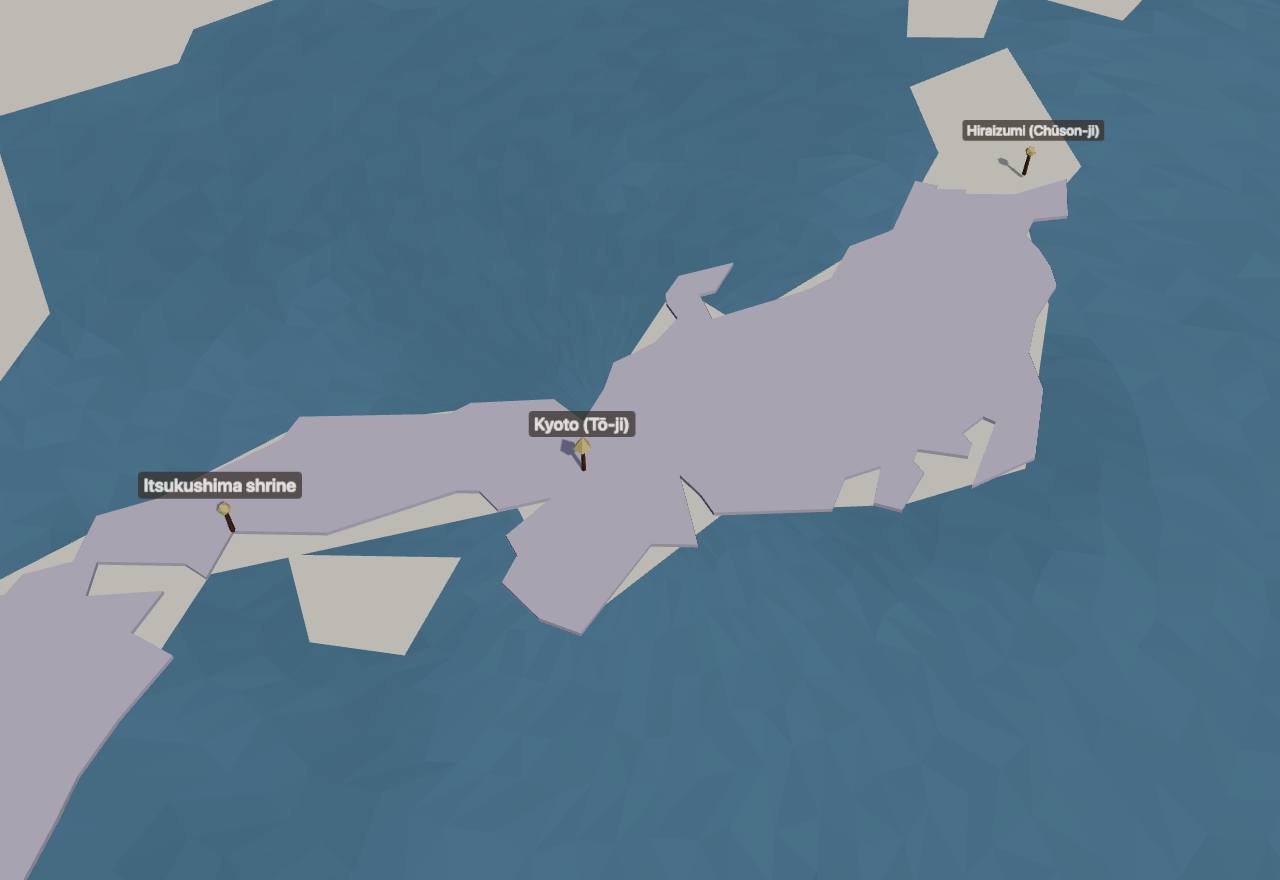
1185 CE – 1333 CE
Court and bakufu
From 1185 Japan had two centres: the emperor’s court and the retired emperors in Kyoto, and the warrior government (bakufu) that Minamoto Yoritomo founded at Kamakura, which put its own men into the provinces and the estates and, after 1221, held the court in check.
On the 28th day of the 11th month of 1185, the Azuma kagami records, Hōjō Tokimasa put Yoritomo’s demand to the court: military governors (shugo) and land stewards (jitō) were to be appointed in every province, and a levy of five shō of rice for each tan of land raised for the army “without regard to whether the estates and public lands belong to powerful houses” (our translation). Murdoch calls it the transfer of the right to appoint land stewards from the estate holders “to the Lord of Kamakura”, and adds that within months Yoritomo gave up the levy and withdrew most of his stewards. Hall dates the appointments 1186 in one place and 1189 in another. 33,3,34 Consensus Texts
Jeffrey Mass describes what followed as “a system of government approximating a dyarchy. During the Kamakura period, Japan had two capitals and two interconnected loci of authority”; he warns that older studies “overstate the warriors’ achievement” by equating the new government with the destruction of the old. 35 Consensus Texts
In 1221 the court of the retired emperor Go-Toba moved against the bakufu. The Azuma kagami has Yoritomo’s widow Masako summon the vassals to her blind and tell them, through Akita-jō-no-suke Kagemori: “All of you, be of one mind and hear me. These are my last words”, reminding them that since Yoritomo founded the Kantō their offices and stipends had been a favour “higher than the mountains and deeper than the seas”, and that an unjust decree had now been issued on the slanders of traitors (our translation). Murdoch counts armies of 50,000, 40,000 and 10,000 sent west; the war, he writes, was “short, sharp, and decisive”, and it ended with two former emperors and the reigning emperor banished and their supporters’ estates confiscated. 33,3,34 Consensus Texts
The Kyoto court
Emperors still reigned and retired emperors still governed their households and estates; the court’s law still ran where the bakufu’s did not.
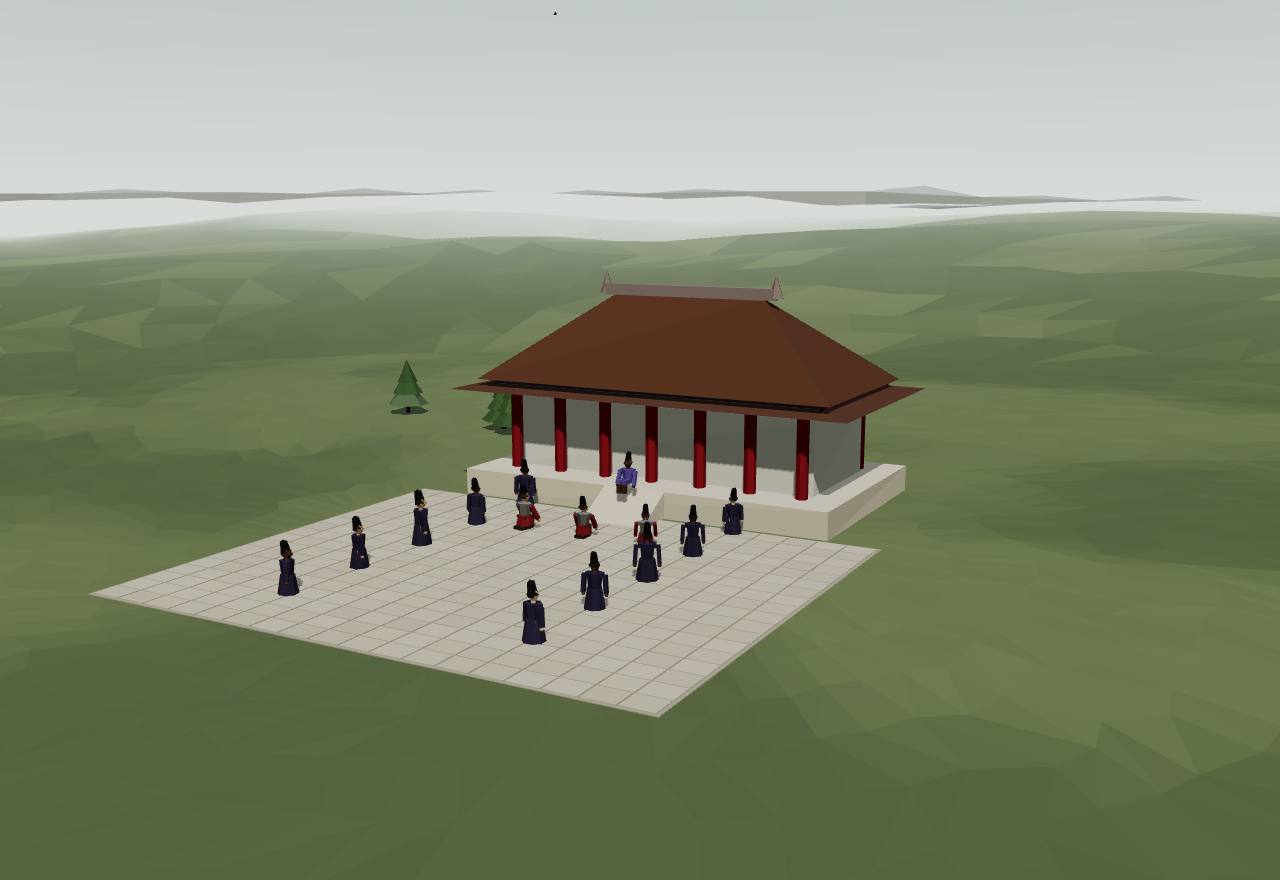
The court in Kyoto receives Kamakura’s envoy
The court was not swept away. Mass writes that the Heian system of imperial-aristocratic rule was “still vigorous during the twelfth century” and “remained the essential framework within which the bakufu, during its lifetime, was obliged to operate”; Nagahara Keiji writes that the bakufu’s land stewards were meant “to supplement rather than supplant” the estate holders’ rights. Hall, the code’s translator, thought the Hōjō “honestly intended that their military institutions should merely supplement and not … supersede the Imperial authorities”. 35,36,34 Consensus Texts
The shogun’s title came from the court. Yoritomo had long wanted the patent of Sei-i-tai shogun, but, Murdoch writes, the retired emperor Go-Shirakawa “looked askance at the request”; Yoritomo had to wait until Go-Shirakawa died in the spring of 1192, and Papinot dates his appointment to that year. Papinot writes that the investiture of the shogun “was at all times received from the emperor”. 3,37 Consensus Texts
Several bodies of law ran side by side. The Kanagawa archives’ account of the period describes the court’s own law, built on the ritsuryō codes, the law of the estate holders, and warrior custom in the east, and calls the society one in which the court and the warrior houses stood side by side as “two great kenmon” (our translation). The 1232 code itself leaves the provincial governors and the estate holders their jurisdiction where they had it (article 6). 38,34 Consensus Texts
After 1221 the court lost its freedom of action. Two retired emperors and the reigning emperor were banished; the bakufu confiscated the lands of those who had fought for Go-Toba and gave them to its own vassals as land stewards, according to Nagahara; and it kept a representative at Rokuhara in Kyoto, the first being Hōjō Yasutoki. Papinot writes that thereafter “the Shōgun, the very Emperors, were chosen, and deposed according to the Hōjō’s will and pleasure”. 34,36,39 Debated Texts
Seshat, which codes the whole Kamakura period as one polity, puts its capital at Kyoto, not Kamakura, with 5.5–6.3 million people in 1200 and a largest city of 100,000–175,000; it codes six or seven levels of administration, courts and judges, a formal legal code, and no examination system or merit promotion. Seshat Consensus Survey
How power worked King · Heredity · Custom and kin
How power worked
- Who rules
- King Debated
Why?
- How chosen
- Heredity Debated
Why?
- Limits on power
- Custom and kin Debated
Why?
- Scale
- Territorial state Debated
Why?
- Claim to rule
- Divine mandate Consensus
Why?
- Who has a say
- A narrow elite Consensus
Why?
The Kamakura bakufu
The warrior government at Kamakura: Yoritomo’s offices, then the Hōjō regents ruling in the name of child shoguns, a council of state, and a written code for the shogun’s own vassals.
Terms: Japan: from the ritsuryō state to the shogunates: Court and bakufu, The Kamakura bakufu
- bakufu幕府 the warrior government; Asakawa glosses it “government in tent”, a modest name for the shogun’s headquarters 17,40
- shugo守護 the military governor of a province (Hall: “Protector”); the code of 1232 limits him to guard duty, rebellion and murder 41,34
- jitō地頭 the land steward the bakufu put into an estate (Hall: “Land-Reeve”) 41,34
- gokenin御家人 a direct vassal of the shogun, the people the code of 1232 was written for 41,40
- shikken執権 the Hōjō regent who ran the bakufu for the shogun (Hall: “Power-holder”) 38,34
- hyōjōshū評定衆 the bakufu’s council of state, whose members swore the oath at the end of the code 41,3
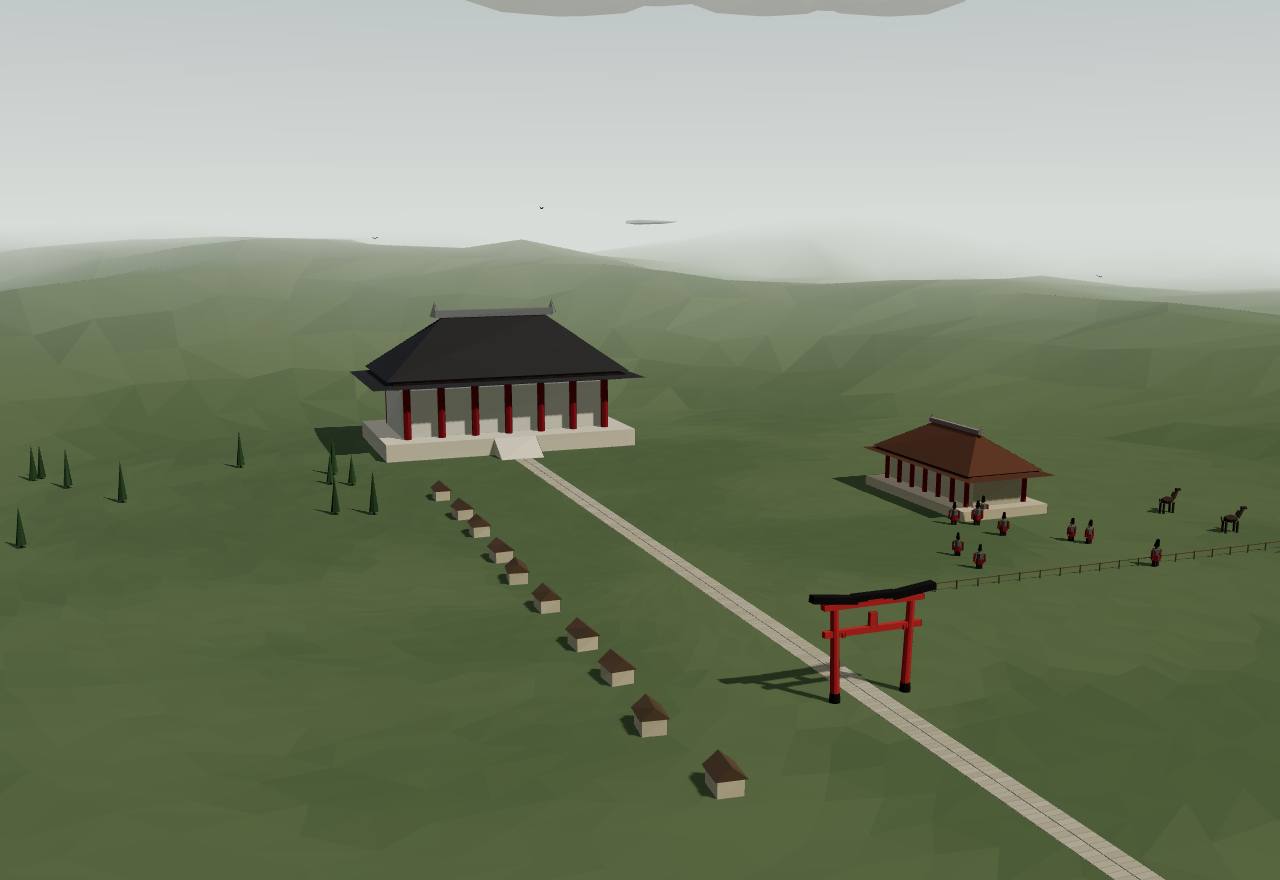
Kamakura: the shrine, the avenue and the shogun’s hall
Yoritomo governed through three boards: the samurai-dokoro (1180), which Murdoch likens to a general staff; the office for general administration set up in 1184 and called the mandokoro from 1191; and the monchūjo (1184), a court for disputes between his retainers. In 1225 the regent took the presidency of a council of fifteen or sixteen councillors, the hyōjōshū. 3,34 Consensus Texts
After Yoritomo the shoguns reigned and the Hōjō ruled. The young shogun’s maternal grandfather, Hōjō Tokimasa, “took upon himself the direction of affairs and received the title of Shikken”, which passed to his son Yoshitoki; after the last Minamoto shogun was murdered in 1219, “a puppet Commander-in-Chief, aged 2”, was brought from Kyoto. Murdoch calls the regents “the true analogues of the Merovingian Mayors of the Palace”. Of the nine shoguns at Kamakura, Papinot’s entries have five deposed. 39,34,3 Consensus Texts
Kamakura was laid out as a capital. In 1180, the shrine’s own history says, Yoritomo set up his headquarters there and moved the Hachiman shrine of his ancestors to its present site, Tsurugaoka; the avenue Wakamiya-ōji runs straight for 2 km from the beach to the shrine, “modeled after Suzaku Oji in Kyoto”. The JAANUS dictionary of Japanese art and architecture calls Kamakura, entered by seven cuttings through the hills, “the only medieval planned city constructed under the Kamakura military authorities”. 42,43 Consensus Texts
In 1232 the regent Hōjō Yasutoki issued a short code, the Goseibai shikimoku, “in order to cut off the source of frivolous suits”, as the Azuma kagami explains (our translation). It has fifty-one articles (the chronicle says fifty), was written in Chinese, and ends with an oath sworn by thirteen members of the council that they would judge without regard for kin, likes or “fear of powerful Houses”. Murdoch calls it “the Great Customary of the Kwanto”, built on fifty years of precedent. 33,34,41,3 Consensus Texts
The code was for the bakufu’s own men. Hall writes that it “had reference only to the feudal lords who had followed the fortunes” of the Minamoto and the Hōjō, and “No attempt is made to legislate for the common folk”; Murdoch adds that the bakufu declared more than once that it was meant for “its own domains and its own vassals solely”. 34,3 Consensus Texts
Women held land under the code. Hall notes “the high position of women. They were allowed to hold fiefs; and the wife could hold separately from the husband”: a childless woman could adopt an heir and pass her fief to him, as had been the rule since Yoritomo (article 23), and a wife divorced without fault kept what her husband had granted her (article 21), though a widow who remarried lost her late husband’s fief to his son (article 24). 34 Consensus Texts
The Iriki documents show the system on the ground. In 1198 an order from Kamakura is addressed “To the Ji-to and Go ke-nin of Satsuma kuni” and closes “Thus has the Lord at Kamakura commanded”; Asakawa explains that the stewards were at once office-holders and direct vassals of the shogun, owing police duty and war service under the provincial shugo, and that the shogun’s confirmation of an heir’s lands came without “any oath of fealty said or any act of homage done”. 40 Consensus Texts
The bakufu met the Mongol invasions. Murdoch, working from Japanese, Korean and Chinese records, counts in 1274 about 26,000 Mongol troops with 15,000 Korean soldiers and 8,000 sailors in 900 vessels, landing at Hakata in November; in 1281 a fleet from Korea and a far larger one from southern China, reported at 100,000 men, until a storm on 15 August ended the attempt. Papinot credits storms both times. Thomas Conlan, reading the scrolls of the vassal Takezaki Suenaga, argues, as his reviewer reports, that the invaders were smaller and the Japanese more capable than the story of divine winds allows. 3,39,44 Debated Texts Read more: The other side: Qubilai’s Yuan
Ishii Susumu dates the bakufu’s turn from Hōjō Tokiyori’s death in 1263, which ended the regents’ “Golden Period”; cultivators rose against stewards and estate holders, and the Kantō records Murdoch trusts end in 1266. In 1333 Nitta raised his standard against the Hōjō on his estates in Kōzuke and marched on Kamakura; the city fell in early July by Murdoch’s reckoning, and the former regent Takatoki “and nearly three hundred of his kinsmen and followers committed harakiri”. 45,3 Consensus Texts
How power worked Feudal monarch · Appointment · Written law
How power worked
- Who rules
- Feudal monarch Debated
Why?
- How chosen
- Appointment Debated
Why?
- Limits on power
- Written law Consensus
Why?
- Scale
- Territorial state Debated
Why?
- Claim to rule
- Force Debated
Why?
- Who has a say
- A narrow elite Consensus
Why?
The code of 1232, article by article
Data: the Goseibai shikimoku in Hall’s 1906 translation, with the Japanese text
The code has 51 articles in Hall’s translation and in the Gunsho ruijū text (the Azuma kagami’s entry for the day it was finished says 50). The articles were never numbered in use: the numbers are a modern editor’s. Choose a subject to see what the regents legislated about; an article can sit under two subjects. 34,41,33
Showing all 51 articles in a scrolling list; open an article to read it.
-
Art. 1 Shrines and worship
The Shrines of the gods must be kept in repair; and their worship performed with the greatest attention.
一可修理神社専祭祀事。
“the established sacrifices to them must not be allowed to deteriorate; and there must be no remissness in paying ceremonial honours to them as if they were present”
Hall 1906, p. 17; Japanese: Gunsho ruijū text on Wikisource. 34,41
-
Art. 2 Temples and services
(Buddhist) Temples and pagodas must be kept in repair and the Buddhist services diligently celebrated.
“In case the incumbent does what he pleases with the income of the temple benefice or covetously misappropriates it, … the offender shall be promptly dismissed, and another incumbent appointed.”
Hall 1906, p. 18. 34
-
Art. 3 Duties of Protectors
Of the duties devolving on Protectors in the Provinces.
一諸國守護人奉行事。
“In the time of the august Right General’s House it was settled that those duties should be the calling out and despatching of the Grand Guard for service at the capital, the suppression of conspiracies and rebellion and the punishment of murder and violence”
Hall 1906, p. 18–19; Japanese: Gunsho ruijū text on Wikisource. 34,41
-
Art. 4 Oppression by Protectors
Of Protectors omitting to report cases of crime and confiscating the successions to fiefs, on account of offences.
“arbitrarily pronounce the escheat of the criminal’s heriditaments, and selfishly cause them to be confiscated. Such unjust judgments are a nefarious artifice for the indulgence of license.”
Hall 1906, p. 19–20. 34
-
Art. 5 Defalcations of Land-Reeves
Of Land-Reeves in the provinces detaining a part of the assessed amounts of the rice-tax.
一諸國地頭令抑留年貢所當事。
“If a plaint is instituted by the lord of the Manor alleging that a Land Reeve is withholding the land-tax payable to him, a statement of account will be at once taken”
Hall 1906, p. 20–21; Japanese: Gunsho ruijū text on Wikisource. 34,41
-
Art. 6 Judicature of Governors and lords
Governors of provinces and Manorial Houses may exercise their normal jurisdiction without referring to the Kwanto (authorities).
“In cases where jurisdiction has heretofore been exercised by the Governor’s Yamens, by lords of Manors, by Shinto Shrines or by Buddhist Temples on the footing of lords of Manors, it will not be necessary for us now to introduce interference.”
Hall 1906, p. 21. 34
-
Art. 7 Recent grants of fiefs confirmed
Whether the fiefs which have been granted since the time of Yoritomo by the successive Shogun’s and by Her Ladyship the Dowager (Masako) are to be revoked or exchanged in consequence of suits being brought by the original owners.
“Such fiefs having been granted as rewards for distinguished merit in the field, or for valuable services in official employment, have not been acquired without just title.”
Hall 1906, p. 21–22. 34
-
Art. 8 Claims to fiefs barred by proscription
Of fiefs which, though deeds of investiture are held, have not been had in possession through a series of years.
一雖帶御下文不令知行。經年序所領事。
“if more than twenty years have elapsed since the present holder was in possession his title is not to be enquired into and no change can be made: following herein the precedent of the time of the Yoritomo house”
Hall 1906, p. 23; Japanese: Gunsho ruijū text on Wikisource. 34,41
-
Art. 9 Rebellious plots
Of plotters of treason.
“The purport of the provision relating to such persons cannot well be settled beforehand. In some cases, precedent is to be followed; in others, such action should be taken as the particular circumstances may require.”
Hall 1906, p. 23. 34
-
Art. 10 Responsibility for homicide, etc.
Of the crimes of killing, maiming and wounding: furthermore, whether parents and children are to be held mutually responsible for each other’s guilt.
“shall be punished in his own person by death or else by banishment or by confiscation of his investiture; but his father, or his son, unless they have actually been accomplices, shall not be held responsible.”
Hall 1906, p. 23–24. 34
-
Art. 11 Wife not responsible for husband’s crime
Whether in consequence of a husband’s crime the estate of the wife is to be confiscated or not.
“In cases of serious crime, treason, murder and maiming, also dacoity, piracy, night-attacks, robbery and the like, the guilt of the husband extends to the wife also.”
Hall 1906, p. 24. 34
-
Art. 12 Abusive language
Of abusive language.
“Quarrels and murders have their origin in abusive and insulting language. In grave cases the offender shall be sent into banishment, in minor cases, ordered into confinement.”
Hall 1906, p. 24. 34
-
Art. 13 Assaults
Of the offence of striking (or beating) a person.
“if the offender be a Samurai, his fief shall be confiscated; if he has no fief he shall be sent into banishment: persons of lower rank, servants, pages and under, shall be placed in confinement.”
Hall 1906, p. 24. 34
-
Art. 14 Principal’s responsibility for Deputy
When a crime or offence is committed by Deputies, whether the principals are responsible.
“if the master in order to shield the Deputy reports that the latter is not to blame, and the truth is afterwards found out, incriminating him, the former cannot escape responsibility and accordingly his fief shall be confiscated.”
Hall 1906, p. 24–25. 34
-
Art. 15 Forgery
Of the crime of forgery.
“If a Samurai commits the above, his fief shall be confiscated; if he has no investiture he shall be sent into exile. If one of the lower class commits it, he shall be branded in the face by burning.”
Hall 1906, p. 25–26. 34
-
Art. 16 lands confiscated for the Shokiu Disturbance
Of the lands which were confiscated at the time of the military disturbance of Shokyu (1219–1221).
“Seeing that the time for severity has now gone by, in their case the utmost generosity will be exercised, and a slice only of their estates, amounting to one fifth, is to be confiscated.”
Hall 1906, p. 26–27. 34
-
Art. 17 Fathers’ and sons’ responsibility for the Shokiu Disturbance
As regards the guilt of those who took part in the battle on the same occasion, a distinction is to be made between fathers and sons.
“Why should one generation be confounded with the other as regards guilt?”
Hall 1906, p. 27. 34
-
Art. 18 Grants to daughters revocable
Whether, after transferring a fief to a daughter, parents may or may not revoke the transfer on account of a subsequent estrangement.
“A set of doctrinaires aver that though the two sexes are distinct as regards denomination, there is no difference between them as regards parental benefactions … In case a daughter shows any unsteadiness of behaviour, the parents ought to be able to exercise their own discretion”
Hall 1906, p. 27–28. 34
-
Art. 19 Ungrateful dependent kinsmen
Of kinsmen, whether near or distant, who having been reared and supported, afterwards turn their backs on the descendants of their original masters.
“the fiefs which were so assigned to them are to be taken from them and given back to the descendant of the original holder.”
Hall 1906, p. 29–30. 34
-
Art. 20 Successors predeceasing parents
Of the succession to a fief when the child, after getting the deed of assignment, predeceases the parents.
“Even when the child is alive, what is to hinder the parents from revoking the assignment?”
Hall 1906, p. 30. 34
-
Art. 21 Assignments to wives made before divorce
Whether when a wife or concubine, after getting an assignment from the husband, has been divorced, she can retain the tenure of the fief or not.
“if the wife in question had a virtuous record and was innocent of any fault and was discarded by reason of the husband’s preference for novelty, the fief which had been assigned to her cannot be revoked.”
Hall 1906, p. 30. 34
-
Art. 22 Disinheriting adult sons
Of parents who when making a disposition of their fief pass over a grown up son whose relationship has not been severed.
“for the wife’s son who has now arrived at manhood one fifth of the fief must be cut off and assigned as his share to any older brother who is without sufficient means.”
Hall 1906, p. 30–31. 34
-
Art. 23 Adoptions by women
Of the adoption of heirs by women.
一女人養子事。
“since the time of the General of the Right (Yoritomo) down to the present day it has been the invariable rule to allow women who had no children of their own to adopt an heir and transmit the fief to him.”
Hall 1906, p. 31; Japanese: Gunsho ruijū text on Wikisource. 34,41
-
Art. 24 Fiefs of widows who marry again
Whether a widow who has succeeded to her husband’s fief and who marries again should continue to hold it.
“if any such, soon forgetting their conjugal constancy marry again, the fief held by their late husband is to be granted to the husband’s son.”
Hall 1906, p. 31. 34
-
Art. 25 Kwanto vassals marrying into noble families
Of vassals in the Kwanto who married their daughters to Court nobles and assigned fiefs to them, thereby diminishing the sufficiency of the public services.
一關東御家人以月卿雲客爲聟君。依讓所領公事足(アシ)减少事。
“although they were assigned to daughters and thus became alienated, nevertheless the assessment for public services must be imposed thereon in accordance with the holders’ rank and standing.”
Hall 1906, p. 32; Japanese: Gunsho ruijū text on Wikisource. 34,41
-
Art. 26 Assignments revocable as between sons
Of revoking an assignment to one son, after a Government patent of assurance has been granted and then making the assignment to another son.
“if the father changes his mind and decides to assign the fief to another son, it is the subsequent decision which is to take effect”
Hall 1906, p. 32. 34
-
Art. 27 Vacant fiefs
Of fiefs the successions to which have not yet been dealt with.
“These should be distributed when suitable occasions offer, due regard being had in each case to the extent of service rendered and after testing the abilities (of the several claimants).”
Hall 1906, p. 32. 34
-
Art. 28 Slander
Of trumping up false statements and instituting slanderous suits.
“If a slanderous accusation is made in the expectation of getting a fief, the fief of the slanderer must be given to the person slandered.”
Hall 1906, p. 33. 34
-
Art. 29 Champerty and maintenance
Of passing over the proper magistrate and having recourse to different persons in order to trump up a law suit.
“If when a suit is brought before him, a magistrate is neglectful and allows twenty days to pass without his taking any action in the matter, the parties may make an application to the Courthouse”
Hall 1906, p. 33. 34
-
Art. 30 Tampering with judicature
Of a party to a pending suit who, instead of awaiting the judgment, sends in a letter from a person high in authority.
“the successful party exults in winning the case by the strength of his powerful connection, whilst the losing side grieves over the influence wielded by those high in office and position.”
Hall 1906, p. 33–34. 34
-
Art. 31 Unsuccessful suitors reviling magistrates
Of persons who, not having justice on their side and therefore failing in their suits, accuse the Magistrate of partiality.
“he shall be punished by the confiscation of one-third of his fief. If the offender has no investiture he is to be expelled from the locality.”
Hall 1906, p. 34. 34
-
Art. 32 Harbouring outlaws
Of harbouring brigands and bands of evil-doers within a fief.
“if Land-Reeves are found allowing gangs of brigands to find refuge in their districts, they will be held to be equally guilty.”
Hall 1906, p. 34–35. 34
-
Art. 33 Robbery, larceny and arson
Of robbing and theft; also of incendiaries.
“For the two kinds of stealing the punishment (death) is already established by precedents.”
Hall 1906, p. 35. 34
-
Art. 34 Adultery
Of illicit intercourse with another person’s wife.
“Whoever embraces another person’s wife is to be deprived of half of his fief … A woman who commits adultery shall in like manner be deprived of her fief”
Hall 1906, p. 35. 34
-
Art. 35 Contempt of judicial Summons
Of persons not coming up (to Kamakura) after being repeatedly summoned in a suit.
“When a plaint has been instituted and the defendant has been thrice served with a summons to appear and plead, if he does not come and abide judgment, the plaintiff, if he has right on his side, shall forthwith obtain judgment”
Hall 1906, p. 36. 34
-
Art. 36 Altering land-marks
Of altering ancient land-marks and so engendering disputes.
“a surveyor must be sent to the locality in question to investigate accurately the boundaries and proofs”
Hall 1906, p. 36. 34
-
Art. 37 Coveting appointments from Nobles
Of vassals of the Kwanto applying to Kyoto for side offices and for the superintendentships of estates.
“This practice was strictly forbidden in the time of the Minamoto House. … Henceforth anyone found indulging in such ill-regulated ambition shall be punished by the escheating of the whole of his fief.”
Hall 1906, p. 36–37. 34
-
Art. 38 Land-Reeves oppressing villeins’ headmen
Of Land-Reeves hindering the functions of the village Headmen within the limits of their charge.
“an Instruction will be issued to the village Headman empowering him to pay the taxes to the Government direct (i.e. passing over the Land-Reeve altogether).”
Hall 1906, p. 37. 34
-
Art. 39 Kwanto the avenue for official promotion
That those desirous of obtaining office or rank must have a written recommendation from the Kwanto.
“As to applications for recommendations by persons who merely desire their own advancement they are strictly prohibited altogether, whether from high or low.”
Hall 1906, p. 37–38. 34
-
Art. 40 Kwanto the avenue for clerical advancement
Of Buddhist clergy within the Kamakura Domain striving at their own option to obtain ecclesiastical positions and rank.
“if any one should in future apply for preferment without first having received our permission he shall, if he be the incumbent of a temple or shrine, be deprived of his benefice.”
Hall 1906, p. 38. 34
-
Art. 41 Slaves and miscellaneous persons
Of Slaves and unclassed persons.
一奴婢雜人事。
“if more than ten years have elapsed without the former owner having asserted his claim, there shall be no discussion as to the merits of the case and the possession of the present owner is not to be interfered with.”
Hall 1906, p. 38–39; Japanese: Gunsho ruijū text on Wikisource. 34,41
-
Art. 42 Molestation of migrating farmers
Of inflicting loss and ruin on absconding farmers under the pretext of smashing runaways.
“And it shall be entirely at the option of the farmer himself whether he shall continue to live in the fief or go elsewhere.”
Hall 1906, p. 39. 34
-
Art. 43 Land-grabbing
Of persons falsely pretending that another’s fief is within their tenure, and greedily appropriating the produce thereof.
“the produce which has been wrongfully appropriated in that way must be promptly accounted for and restored. If the aggressor be the holder of a fief it shall be escheated.”
Hall 1906, p. 39. 34
-
Art. 44 Scrambling for fiefs
Of eager rivalries when a companion has incurred guilt and others covet his investiture before his case has been decided.
“before the degree of guilt has been ascertained, the hope of getting the fief in question should engender the desire to condemn the man is not what can be deemed a righteous mode of proceeding.”
Hall 1906, p. 40. 34
-
Art. 45 Punishing without investigating
When a report is made of some offence having been committed, of relieving a man of his post without investigating the matter.
“there must be prompt and thorough investigation in such cases before deciding one way or the other.”
Hall 1906, p. 40. 34
-
Art. 46 Rights of incoming and retiring Governors
Of the respective limits of judicature of the incoming and outgoing Governor of a province on the occasion of an exchange of fiefs.
“In such cases the new Governor shall have adjudication as regards the annual rice-tax revenue”
Hall 1906, p. 40–41. 34
-
Art. 47 Attempts at commendation
Of making a present to another person of documents of a fief not in one’s possession: Furthermore; of village headmen making presents to influential Houses without the cognizance of the lord.
“Henceforth those who make such presents shall be sent away bodily; those who receive them shall be fined for the benefit of the Shrines and temples repair fund.”
Hall 1906, p. 41. 34
-
Art. 48 Buying and selling fiefs
Of buying and selling fiefs.
“for them to buy and sell such at their own pleasure is a proceeding that is by no means blameless. … both the sellers and the buyers shall be equally dealt with as guilty.”
Hall 1906, p. 41–42. 34
-
Art. 49 Summary adjudication
Of holding a formal trial in a suit when it is quite clear on the face of the documents that one of the parties has no case.
“adjudication may be given at once without confronting the parties at a formal hearing.”
Hall 1906, p. 42. 34
-
Art. 50 Accessories in brawls
Of persons who, when a disorderly incident occurs, proceed to the scene of the affray without knowing the particulars.
“As regards the gravity of their offence it is impossible to lay down a rule beforehand. The circumstances of each case must be taken into consideration.”
Hall 1906, p. 42. 34
-
Art. 51 Abuse of legal process
Of disorderly behaviour by persons holding a writ of summons or a Decree in a suit.
“if the writ is made use of as a ground for disorderly behaviour, such malicious truculence must be held to involve culpability.”
Hall 1906, p. 42. 34
The councillors’ oath (Jōei 1 (1232), 7th month, 10th day)
13 members of the council signed it, the regent Yasutoki and his colleague Tokifusa among them: “there shall be no regard for ties of relationship, there shall be no giving-in to likes or dislikes, but in whatever direction reason pushes and as the inmost thought of the mind leads, without regard for companions or fear of powerful Houses, we shall speak out.” And: “If a mistake is made in the matter, it shall be the error of the whole Council acting as one.” 34,41,3
Who made the shogun, and who made the regent?
Data: Papinot’s dictionary, Hall and Murdoch
9 shoguns and 11 regents at Kamakura, as Papinot’s dictionary dates them. After the third shogun was murdered in 1219 the shoguns were Fujiwara boys and imperial princes: 5 of the 9 were chosen or put in by the Hōjō, and 5 of the 9 were deposed. The regency stayed in the Hōjō family; 4 regents gave it up, three of them by taking the tonsure, and Murdoch says Tokiyori and Sadatoki went on directing affairs afterwards. 39,37,34,3
20 accessions: 1 invested by the court, 11 succeeded a kinsman, 8 chosen by the hōjō; median reign 15 years. Ended: 6 died in office, 6 deposed, 2 killed, 5 abdicated, 1 conquered.
Marks at the end of a bar: ○ died in office · × killed · ▽ deposed · | abdicated · □ conquered
Show the table: Shoguns and regents at Kamakura, 1192–1333
| Ruler | Years | Came to power | Reign ended | Source |
|---|---|---|---|---|
| Shogun Minamoto Yoritomo | 1192 CE – 1199 CE | Invested by the court | died in office (The emperor Go-Toba bestowed the title (Papinot); Hall: “1199. Death of Yoritomo, aged 53.”) | 37,39,34 |
| Shogun Minamoto Yoriie | 1202 CE – 1203 CE | Succeeded a kinsman | deposed (Yoritomo’s son, named shogun in 1202 (Hall counts from 1199); forced by his grandfather Tokimasa to give up the office, he “was ordered to shave his head and was confined in Shuzenji (Izu), where Tokimasa had him assassinated the following year”.) | 39,34 |
| Regent Hōjō Tokimasa | 1203 CE – 1205 CE | Succeeded a kinsman | deposed (The young shogun’s maternal grandfather “took upon himself the direction of affairs and received the title of Shikken”; a plot was discovered and he “was exiled (1205)”.) | 39,3 |
| Shogun Minamoto Sanetomo | 1203 CE – 1219 CE | Succeeded a kinsman | killed (Yoriie’s brother, put in by Tokimasa; “assassinated by his nephew Kugyō, son of Yoriie”, ending the Minamoto line.) | 39,34 |
| Regent Hōjō Yoshitoki | 1205 CE – 1224 CE | Succeeded a kinsman | died in office (Tokimasa’s son. Papinot writes that he was “assassinated by a servant of the imperial Court”; no other source read says so.) | 39 |
| Regent Hōjō Yasutoki | 1224 CE – 1242 CE | Succeeded a kinsman | died in office (Yoshitoki’s son (Hall dates his succession 1225); the author of the code of 1232.) | 39,34 |
| Shogun Fujiwara Yoritsune | 1226 CE – 1244 CE | Chosen by the Hōjō | abdicated (Brought from Kyoto as a child, “a puppet” with the Hōjō in control (Hall); “In 1244, he transferred the shogunate to his son Yoritsugu.”) | 39,34 |
| Regent Hōjō Tsunetoki | 1242 CE – 1246 CE | Succeeded a kinsman | abdicated (Yasutoki’s grandson; “Having become ill, he abdicated in favor of his brother Tokiyori and died soon afterwards.”) | 39,3 |
| Shogun Fujiwara Yoritsugu | 1244 CE – 1252 CE | Succeeded a kinsman | deposed (Tokiyori “deposed the young Shogun (1252) and replaced him by Munetaka-shinnō, a son of the emperor Go-Saga”.) | 39 |
| Regent Hōjō Tokiyori | 1246 CE – 1256 CE | Succeeded a kinsman | abdicated (“In 1256, his health failed. He shaved his head … and retired”; Murdoch says he still held the reins until his death in 1263.) | 39,3 |
| Shogun Prince Munetaka | 1252 CE – 1266 CE | Chosen by the Hōjō | deposed (An emperor’s son chosen by Tokiyori; when a plot became known “he was deposed and confined in the Rokuhara (Kyoto)”.) | 39 |
| Regent Hōjō Nagatoki | 1256 CE – 1264 CE | Chosen by the Hōjō | died in office (Tokiyori let Nagatoki “govern in the name of his son Tokimune”; he died aged 35.) | 39 |
| Regent Hōjō Tokimune | 1256 CE – 1284 CE | Succeeded a kinsman | died in office (Tokiyori resigned the regency in his favour in 1256, but Nagatoki governed for him until 1264; regent through both Mongol invasions, he “died soon after at the age of 34”.) | 39 |
| Shogun Prince Koreyasu | 1266 CE – 1289 CE | Chosen by the Hōjō | deposed (Put in by Tokimune at the age of three in his father’s place; “He was deposed by Hōjō Sadatoki and retired to Saga near Kyoto.”) | 39 |
| Regent Hōjō Sadatoki | 1284 CE – 1301 CE | Succeeded a kinsman | abdicated (Tokimune’s son; “In 1301, he had his head shaved … and retired”, though Murdoch says he still directed policy.) | 39,3 |
| Shogun Prince Hisaakira | 1289 CE – 1308 CE | Chosen by the Hōjō | deposed (Chosen by Sadatoki; “Having in his turn displeased the powerful Shikken, he was deposed and replaced by his son”.) | 39 |
| Regent Hōjō Morotoki | 1301 CE – 1311 CE | Chosen by the Hōjō | died in office (Named regent when Sadatoki retired (his son-in-law, says Papinot; his younger brother, says Murdoch); regent “at his death (1311)”.) | 39,3 |
| Shogun Prince Morikuni | 1308 CE – 1333 CE | Chosen by the Hōjō | conquered (Put in at seven in place of his deposed father; “After the destruction of the Hōjō he became bonze and died the same year.”) | 39 |
| Regent Hōjō Takatoki | 1311 CE – 1326 CE | Succeeded a kinsman | abdicated (Sadatoki’s son, “then only 8 years old”; in 1326 he fell ill and “entered religion”, and in 1333 killed himself with his kinsmen when Kamakura fell.) | 39,3 |
| Regent Akabashi Moritoki | 1326 CE – 1333 CE | Chosen by the Hōjō | killed (Made joint regent after Takatoki’s retirement; defeated in 1333, he “put an end to his life”.) | 39,3 |
Left out (4): Hōjō Masamura, named by Papinot as regent with no dates 39 ; Kanazawa Sadaaki and Hōjō Yasuie, regents in 1326 who “threw up their offices in a few weeks” 3 ; Hōjō Koresada, Moritoki’s joint regent 3 ; Princes Morinaga and Narinaga, named shogun by the emperor Go-Daigo in 1333 and 1334, after the Hōjō fell 39 .
1333 CE – 1467 CE
The Ashikaga shogunate
The emperor Go-Daigo destroyed the Kamakura regents in 1333 and tried to rule himself; within three years the Ashikaga had taken Kyoto and set up a second shogunate there, beside a court split in two for nearly sixty years.
Terms: Japan: from the ritsuryō state to the shogunates: The Ashikaga shogunate
- kanrei the shogun’s chief minister from 1367, “the Shikken of Kamakura under a new name” (Murdoch), but held in turn by several great houses 3
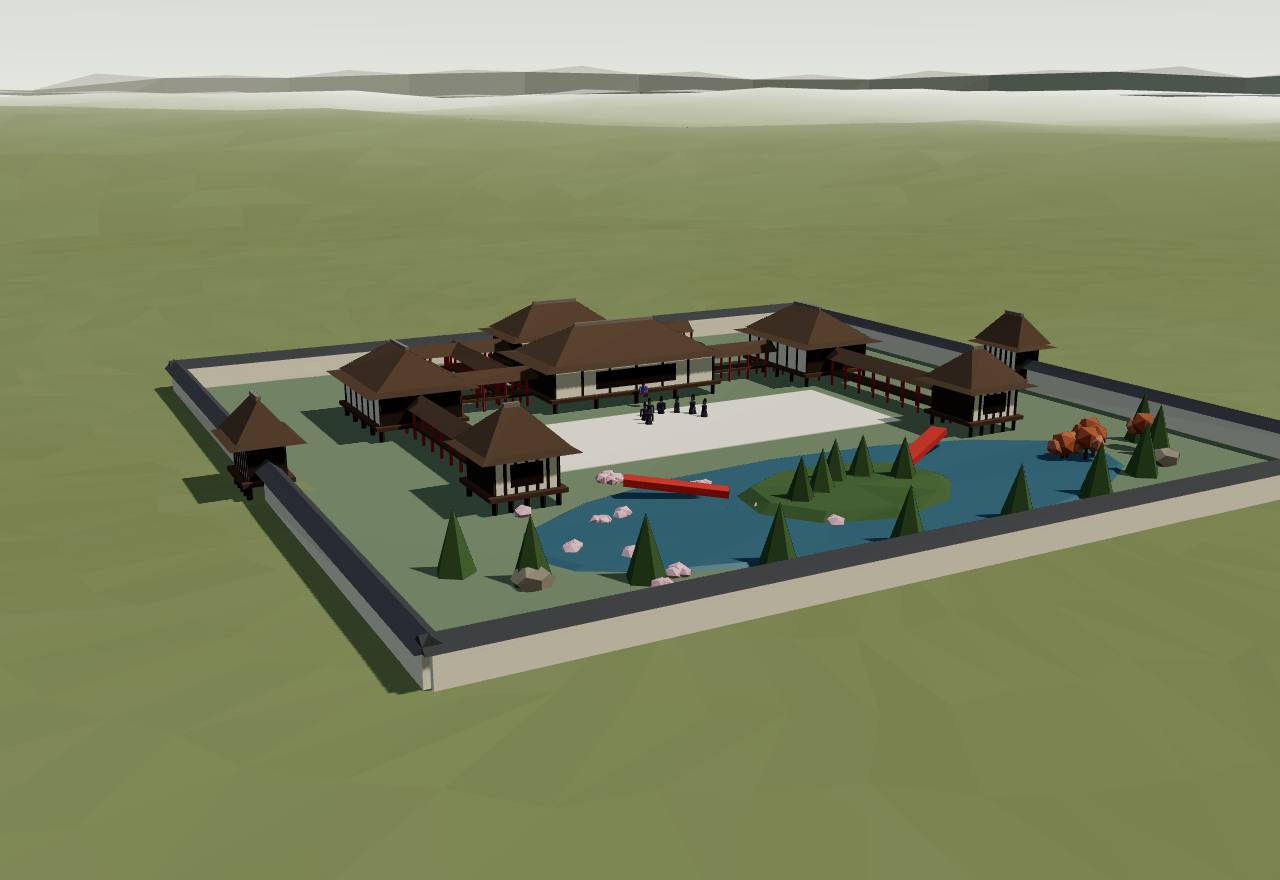
The Flower Palace: the shogun’s mansion at Muromachi
Go-Daigo’s restoration of 1333 tried to undo the warrior age. Murdoch sums up the courtiers’ programme as “Back to Engi!”, a return to the tenth century now that there had been “a clean sweep of Kamakura, the Rokuhara, Shogun, Shikken, Bakufu, and all”; the emperor the Hōjō had set up, Kōgon, was not deposed, since “the theory was that he had never reigned”. Go-Daigo conferred the title of shogun on Prince Morinaga; according to the Taiheiki, estates were “lavishly granted to worthless intriguers”, though Murdoch warns that the Taiheiki “is no history; it is mostly a romance”. 3,39 Debated Texts
The second military government, John Whitney Hall writes, “was founded between 1336 and 1338 by Ashikaga Takauji”; its name comes from the Muromachi district of Kyoto where the Ashikaga residence and headquarters stood after 1378. Like the Hōjō, its founders began with a short code, the Kemmu shikimoku of seventeen articles, drawn up by former councillors of the Kamakura bakufu (1336 in Murdoch, 1335 in Hall). 5,3,34 Consensus Texts
The throne split into two lines: “For nearly 60 years, there were two emperors at the same time”, Papinot writes, until the schism “which for 56 years had divided the country into two hostile camps” ended in 1392. Murdoch calls the years from 1337 to 1392 the great succession wars. 39,3 Consensus Texts
From 1367 the shogun’s first minister was called kanrei, which Murdoch calls “in most respects … the Shikken of Kamakura under a new name”, with one difference: the office “was not hereditary in a single family as that of the Shikken had been in the house of the Hōjō”. The provincial governors (shugo) kept the Kamakura duties of punishing murderers, putting down rebellion and sending men for guard duty, and gained jurisdiction over land, Imatani Akira writes. 3,47 Consensus Texts
The third shogun, Yoshimitsu, built his residence on Muromachi street in Kyoto, known as the Flower Palace (Hana no gosho): the Japan Tourism Agency dates it to 1379, and in the spring of 1381 he received the emperor there, his first cousin, Matthew Stavros writes. Excavation in 2020 found that its garden pond measured about 45 m north–south and more than 60 m east–west. Yoshimitsu took the highest court rank and the post of Chancellor, and the Ming emperor addressed him as “King of Japan”. 48,49,50,3 Consensus Texts Excavation
Stavros argues that the Ashikaga did not reject court ways but “embraced and celebrated them”: “By maintaining shinden style and faithfully observing Ritsuryo customs, Ashikaga shoguns authenticated their status as vested members of the imperial hierarchy.” For Adolphson, as Ruppert reports, it was Yoshimitsu who gave the “final blow to cooperative rulership” between court, temples and warriors. 49,29 Debated Texts
Shoguns were made and unmade by the great houses. Murdoch notes that “no fewer than eleven” of the fifteen Ashikaga shoguns were minors when they were named; the sixth, Yoshinori, a monk brought back to the world as successor, was murdered at a feast in 1441 by Akamatsu Mitsusuke, whose lands he had meant to give away. 3,39 Consensus Texts
Seshat codes the Ashikaga period with 12.5 million people in 1400 and 17 million in 1500, a capital of about 150,000 until the mid-fifteenth century, six or seven levels of administration, constraints on the ruler both from within the government and from outside it, and only “nominal allegiance” from the provinces. Seshat Consensus Survey
How power worked Feudal monarch · Heredity · Written law
How power worked
- Who rules
- Feudal monarch Debated
Why?
- How chosen
- Heredity Debated
Why?
- Limits on power
- Written law Debated
Why?
- Scale
- Territorial state Debated
Why?
- Claim to rule
- Law Debated
Why?
- Who has a say
- A narrow elite Consensus
Why?
Fifteen Ashikaga shoguns: who put them in, and how they left
Data: Papinot’s list of the shoguns and his entries
16 terms of office from 1338 to 1573 (Yoshitane held it twice). Before the Ōnin war 6 of 8 shoguns followed a father or brother, often when he abdicated; after 1467, 5 of 8 were put in by a warlord’s army. 5 terms ended in abdication, 4 in deposition and 2 in a violent death. 37,39
16 accessions: 1 invested by the court, 8 succeeded a kinsman, 2 chosen by the great lords, 5 installed by a warlord; median reign 14 years. Ended: 5 died in office, 4 deposed, 2 killed, 5 abdicated.
Marks at the end of a bar: ○ died in office · × killed · ▽ deposed · | abdicated · □ conquered
Show the table: The Ashikaga shoguns, 1338–1573
| Ruler | Years | Came to power | Reign ended | Source |
|---|---|---|---|---|
| Takauji | 1338 CE – 1358 CE | Invested by the court | died in office (Nominated in 1338 after taking Kyoto; “He died of a cancer in 1358, leaving his power to his son Yoshiakira.”) | 37,39,5 |
| Yoshiakira | 1358 CE – 1367 CE | Succeeded a kinsman | abdicated (“Finally, overcome by illness, he abdicated in favor of his son Yoshimitsu then only 10 years old.”) | 37,39 |
| Yoshimitsu | 1367 CE – 1395 CE | Succeeded a kinsman | abdicated (Abdicated in favour of his nine-year-old son Yoshimochi (1395 in Papinot’s table; his entry implies 1394).) | 37,39 |
| Yoshimochi | 1395 CE – 1423 CE | Succeeded a kinsman | abdicated (“In 1423, he abdicated in favor of his son Yoshikazu and became a bonze”; he took the power back when Yoshikazu died.) | 37,39 |
| Yoshikazu | 1423 CE – 1425 CE | Succeeded a kinsman | died in office (Shogun at 17 “by the abdication of his father Yoshimochi in 1423, and died two years afterwards”.) | 37,39 |
| Yoshinori | 1428 CE – 1441 CE | Chosen by the great lords | killed (A monk brought back to be Yoshimochi’s successor; Akamatsu Mitsusuke “invited Yoshinori to a feast, and had him assassinated in the middle of the entertainment (1441)”.) | 37,39 |
| Yoshikatsu | 1441 CE – 1443 CE | Succeeded a kinsman | died in office (Yoshinori’s son, shogun at eight; died two years later in a fall.) | 37,39 |
| Yoshimasa | 1449 CE – 1474 CE | Succeeded a kinsman | abdicated (His brother, aged eight (Papinot’s table has him nominated in 1449, his entry from 1443); abdicated in favour of his nine-year-old son Yoshihisa.) | 37,39 |
| Yoshihisa | 1474 CE – 1489 CE | Succeeded a kinsman | died in office (Died of illness on campaign in Ōmi.) | 37,39 |
| Yoshitane (first time) | 1490 CE – 1493 CE | Chosen by the great lords | deposed (Adopted by his uncle Yoshimasa and his successor in 1490; driven out when the deputy Hosokawa Masamoto raised Yoshizumi in his place (1493).) | 37,39 |
| Yoshizumi | 1493 CE – 1508 | Installed by a warlord | deposed (Raised by Hosokawa Masamoto; when Yoshitane came back with an army, “Yoshizumi fled into Ōmi (1508)”.) | 37,39 |
| Yoshitane (second time) | 1508 – 1521 | Installed by a warlord | deposed (Restored by the army of Ōuchi Yoshioki; pushed out when Hosokawa Takakuni “nominated Yoshiharu … in his place”.) | 37,39 |
| Yoshiharu | 1521 – 1545 | Installed by a warlord | abdicated (Put in by Hosokawa Takakuni; “At the end he abdicated the shogunate in favor of his son Yoshiteru (1545).”) | 37,39 |
| Yoshiteru | 1545 – 1565 | Succeeded a kinsman | killed (When Matsunaga Hisahide surrounded his palace in Kyoto, he “killed himself by harakiri (1565)”.) | 37,39 |
| Yoshihide | 1568 – 1568 | Installed by a warlord | died in office (Set up by Miyoshi Yoshitsugu and Matsunaga Hisahide; “the imperial investiture was however refused”, and he “died soon afterwards, — some say of illness, others, that he was assassinated”.) | 37,39 |
| Yoshiaki | 1568 – 1573 | Installed by a warlord | deposed (Put in by Oda Nobunaga; in 1573 Nobunaga “seized the Shogun and sent him a prisoner” to Wakae in Kawachi, and the Ashikaga shogunate ended.) | 37,39,6 |
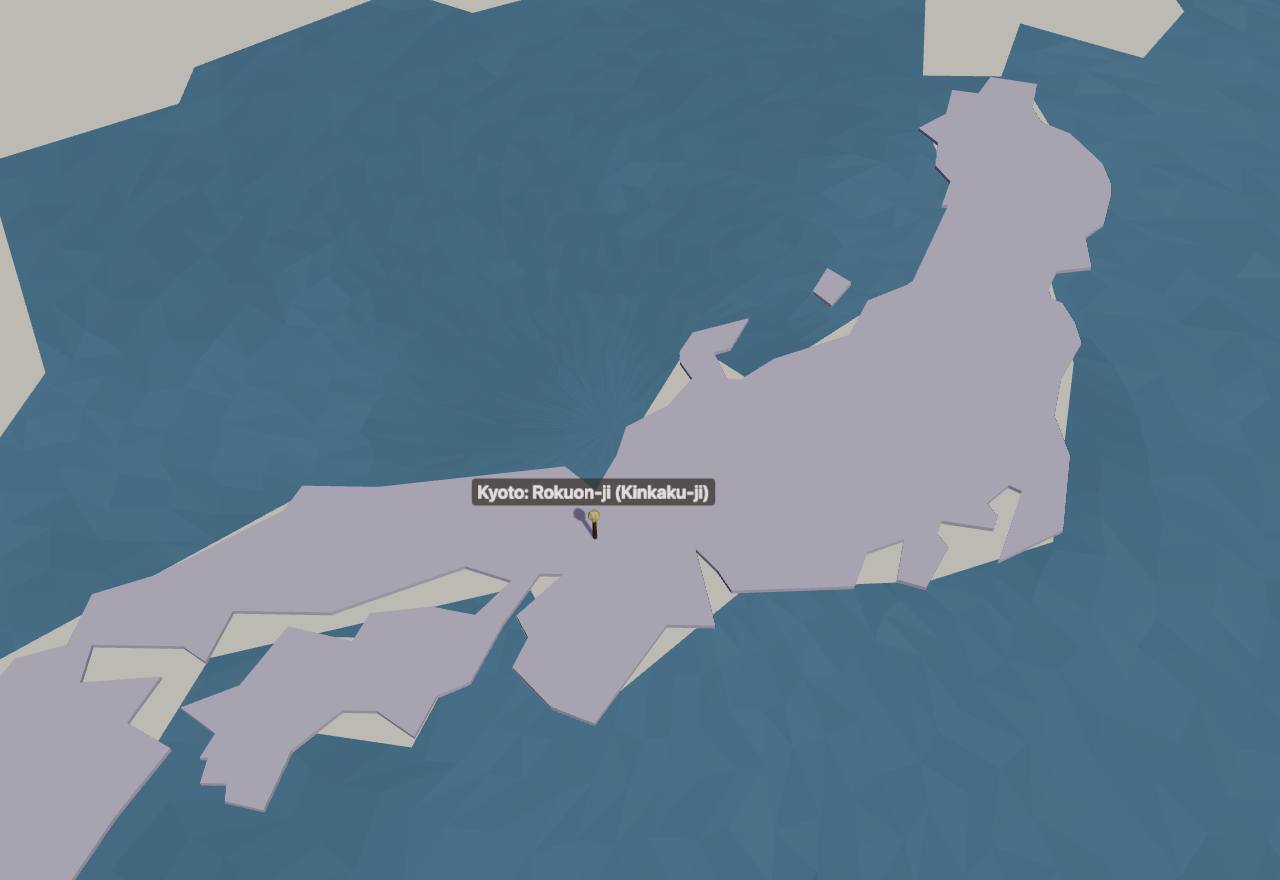
The Ashikaga shogunate, 1400
Places: 1 cited site over Cliopatria (CC BY 4.0) territories, drawn flat and low. Kyoto: Rokuon-ji (Kinkaku-ji) 22
1467 CE – 1573 CE
Warring states and leagues
After the Ōnin war the shogun’s writ stopped at the edge of Kyoto. Provinces fell to regional lords who held land by the sword and to sworn leagues of villagers, warriors and believers, one of which governed a whole province for nearly a century.
Terms: Japan: from the ritsuryō state to the shogunates: Warring states and leagues
- Sengoku jidai戦国時代 the “Warring States period”, as the JAANUS dictionary of Japanese art and architecture renders it: the age of war between the regional lords 51
The Ōnin war broke out in Kyoto in the summer of 1467 between the armies of Hosokawa and of Yamana, “the Red Monk”, camped on either side of the shogun’s offices at Muromachi; the imperial palace and the Shōkokuji temple were burned. Both leaders were dead by 1473, but the war dragged on until the winter of 1477, when the Yamana men burned their camps and left; then, Murdoch writes, the war “was now wholly transferred to the provinces”. Imatani Akira dates from it the shugo’s “increasing separation and independence from the bakufu”. 3,47 Consensus Texts
Historians call the years from 1467 to 1573, when Oda Nobunaga drove the last Ashikaga shogun, Yoshiaki, out of Kyoto, the Sengoku period, the country at war. Nobunaga had begun to use a seal reading “the realm subjected to military power” (tenka fubu), Asao Naohiro writes, “showing his intention to unite all of Japan by military power”. 6,5,52 Consensus Texts
The old powers fell with the old order. Kuroda Toshio writes that the great temple-shrine complexes kept their power “in relative independence from both aristocratic and warrior governments” throughout the medieval period, and that its decisive end “had to await Nobunaga’s burning of Enryaku-ji and Hideyoshi’s destruction of Negoro-ji”. 27 Consensus Texts
The daimyo
Regional lords who held their provinces by force, many of them former governors or their deputies, others the vassals who had pushed them out.
Terms: Japan: from the ritsuryō state to the shogunates: Warring states and leagues, The daimyo
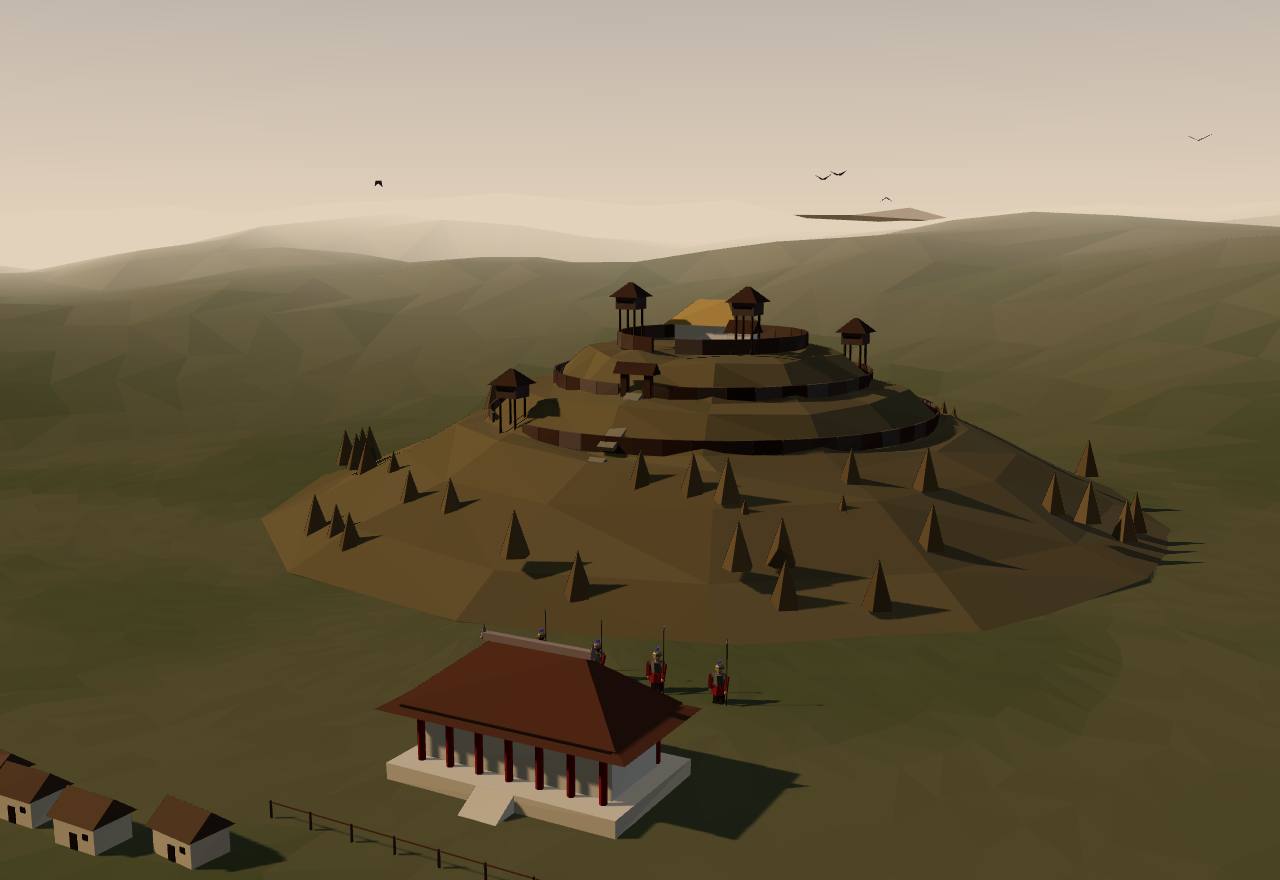
A lord’s mountain castle above his valley
Most of the sixteenth-century lords “could trace their lineages back to the Muromachi shugo or to their retainers, the deputy shugo (shugodai)”, Imatani Akira writes. John Whitney Hall calls their rise the “daimyo phenomenon”: “local military lords who first carved out their own domains and then began to war among themselves for national hegemony”. 47,54 Consensus Texts
Vassals displaced their lords. When the Ōnin war ended, Murdoch writes, the great house of Shiba had been replaced in Echizen by its former vassal Asakura, and in Owari its retainers the Oda had seized most of the province; the Shiba lingered as “a mere shadow” until 1572. 3 Consensus Texts
Some lords rose from service. Ise Shinkurō, a retainer of the Imagawa of Suruga, made himself lord of Izu, seized Odawara in 1495 and raised a castle there; as Hōjō Sōun he held the whole of Sagami by his death, and his son Ujitsuna took Edo in 1524 and went on to bring the whole Kantō under his rule. Murdoch, who calls Sōun a “land-thief”, adds that both worked hard “to establish a sound and just administration” and that samurai flocked to them from other provinces. 3 Consensus Texts
Lords bound men with written oaths sworn before the gods. In a pledge of 1481 among the Iriki documents, a vassal of the Shimazu swears that if his words are false, “the punishments of the Ten-sho Dai-zhin Gu, of Ise” and of the gods of Kumano, Hachiman, Tenman and Suwa “would be visited” on him. Asakawa notes that the shogun’s confirmations of vassals’ holdings, by contrast, carried no oath of fealty or act of homage. 40 Consensus Texts
For Asakawa the civil wars finished what Kamakura began: the rule of the country became “more completely feudalized”, and the true fief, granted for military service, arrived in Japan only after them, “five centuries after Hugh Capet’s time”. Kuroda’s school, by contrast, located the feudalization of society in the passage from the ancient to the medieval period, centuries earlier. 40,16 Debated Texts
Seshat codes Sengoku Japan at 15 million people in 1467, 17 million in 1500 and 20 million in 1568, with a largest city of about 40,000 in 1500 and 100,000 in 1550, six levels of military command and a formal legal code, but no professional soldiers or officers and no merit promotion; it codes relations between the lords as alliances. Seshat Consensus Survey
How power worked Feudal monarch · Heredity · Written law
How power worked
- Who rules
- Feudal monarch Debated
Why?
- How chosen
- Heredity Debated
Why?
- Limits on power
- Written law Debated
Why?
- Scale
- Territorial state Debated
Why?
- Claim to rule
- Force Debated
Why?
- Who has a say
- A narrow elite Consensus
Why?
Leagues sworn of one mind
Leagues bound by a common oath: of warriors, of villagers on one estate, of believers of one school. Most broke up when their aim was won; one ruled a province.
Terms: Japan: from the ritsuryō state to the shogunates: Warring states and leagues, Leagues sworn of one mind
- ikki一揆 a league or sworn community; the characters mean “one reckoning”, “one mind”. Only later did the word come to mean a revolt 17
- ichimi dōshin一味同心 “same disposition, same mind”: the unity of wills a league swore to 17
- ichimi shinsui一味神水 the sacred water into which the ashes of the burnt oath were mixed, drunk by all who swore 17
- chōsan逃散 a whole community leaving its fields together in protest 17
- Ikkō ikki一向一揆 leagues of the “single-minded” school, the True Pure Land (Jōdo shinshū) believers led from the Honganji 17,56
- Kaga加賀国 the province on the Sea of Japan that a league governed after 1488 17
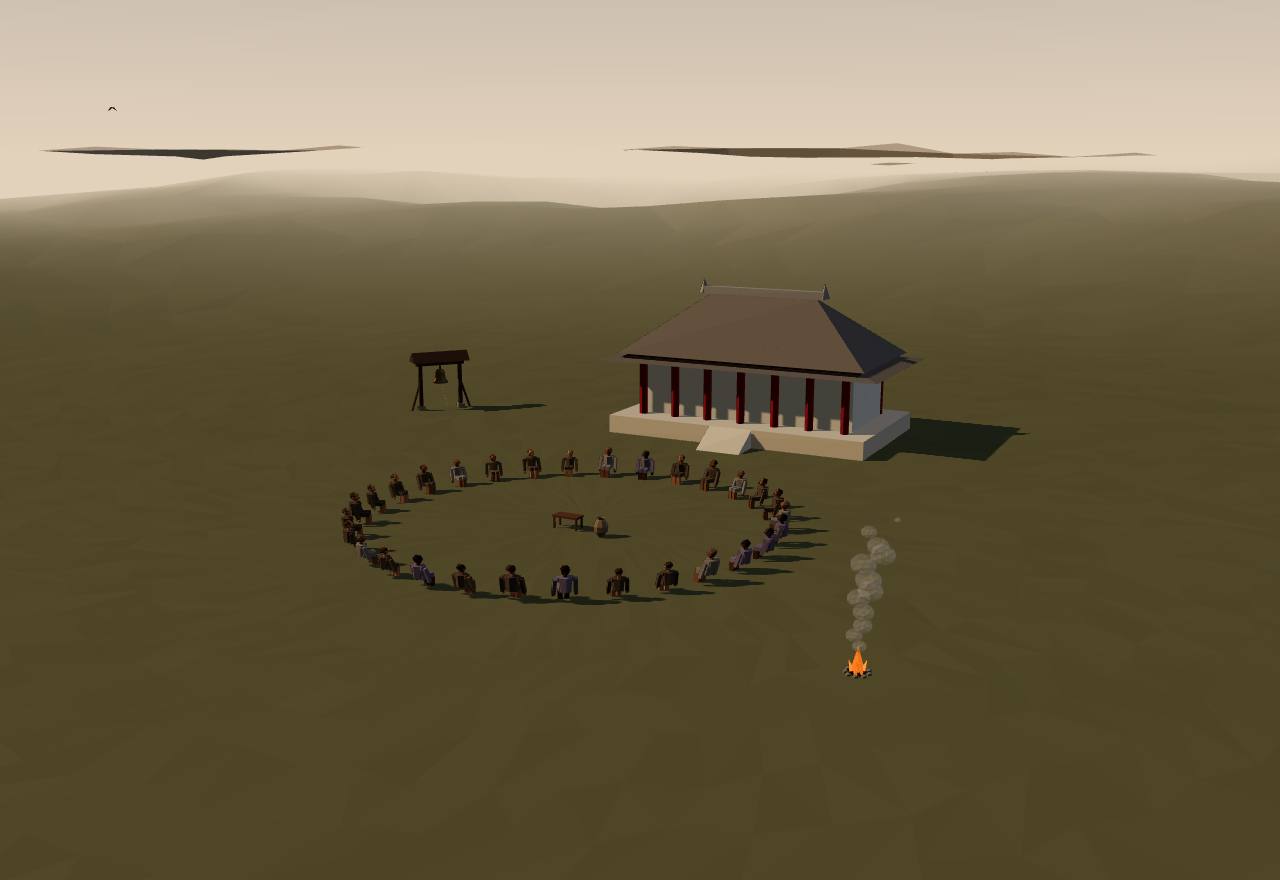
A league’s assembly before a temple hall
The characters of the word ikki “refer to the notion of being of ‘one reckoning’, of ‘one mind’”, Ferente and Satō write. The league was not tied to any one social status: there were leagues of local lords, of kinsmen, of the warriors of a province, and of the peasants of one estate, whose shared idea of being “one” cut across the gap between the richer farmers and their dependants. 17 Consensus Texts
The league was made by oath. Members could sign one written oath, burn it, mix the ashes with sacred water and drink it together “in the presence of Buddhas and kami”; the water, drunk by all, “transformed them into a collective entity invested with the specific mission detailed in the oath”. Decisions were taken in assemblies, “with more-or-less regulated meetings and procedures and more-or-less developed debate and vote”, and an ikki usually “quickly dissolved once the objective had been reached”. 17 Consensus Texts
On the estate of Yano-no-shō in Harima, held by the temple Tōji, the inhabitants rose in 1377 in a “concerted abandonment of the land”, chōsan, and declared they would never return unless the estate’s agent, Yūson, was removed; when they met to discuss it, his men attacked the meeting place. In 1428, Sugiyama writes, the first large-scale peasant uprising broke out in Ōmi. 17,6 Consensus Texts
The most durable leagues grew from the True Pure Land school. Under Rennyo, head abbot of the Honganji from 1457 to 1489, its followers multiplied. After the armed monks of Enryaku-ji destroyed his Ōtani temple in the capital in 1465 he travelled, fleeing persecution, until in 1471 he settled at Yoshizaki on the Sea of Japan coast. He won villages by converting their leaders first, and the shared belief in the equality of all in Amida’s embrace let low-ranking samurai join peasants in the same leagues. 17,6 Consensus Texts
In 1488 the Shinshū leagues of Kaga surrounded the castle of the governor, Togashi Masachika, whom they had backed in 1473; defeated, he took his own life, and “for the next ninety-three years administrative power rested in the hands of a political coalition of Jodo Shinshu adherents”, Sugiyama writes. Ferente and Satō: “for nearly a century they dominated the wealthy and vast Kaga province”, and were among Oda Nobunaga’s most dangerous opponents. The Ikkō ikki museum at Hakusan writes that Kaga became known as the “Kingdom of Peasants”, and that from 1546 the Honganji sent trusted monks to govern it from its new temple at Kanazawa (Oyama). 6,17,57 Consensus Texts
The leaders did not preach revolt. Rennyo told his followers in 1474 not to slight the provincial governors and land stewards but to meet their “public obligations in full”, taking “the laws of the state as your outer aspect” and keeping faith in their hearts; when the shogun ordered him after 1488 to expel the Kaga rebels, he sent reprimands to the temples instead. 17,6 Consensus Texts
The leagues are seen mostly through their enemies’ eyes: “Almost no written material is extant which emanates directly and autonomously from the ikki”, Ferente and Satō write, and Sugiyama notes that scholars do not agree on the leagues’ make-up or the status of their members. Even the Ikkō leagues took several forms, some spontaneous and some ordered by the Honganji’s head; in one civil war in Kaga two Honganji factions fought each other as the “large and small leagues” (daishō ikki). 17,6,56 Consensus Texts
In Europe some sworn societies became states, like the Swiss Confederation, and others were absorbed or outlawed. In Japan, Ferente and Satō write, the ikki took the last path: “under the Tokugawa regime ikki were outlawed, punished and denigrated as mere revolts, limited to the peasant class”, which is how the word came to mean an uprising. 17 Consensus Texts
How power worked Citizen assembly · Consensus · Custom and kin
How power worked
- Who rules
- Citizen assembly Debated
Why?
- How chosen
- Consensus Debated
Why?
- Limits on power
- Custom and kin Debated
Why?
- Scale
- Confederation Debated
Why?
- Claim to rule
- Ideology Debated
Why?
- Who has a say
- Male citizens Speculative
Why?
How a league bound itself and decided
Data: Ferente and Satō 2022, Sugiyama 1994 · Model, not evidence: the assembly
-
1 People of any standing come together
Warriors, villagers, monks, townspeople or believers of one school, often across lines of rank, join for a shared purpose: lords’ leagues, kin leagues, provincial leagues and estate leagues of peasants are all called ikki.
“The medieval ikki is a form of league not exclusive to any single social status or legal category” (Ferente and Satō 2022, §6) 17
-
2 For one aim
The league exists for something it means to do together, and only until it is done.
“An ikki was by definition a temporary movement, aimed at a particular objective” (§32) 17
-
3 A written oath, burnt and drunk
Members sign one written oath; it can be burnt, its ashes mixed with sacred water, and the water drunk by all before the Buddhas and the gods.
“a collective written oath, which was then burnt and whose ashes were mixed with sacred water 一味神水 (ichimi shinsui) and drunk by all the oath-takers” (§31) 17
-
4 One body, one mind
The oath makes the members one body with the mission it names, bound as equals: ikki means one reckoning, one mind (ichimi dōshin, same disposition, same mind).
“transformed them into a collective entity invested with the specific mission detailed in the oath” (§31) 17
-
5 The assembly meets and talks
Decisions are taken in assembly, with more or less regular meetings, debate and vote; in the True Pure Land congregations leaders give up the higher seats and everyone eats the same food.
“such forms were often assemblies, with more-or-less regulated meetings and procedures and more-or-less developed debate and vote” (§32; seating, §48) 17
-
6 Until there is one decision
The point of the league is to reach a single decision out of many minds: the ideal of harmonious accord (ichimi wagō) that resembles a Buddhist monastic assembly.
“the need to reach a collective decision, one decision, from the multiplicity of hearts and opinions, as the raison d’être of ikki” (§32–33) 17
-
7 Act together
At Yano-no-shō in Harima in 1377 the estate’s people left their fields together (chōsan) and would not return until the estate’s agent was removed.
“The protest broke out in 1377 and took the form of a concerted abandonment of the land, which was called chōsan 逃散” (§12, §18) 17
-
8 Dissolve, or rule
Most leagues broke up when their aim was reached. In Kaga, a league of True Pure Land believers and local warriors overthrew the governor in 1488 and held the province for about ninety years.
“for the next ninety-three years administrative power rested in the hands of a political coalition of Jodo Shinshu adherents” (Sugiyama 1994, p. 62; Ferente and Satō §32, §34) 6,17
Model, not evidence: an assembly seeking one mind
The sources say a league met, debated and sought “one decision, from the multiplicity of hearts and opinions”, but not how votes were counted. This model shows only the idea: members begin leaning towards one course or the other (to leave the land together, or to petition the lord), and each round of talk moves everyone part of the way towards the assembly’s view. Each bar below is one round of talk. One decision is reached when all lean the same way and their views lie close; if not after twelve rounds, the meeting breaks up. 17
One decision after 10 rounds: petition the lord.
Artefacts
 Model, not a scan
In numbers
- Marks, by Seshat polity:
- Kansai - Asuka Period
- Kansai - Nara Period
- Kansai - Heian Period
- Kamakura Shogunate
- Ashikaga Shogunate
- Japan - Sengoku Jidai
- Background bands, by phase:
- The ritsuryō state
- Heian: regents and retired emperors
- Court and bakufu
- The Ashikaga shogunate
- Warring states and leagues
| Seshat polity | Years | Value |
|---|---|---|
| Kansai - Asuka Period | 600 CE – 710 CE | 100,000–150,000 |
| Kansai - Heian Period | 794 CE – 1185 CE (whole period) | 250,000–300,000 |
| Kamakura Shogunate | 1185 CE – 1333 CE (whole period) | 295,000 |
| Ashikaga Shogunate | 1336 CE – 1467 CE (whole period) | 295,000 |
| Japan - Sengoku Jidai | 1467 CE – 1568 (whole period) | 15,000 |
| Seshat polity | Years | Value |
|---|---|---|
| Kansai - Asuka Period | 538 CE – 600 CE | 1,500,000–2,000,000 |
| Kansai - Asuka Period | 601 CE – 709 CE | 2,000,000–3,000,000 |
| Kansai - Nara Period | 700 CE | 5,800,000–6,400,000 |
| Kansai - Heian Period | 800 CE | 4,000,000 |
| Kansai - Heian Period | 900 CE | 4,400,000–5,600,000 |
| Kansai - Heian Period | 1000 CE | 4,500,000–5,000,000 |
| Kansai - Heian Period | 1100 CE | 5,500,000–6,300,000 |
| Kamakura Shogunate | 1200 CE | 5,500,000–6,300,000 |
| Kamakura Shogunate | 1300 CE | 5,700,000–6,200,000 |
| Ashikaga Shogunate | 1400 CE | 12,500,000 |
| Japan - Sengoku Jidai | 1467 CE | 15,000,000 |
| Ashikaga Shogunate | 1500 | 17,000,000 |
| Japan - Sengoku Jidai | 1500 | 17,000,000 |
| Japan - Sengoku Jidai | 1568 | 20,000,000 |
| Seshat polity | Years | Value |
|---|---|---|
| Kansai - Nara Period | 710 CE – 794 CE (whole period) | 100,000–250,000 |
| Kansai - Heian Period | 800 CE – 925 CE | 200,000 |
| Kansai - Heian Period | 1000 CE – 1100 CE | 175,000 |
| Kansai - Heian Period | 1150 CE | 150,000 |
| Kamakura Shogunate | 1200 CE | 100,000–175,000 |
| Kamakura Shogunate | 1250 CE | 100,000–200,000 |
| Kamakura Shogunate | 1300 CE | 100,000–200,000 |
| Ashikaga Shogunate | 1400 CE – 1450 CE | 150,000 |
| Ashikaga Shogunate | 1500 | 40,000 |
| Japan - Sengoku Jidai | 1500 | 40,000 |
| Ashikaga Shogunate | 1550 | 100,000 |
| Japan - Sengoku Jidai | 1550 | 100,000 |
| Seshat polity | Years | Value |
|---|---|---|
| Kansai - Asuka Period | 538 CE – 710 CE (whole period) | 5–6 |
| Kansai - Nara Period | 710 CE – 794 CE (whole period) | 5 |
| Kansai - Heian Period | 794 CE – 1185 CE (whole period) | 5 |
| Kamakura Shogunate | 1185 CE – 1333 CE (whole period) | 6–7 |
| Ashikaga Shogunate | 1336 CE – 1467 CE (whole period) | 6–7 |
| Japan - Sengoku Jidai | 1467 CE – 1568 (whole period) | 4–5 |
| Seshat polity | Years | Value |
|---|---|---|
| Kansai - Asuka Period | 538 CE – 710 CE (whole period) | 4 |
| Kansai - Nara Period | 710 CE – 794 CE (whole period) | 4 |
| Kansai - Heian Period | 794 CE – 1185 CE (whole period) | 4 |
| Kamakura Shogunate | 1185 CE – 1333 CE (whole period) | 5 |
| Ashikaga Shogunate | 1336 CE – 1467 CE (whole period) | 6 |
| Japan - Sengoku Jidai | 1467 CE – 1568 (whole period) | 4–6 |
| Seshat polity | Years | Value |
|---|---|---|
| Kansai - Asuka Period | 538 CE – 710 CE (whole period) | 4–5 |
| Kansai - Heian Period | 794 CE – 1185 CE (whole period) | 4–5 |
| Kamakura Shogunate | 1185 CE – 1333 CE (whole period) | 4–5 |
| Ashikaga Shogunate | 1336 CE – 1467 CE (whole period) | 5–6 |
| Japan - Sengoku Jidai | 1467 CE – 1568 (whole period) | 6 |
Values as Seshat codes them: bands are ranges, dots single values, flat bars values given for a whole period, hatching “unknown”; from one Seshat polity to the next, marks alternate between a light tone and a darker one with dashed joining lines (the key above names each polity). Source: Seshat Global History Databank (Equinox-2020), CC BY 4.0.
Governance fingerprint
Seshat's institutional variables, phase by phase. Hover or focus a cell for the values and years.
- Present
- Inferred present
- Absent
- Inferred absent
- Unknown
- Not coded in Seshat
- Mixed: present in one Seshat polity or period, absent in another
Not coded in Seshat: Warring states and leagues: Leagues sworn of one mind. The Seshat Databank has no polity for it, so its six axes rest on the cited scholarship alone.
The axes against Seshat
13 agree, 0 disagree.
Show the 13 pairs that agree
- Agree The ritsuryō state: claim to rule coded “Divine mandate”, which implies rulers legitimated by gods present; Seshat has it inferred present.
- Agree The ritsuryō state: limits on power coded “Written law”, which implies formal legal code present; Seshat has it present.
- Agree The ritsuryō state: how chosen coded “Heredity”, which implies elite status hereditary present; Seshat has it present.
- Agree Heian: regents and retired emperors: claim to rule coded “Divine mandate”, which implies rulers legitimated by gods present; Seshat has it inferred present.
- Agree Heian: regents and retired emperors: how chosen coded “Heredity”, which implies elite status hereditary present; Seshat has it present.
- Agree Court and bakufu: The Kyoto court: claim to rule coded “Divine mandate”, which implies rulers legitimated by gods present; Seshat has it present.
- Agree Court and bakufu: The Kyoto court: how chosen coded “Heredity”, which implies elite status hereditary present; Seshat has it present.
- Agree Court and bakufu: The Kamakura bakufu: limits on power coded “Written law”, which implies formal legal code present; Seshat has it present.
- Agree The Ashikaga shogunate: limits on power coded “Written law”, which implies formal legal code present; Seshat has it present.
- Agree The Ashikaga shogunate: claim to rule coded “Law”, which implies formal legal code present; Seshat has it present.
- Agree The Ashikaga shogunate: how chosen coded “Heredity”, which implies elite status hereditary present; Seshat has it present.
- Agree Warring states and leagues: The daimyo: limits on power coded “Written law”, which implies formal legal code present; Seshat has it present.
- Agree Warring states and leagues: The daimyo: how chosen coded “Heredity”, which implies elite status hereditary present; Seshat has it inferred present.
Only pairs where an axis value on its own implies a Seshat variable are compared; the rest is not counted as disagreement.
Source: Seshat Global History Databank (Equinox-2020), CC BY 4.0.
Compare
| Axis | Japan: from the ritsuryō state to the shogunates | Sui, Tang and Song China: Reunification and the early Tang | China: Shang | Latin Europe: The Merovingians |
|---|---|---|---|---|
| Who rules | King | Emperor | King | King |
| How chosen | Heredity | Heredity | Heredity | Heredity |
| Limits on power | Written law | Written law | None in practice | Custom and kin |
| Scale | Territorial state | Empire | Territorial state | Territorial state |
| Claim to rule | Divine mandate | Divine mandate | Divine mandate | Kinship and descent |
| Who has a say | A narrow elite | A narrow elite | A narrow elite | A narrow elite |
Legacy
Kamakura was the first of three warrior governments. John Whitney Hall counts the Muromachi bakufu as “the second of the three military governments that held power in Japan from 1185 to 1867”; the third was the Tokugawa. Through all of them the emperor stayed on the throne and invested each shogun. 5,37 Consensus Texts
The code of 1232 outlived its makers. Hall writes that it “continued in force for a century” and became the nucleus of later warrior law, the Ashikaga beginning with a short code of their own; centuries later it was still used “as a school-book in the Tokugawa times”. 34 Consensus Texts
The old capitals are World Heritage sites: Ancient Nara (inscribed 1998), Ancient Kyoto (1994) and Hiraizumi (2011). At Nara the audience hall of the Heijō palace was rebuilt on its excavated site and finished in April 2010, to dimensions worked out by the Nara National Research Institute for Cultural Properties. 11,22,32,15 Consensus Texts
The leagues lost the argument over their own name. Under the Tokugawa, Ferente and Satō write, ikki were outlawed and “denigrated as mere revolts, limited to the peasant class”, and comparative histories of revolt have usually taken the word in that derived sense of “rebellion” rather than its original meaning of “league”, or “sworn community”. 17 Debated Texts
See also forms of government and the country edition.
Sources
Bibliography
58 sources, numbered as cited: 27 papers · 4 books · 16 datasets · 7 primary sources · 4 popular syntheses
- Book Asakawa, K. (1903). The Early Institutional Life of Japan: A Study in the Reform of 645 A.D.. Tokyo: Shueisha. Read: ch. IV (the reform: land, census and taxes) and the supplementary chapter on its decay.
- Primary Aston, W. G. (trans.) (1896). Nihongi: Chronicles of Japan from the Earliest Times to A.D. 697, vol. 2. Transactions and Proceedings of the Japan Society, London, Supplement I (Kegan Paul). Read: the reigns of Kōtoku (pp. 196–232), Tenchi, Temmu and Jitō. The Nihongi was compiled in 720; Aston’s footnotes warn that its Japanese readings may be translations of Chinese titles.
- Book Murdoch, J. (1925). A History of Japan, vol. 1: From the Origins to the Arrival of the Portuguese in 1542 A.D.. Kegan Paul, Trench, Trubner (first published 1910; the scan is the 1949 third impression).
- Paper Hurst, G. C., III (1999). Insei. The Cambridge History of Japan, vol. 2: Heian Japan (ed. D. H. Shively and W. H. McCullough), 576–643. Opening page read (free on Cambridge Core).
- Paper Hall, J. W. (1990). The Muromachi bakufu. The Cambridge History of Japan, vol. 3: Medieval Japan (ed. K. Yamamura), 175–230. Opening page read (free on Cambridge Core).
- Paper Sugiyama, S. J. (1994). Honganji in the Muromachi-Sengoku Period: Taking Up the Sword and its Consequences. Pacific World, new series 10, 56–74 (Institute of Buddhist Studies, Berkeley). Read pp. 56–62 and the notes.
- Dataset Turchin, P., Hoyer, D., Bennett, J., Reddish, J., Benam, M. (2022). Seshat Equinox Packaged Data (v.1). Zenodo, doi:10.5281/zenodo.6642230 (Equinox-2020 release).
- Dataset JAANUS (2001). chou 調. Japanese Architecture and Art Net Users System (JAANUS). Dictionary entry (prints 律令).
- Paper Naoki Kōjirō (trans. F. G. Bock) (1993). The Nara state. The Cambridge History of Japan, vol. 1: Ancient Japan (ed. D. M. Brown), 221–267. Opening page read (free on Cambridge Core).
- Dataset JAANUS (2001). choudouin 朝堂院. Japanese Architecture and Art Net Users System (JAANUS). Dictionary entry (prints 大極殿).
- Dataset UNESCO World Heritage Centre (1998). Historic Monuments of Ancient Nara (World Heritage List no. 870). UNESCO open data, World Heritage List dataset whc001. Nara the capital from 710 to 784; Heijō-kyō laid out on an orthogonal grid after Chinese examples such as Chang'an; the palace at the north end of the central avenue, 120 ha, with the Daigokuden; coordinates of the Nara Palace Site.
- Paper Inoue Mitsusada with Brown, D. M. (1993). The century of reform. The Cambridge History of Japan, vol. 1: Ancient Japan (ed. D. M. Brown), 163–220. Opening page read (free on Cambridge Core).
- Dataset Ministry of Land, Infrastructure, Transport and Tourism, Kinki Regional Bureau (2008). 平城宮跡 (committee material 3, Heijō palace site initiative). MLIT Kinki (PDF, citing Nabunken). Heijō-kyō about 4.3 km east–west by 4.8 km north–south, with an eastern extension of about 1.6 × 2.4 km; Suzaku avenue about 74 m wide; the palace about 1 km square with an eastern annex, about 131 ha; twelve palace gates.
- Dataset JAANUS (2001). suzakumon 朱雀門. Japanese Architecture and Art Net Users System (JAANUS). Dictionary entry.
- Primary Nara National Research Institute for Cultural Properties (2010). Former Imperial Audience Hall, Nara Palace. Nabunken (pamphlet, April 2010). The restoration’s dimensions: podium 53.2 × 28.7 m and 3.4 m high; first storey 9 × 4 spans, 44.0 × 19.5 m; hip-and-gable roof; compound 320 × 180 m.
- Paper Kuroda Toshio (trans. J. C. Dobbins) (1996). The development of the kenmitsu system as Japan’s medieval orthodoxy. Japanese Journal of Religious Studies 23(3–4), 233–269.
- Paper Ferente, S. and Satō, H. (2022). Ikki 一揆 / Leagues: Languages and Representations of Community in Medieval Japan and Europe. In Horizons médiévaux d’Orient et d’Occident (Éditions de la Sorbonne), OpenEdition.
- Dataset JAANUS (2001). Heian jidai 平安時代. Japanese Architecture and Art Net Users System (JAANUS). Dictionary entry (prints 院政).
- Dataset JAANUS (2001). shinden-zukuri 寝殿造. Japanese Architecture and Art Net Users System (JAANUS). Dictionary entry; with chuumonrou 中門廊 and machi 町 read on the same site.
- Paper McCullough, W. H. (1999). The Heian court, 794–1070. The Cambridge History of Japan, vol. 2: Heian Japan (ed. D. H. Shively and W. H. McCullough), 20–96. Opening page read (free on Cambridge Core).
- Paper McCullough, W. H. (1999). The capital and its society. The Cambridge History of Japan, vol. 2: Heian Japan (ed. D. H. Shively and W. H. McCullough), 97–182. Opening page read (free on Cambridge Core).
- Dataset UNESCO World Heritage Centre (1994). Historic Monuments of Ancient Kyoto (Kyoto, Uji and Otsu Cities) (World Heritage List no. 688). UNESCO open data, World Heritage List dataset whc001. Kyoto built in 794 on the model of the capitals of ancient China, the imperial capital until the mid-nineteenth century; coordinates of Rokuon-ji (Kinkaku-ji), Jishō-ji (Ginkaku-ji) and Enryaku-ji.
- Paper Kiley, C. J. (1999). Provincial administration and land tenure in early Heian. The Cambridge History of Japan, vol. 2: Heian Japan (ed. D. H. Shively and W. H. McCullough), 236–340. Opening page read (free on Cambridge Core).
- Paper Nagahara Keiji with Gay, S. (1990). The medieval peasant. The Cambridge History of Japan, vol. 3: Medieval Japan (ed. K. Yamamura), 301–343. Opening page read (free on Cambridge Core).
- Paper Morris, D. (1999). Land and society. The Cambridge History of Japan, vol. 2: Heian Japan (ed. D. H. Shively and W. H. McCullough), 183–235. Opening page read (free on Cambridge Core).
- Paper Dobbins, J. C. (1996). Editor’s introduction: Kuroda Toshio and his scholarship. Japanese Journal of Religious Studies 23(3–4), 217–232. Full PDF read (Nanzan, open).
- Paper Kuroda Toshio (trans. J. I. Stone) (1996). The imperial law and the Buddhist law. Japanese Journal of Religious Studies 23(3–4), 271–285. Full PDF read (Nanzan, open).
- Paper Takeuchi Rizō (1999). The rise of the warriors. The Cambridge History of Japan, vol. 2: Heian Japan (ed. D. H. Shively and W. H. McCullough), 644–709. Opening page read (free on Cambridge Core).
- Paper Ruppert, B. O. (2002). Review of: Mikeal S. Adolphson, The Gates of Power: Monks, Courtiers, and Warriors in Premodern Japan. Japanese Journal of Religious Studies 29(1–2), 156–162.
- Paper Taira Masayuki (1996). Kuroda Toshio and the Kenmitsu Taisei Theory. Japanese Journal of Religious Studies 23(3–4), 427–448. Full PDF read (Nanzan, open).
- Dataset UNESCO World Heritage Centre (1996). Itsukushima Shinto Shrine (World Heritage List no. 776). UNESCO open data, World Heritage List dataset whc001. Founded in its present form by Taira no Kiyomori; coordinates.
- Dataset UNESCO World Heritage Centre (2011). Hiraizumi – Temples, Gardens and Archaeological Sites Representing the Buddhist Pure Land (World Heritage List no. 1277). UNESCO open data, World Heritage List dataset whc001. The northern Fujiwara’s capital, political and administrative centre of the north in the eleventh and twelfth centuries; much destroyed in 1189; coordinates of Chūson-ji.
- Primary Kamakura bakufu (compilers); transcribed by Rekisan Katō-juku (1266). 吾妻鏡 (Azuma kagami), books 1–10 and 21–30, kanbun text. Rekisan Katō-juku bekkan, “Azuma kagami nyūmon” (private transcription; base text not named). Entries read: Bunji 1.11.28 (1185), Jōkyū 3.5.19 (1221), Jōei 1.5.14, 8.10 and 9.11 (1232). Japanese Wikisource has only books 1–2; this transcription has not been checked against a printed edition. The chronicle’s entries end in 1266 (Murdoch); the year shown is that of its last entries, not of its compilation, which the sources read do not date.
- Primary Hall, J. C. (1906). Japanese Feudal Law: The Institutes of Judicature: being a translation of 'Go Seibai Shikimoku'; the magisterial code of the Hojo power-holders (A.D. 1232). Transactions of the Asiatic Society of Japan 34 (IGNCA scan).
- Paper Mass, J. P. (1990). The Kamakura bakufu. The Cambridge History of Japan, vol. 3: Medieval Japan (ed. K. Yamamura), 46–88. Opening page read (free on Cambridge Core).
- Paper Nagahara Keiji with Birt, M. P. (1990). The decline of the shōen system. The Cambridge History of Japan, vol. 3: Medieval Japan (ed. K. Yamamura), 260–300. Opening page read (free on Cambridge Core). Its DOI (10.1017/chol9780521223546.008) is not registered with Crossref.
- Book Papinot, E. (1910). Historical and Geographical Dictionary of Japan, vol. 2 (O–Z and appendixes). Kelly and Walsh / Sanseidō (English edition). Appendix X, Chronological list of the shōgun (p. 822), read against the page image; entries Sei-i-shi (p. 550) and Shikken (p. 568).
- Popular Kanagawa Prefectural Library and Archives (2017). 鎌倉再発見 (Kamakura rediscovered: exhibition pamphlet, 28 January–31 March 2017). Kanagawa Prefectural Archives. Read the section on the Goseibai shikimoku; prints 執権, 御家人, 地頭 and 荘園.
- Book Papinot, E. (1910). Historical and Geographical Dictionary of Japan, vol. 1 (A–N). Kelly and Walsh / Sanseidō (English edition). Entries read: Ashikaga (pp. 28–35), Hōjō (pp. 163–168, checked against the page images), Minamoto, the Kamakura princes, Sei-i-shi and Shikken.
- Primary Asakawa, K. (ed. and trans.) (1929). The Documents of Iriki, Illustrative of the Development of the Feudal Institutions of Japan. Yale University Press.
- Primary Kamakura bakufu (Hōjō Yasutoki and the council); ed. Hanawa Hokiichi (1232). 御成敗式目 (Goseibai shikimoku). Japanese Wikisource, from the Gunsho ruijū text (Keizai zasshi sha, 1894). The whole text read: 51 articles, the councillors’ oath (起請) and the 13 signatures. Wikisource rates the transcription 50 %.
- Popular Tsurugaoka Hachimangū (2026). Learn | Tsurugaoka Hachimangu. hachimangu.or.jp, the shrine’s own site (Internet Archive copy of 2 July 2025). The 1180 move of the shrine; Wakamiya-ōji, 2 km, modelled on Kyoto’s Suzaku-ōji. Undated page.
- Dataset JAANUS (2001). kiridooshi 切通. Japanese Architecture and Art Net Users System (JAANUS). Dictionary entry: the seven cuttings into Kamakura, “the only medieval planned city constructed under the Kamakura military authorities”.
- Paper Wakabayashi, H. (2004). Review of: Thomas Conlan, In Little Need of Divine Intervention: Takezaki Suenaga's Scrolls of the Mongol Invasions of Japan. Japanese Journal of Religious Studies 31(1), 209–213. Full PDF read (Nanzan, open).
- Paper Ishii Susumu (1990). The decline of the Kamakura bakufu. The Cambridge History of Japan, vol. 3: Medieval Japan (ed. K. Yamamura), 128–174. Opening page read (free on Cambridge Core).
- Paper Friday, K. F. (2010). The Futile Paradigm: In Quest of Feudalism in Early Medieval Japan. History Compass 8(2).
- Paper Imatani Akira with Gay, S. (1990). Muromachi local government: shugo and kokujin. The Cambridge History of Japan, vol. 3: Medieval Japan (ed. K. Yamamura), 231–259. Opening page read (free on Cambridge Core). Its DOI (10.1017/chol9780521223546.007) is not registered with Crossref.
- Popular Japan Tourism Agency (2020). Site of Ashikaga Shoguns’ Mansion. Japan Tourism Agency multilingual explanatory text database. Yoshimitsu built his residence here in 1379; known as the Flower Palace (Hana no gosho); devastated by war in the fifteenth century.
- Paper Stavros, M. (2006). Building Warrior Legitimacy in Medieval Kyoto. East Asian History 31, 1–28 (Australian National University). Read pp. 1–3, 8–10, 17 (open PDF, no DOI; link to the Internet Archive copy).
- Primary Kyoto City Archaeological Research Institute (2020). 室町殿跡 (press release on the excavation of the Muromachi-dono garden pond). kyoto-arc.or.jp, 3 April 2020. The Muromachi-dono, begun by Yoshimitsu, also called the Flower Palace; its pond about 45 m north–south and over 60 m east–west.
- Dataset JAANUS (2001). Muromachi jidai 室町時代. Japanese Architecture and Art Net Users System (JAANUS). Dictionary entry (prints 戦国時代).
- Paper Asao Naohiro with Susser, B. (1991). The sixteenth-century unification. The Cambridge History of Japan, vol. 4: Early Modern Japan (ed. J. W. Hall), 40–95. Opening page read (free on Cambridge Core).
- Dataset JAANUS (2001). Asakurajou 朝倉城. Japanese Architecture and Art Net Users System (JAANUS). Dictionary entry (prints 大名).
- Paper Hall, J. W. (1991). Introduction. The Cambridge History of Japan, vol. 4: Early Modern Japan (ed. J. W. Hall), 1–39. Opening page read (free on Cambridge Core).
- Dataset JAANUS (2001). yamajiro 山城. Japanese Architecture and Art Net Users System (JAANUS). Dictionary entry.
- Paper Tsang, C. R. (2005). Marriage, Adoption, and Honganji. Japanese Journal of Religious Studies 32(1), 53–83. PDF read, pp. 53–55 and 70–72 (Nanzan, open).
- Popular Hakusan City Ikkō Ikki History Museum (2026). The Ikko Ikki and Kaga. city.hakusan.lg.jp (English pages). The Kanazawa (Oyama) gobō, 1546; Kaga called the “Kingdom of Peasants” after the uprising of 1488. Undated page.
- Dataset National Museum of American History, National Numismatic Collection (2026). Wado Kaichin, Japan, 708 (NU.66.13384). Smithsonian Open Access (CC0); the museum page answers 403 to scripts, so the link is the Internet Archive copy of 26 July 2025. Copper, “overall: 1.9 mm x 23 mm”; six other records of the coin measure 22.3–25 mm across. The record says the coin was modelled on the Tang Kaiyuan tongbao. Undated record.
Quantitative values from the Seshat Global History Databank (Equinox-2020), licensed CC BY 4.0. Dataset: Seshat Equinox Packaged Data (v.1). See also Seshat: The Global History Databank (Turchin et al. 2015).