A city with no known kings, rulers chosen by councils of lords, and a republic of lords
Central Mexico: Teotihuacan to the Triple Alliance
100 CE – 1521 CE
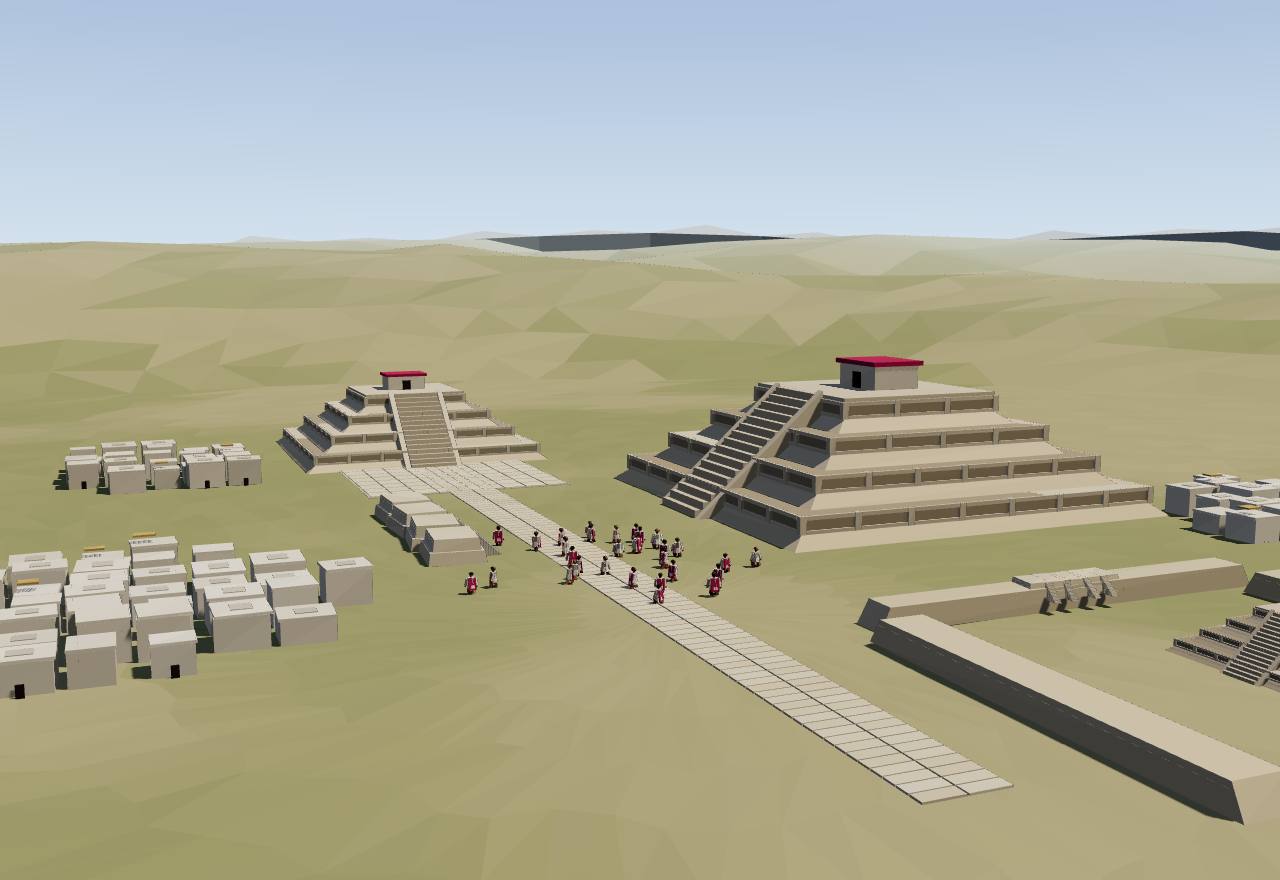
Teotihuacan: the Avenue of the Dead
100 CE – 650 CE
Teotihuacan
For five centuries the largest city in the Americas stood in a side valley of the Basin of Mexico, its avenue lined with pyramids and its people housed in thousands of walled apartment compounds. Its builders left no names of kings and no royal tombs that anyone has found. Whether a monarch, a council or co-rulers governed it is still argued; around 550 the buildings along its central avenue were burned.
Terms: Central Mexico: Teotihuacan to the Triple Alliance: Teotihuacan
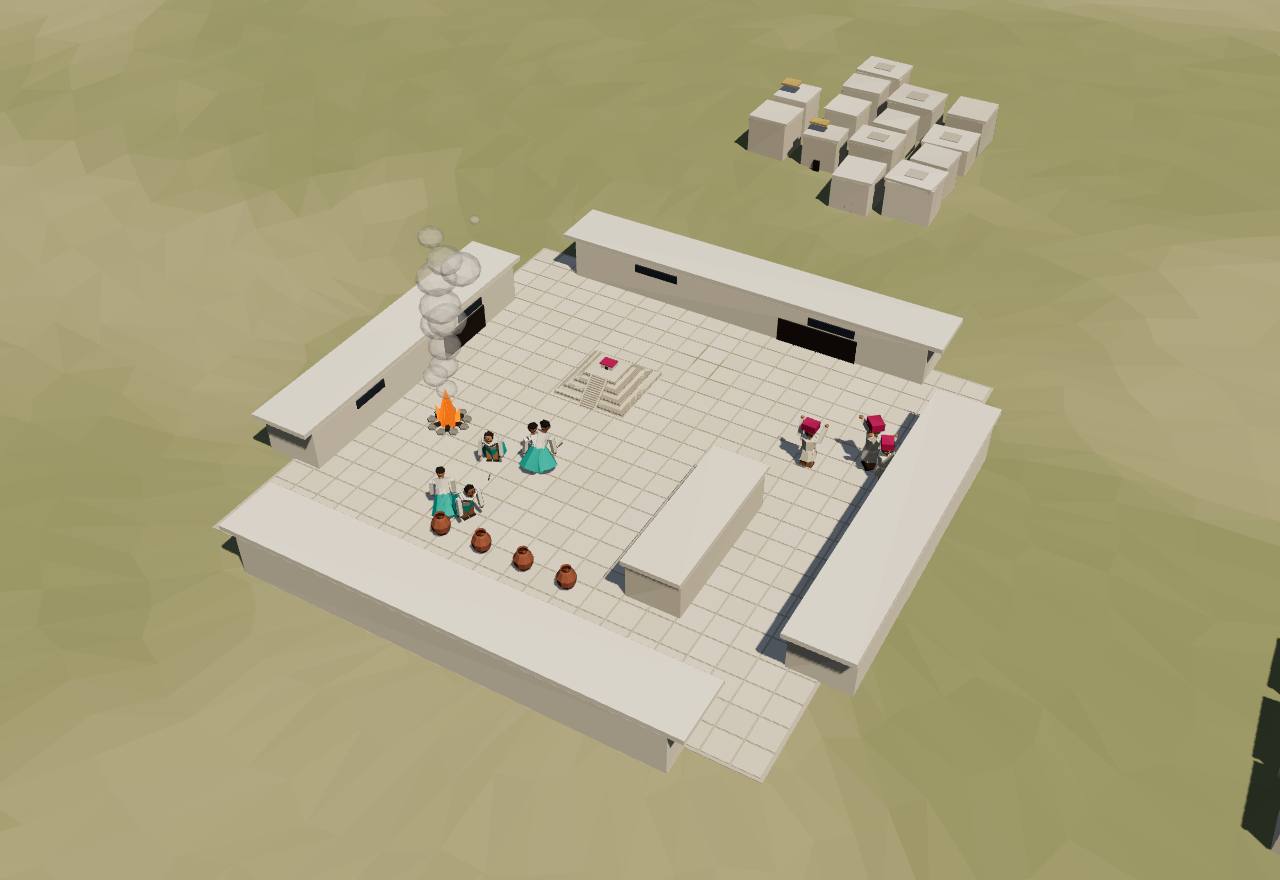
Inside an apartment compound
Teotihuacan was, in Cowgill's words, the “largest city in the Americas before the 1400s”. Froese, Gershenson and Manzanilla put its population on a plateau of 80,000 to 100,000 by about 150 CE, over some 20 km²; UNESCO's record says that at its peak it “stretched out over 36 km²” and gives “at least 25,000 inhabitants”. Seshat codes its largest settlement at 100,000–125,000. The figures differ because they are estimates from surveyed house remains, not counts. 7,17,8 Seshat Consensus Survey Excavation
The city grew fast. Between 100 BCE and 200 CE, Cowgill writes, “most of the Basin of Mexico population was relocated in the city” and immense civic-religious structures were built. In the Patlachique phase (c. 100–1 BCE) dense sherd cover already spread over 6 to 8 km² with “at least 20,000” people. Manzanilla links two waves of incomers to volcanic eruptions: Popocatépetl in the first century CE and Xitle around 320. 18,7,5 Consensus Survey Dating
The city was laid out on one plan. Its central avenue (the Street, or Avenue, of the Dead) runs to the Pyramid of the Moon, whose first stage was “a square pyramidal platform that measures 23.5 m on a side”, oriented “11–12 degrees east of astronomic north”. UNESCO gives the Pyramid of the Sun beside the avenue as 225 × 222 m at the base and 75 m high. 7,8 Consensus Excavation
From about 200 CE most people lived in walled “apartment compounds”: more than 2,000 were built. Cowgill estimates three to five households per compound and five to twelve people per household, as Froese and colleagues report; Manzanilla describes the compounds as the cooperative, “corporate” base of the society. 17,5 Consensus Excavation Survey
The city drew people from far away and housed them in their own neighbourhoods: Tlailotlacan, the “Oaxaca Barrio” in the south-west; the Merchants' Barrio, of people from the Gulf Coast, in the east; and a small group from Michoacán in the west. The neighbourhood centre of Teopancazco was occupied from about 150 to 650 and yielded 116 formal burials; about 350, 29 decapitated individuals were buried there in a single ceremony. 5 Consensus Excavation Bioarchaeology
In the Ciudadela, a vast walled square, the Feathered Serpent Pyramid was raised around 200 CE, and a mass sacrifice was associated with it. Oxygen isotopes in the bones of 41 of the victims show that at least four regions are represented, and some of those buried as soldiers had come from abroad, which White and colleagues read as foreign “recruitment” or mercenaries. Sugiyama concludes that the pyramid commemorated “the accession of rulers who were inscribed to govern with military force on behalf of the gods”. 19,20 Debated Excavation Bioarchaeology
What is missing is as telling as what was found. Froese and colleagues list “the prominent lack of … supreme rulers' tombs, royal portraiture, dynastic stele and inscriptions”, and find that in Teotihuacan “there is not a single piece of art depicting the subjugation of one person by another person”. Paulinyi, who argues that figures wearing the “Great Tasseled Headdress” were the city's rulers, starts from the same gap: “Neither archaeologists nor authors of iconographical studies have reached a consensus.” 17,21 Debated Excavation
Manzanilla describes a city run in two modes at once: a “corporate” mode among the ruling elite and in the apartment compounds, and an “exclusionary” one in the neighbourhood centres, run by intermediate elites who handled long-distance goods. The contrast, she argues, “introduced the tensions that became exacerbated with time, setting the stage for the collapse.” 5 Debated Excavation
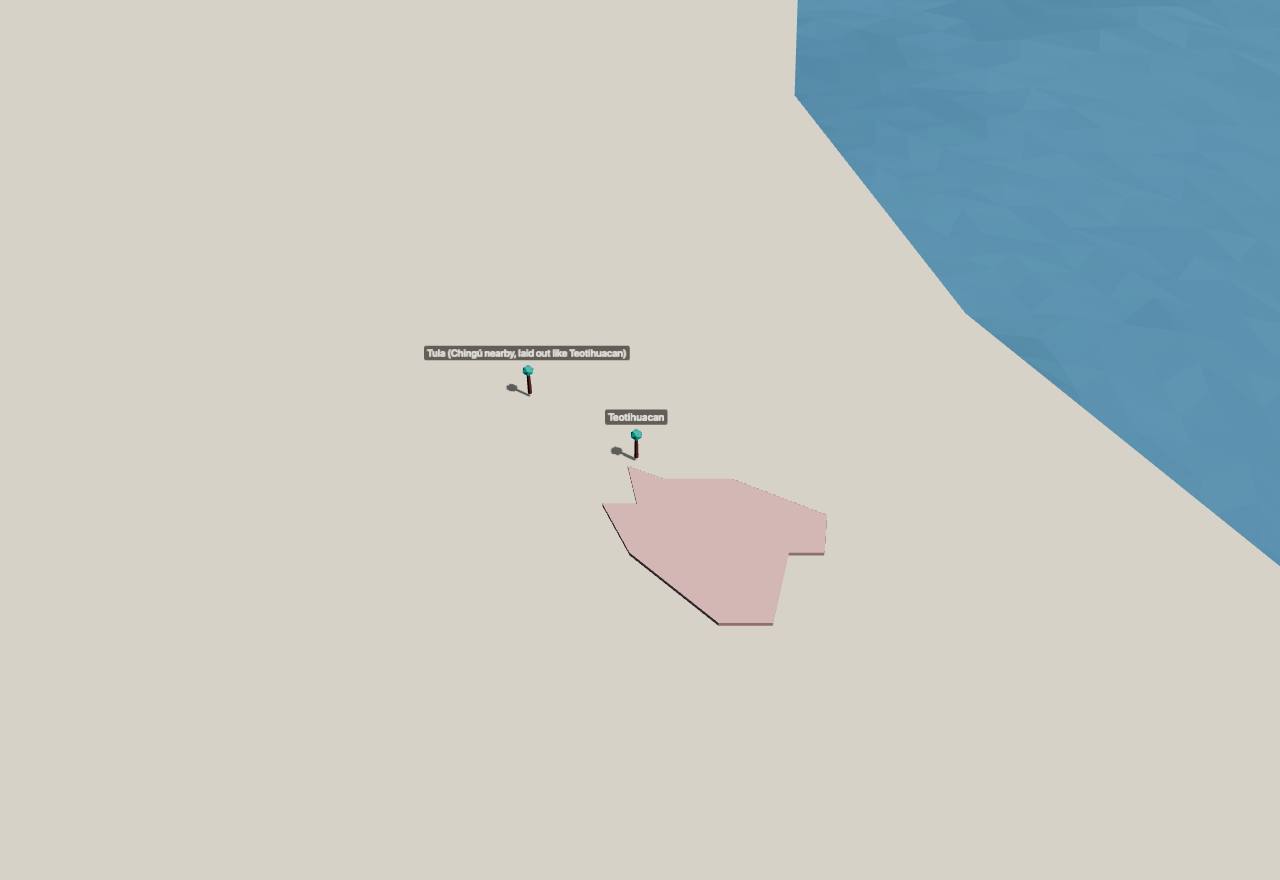
How far Teotihuacan ruled is uncertain. Cowgill judged that its political control “probably did not extend beyond central Mexico, except perhaps for some outposts”; Smith puts its “small empire” at about 20,000 to 25,000 km². Healan and colleagues see “little doubt” that Chingú, a site near Tula laid out like Teotihuacan, was under its control. Paulinyi dates its reach to Tikal, in the Maya lowlands, to 378. 18,10,9,21 Debated Survey Excavation Read more: The Maya: Early Classic
“The major ritual and administrative buildings along the Street of the Dead were set on fire in A.D. 550”, Manzanilla writes, and sculptures inside palaces such as Xalla were smashed; with “no traces of foreign invasion”, she reads it as “a revolt against the ruling elite”. A Bayesian analysis of 33 radiocarbon dates from Teopancazco puts the end of the Xolalpan phase “around cal AD 550”. The city was not emptied at once: Smith writes that 30,000 to 40,000 people still lived there in the Epiclassic. 5,6,10 Debated Excavation Dating
Seshat codes the Classic Basin of Mexico (100–649) with a three-level settlement hierarchy and a largest settlement of 100,000–125,000 people, but leaves the polity's population “suspected unknown” and codes no territory, government offices or legal institutions for it: the evidence to code them is not there. Seshat Consensus Texts
How power worked Council · Territorial state · Divine mandate · 3 unknown
How power worked
- Who rules
- Unknown
Why?
No ruler's portrait, royal tomb or dynastic inscription has been identified at Teotihuacan; readings range from a monarch to co-rulers and a council (see the debate).
- How chosen
- Unknown
Why?
No text from the city says how anyone came to power.
- Limits on power
- Council Speculative
Why?
- Scale
- Territorial state Debated
Why?
- Claim to rule
- Divine mandate Debated
Why?
- Who has a say
- Unknown
Why?
No source read says who, beyond the elites, had a say; the 'corporate' reading rests on the absence of royal display and on the plan of the compounds.
650 CE – 1150 CE
Epiclassic cities and Tula
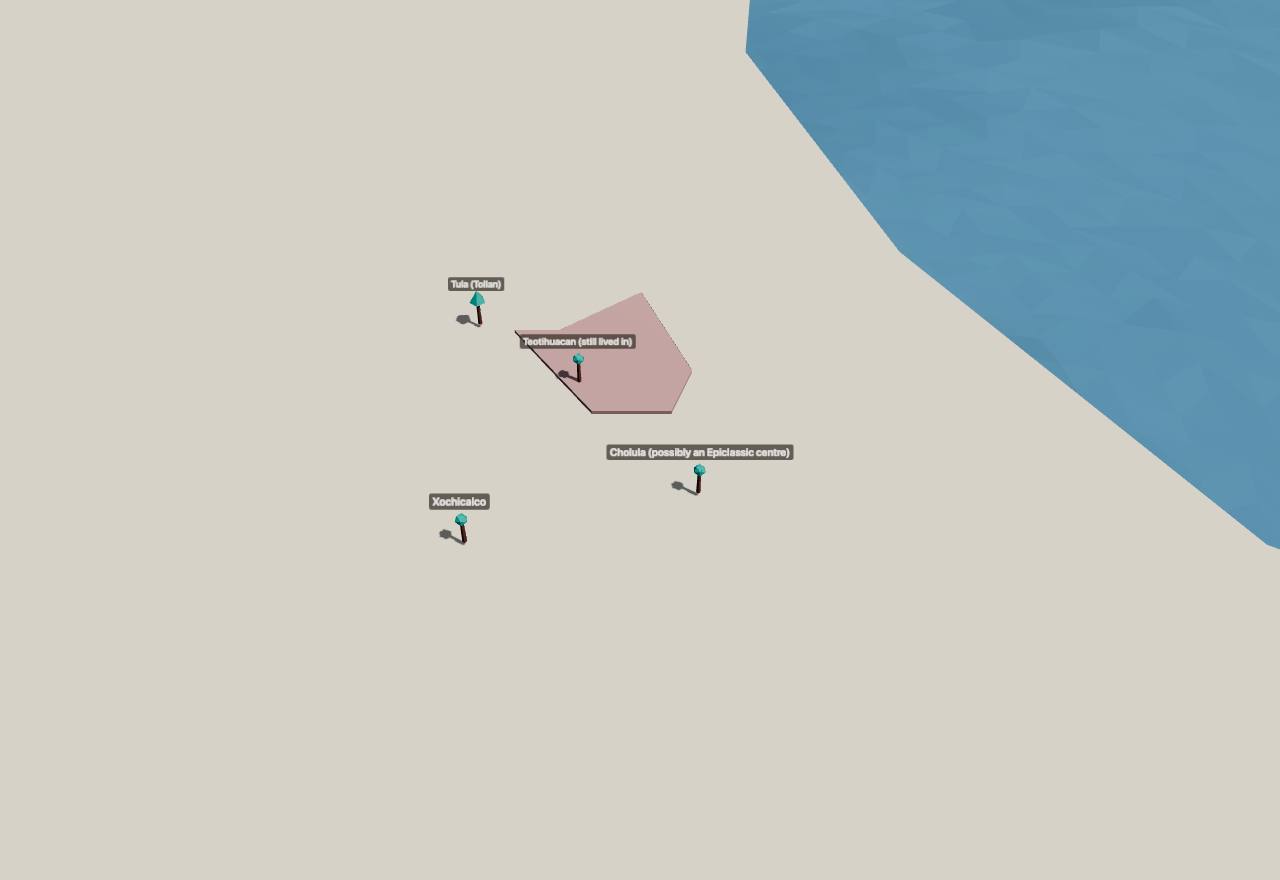
After Teotihuacan's centre burned, Central Mexico broke into smaller states behind walls on hilltops: Xochicalco, Cacaxtla, Cantona. Then Tula grew into the largest city since Teotihuacan, with pillared halls for gatherings and stone warriors on its pyramid. It was in ruins by the time the Aztecs' ancestors arrived; they remembered it as Tollan.
Terms: Central Mexico: Teotihuacan to the Triple Alliance: Epiclassic cities and Tula
- Tollan the city the Aztecs remembered as their great predecessor; Healan and colleagues identify it with the ruins of Tula, Hidalgo 9
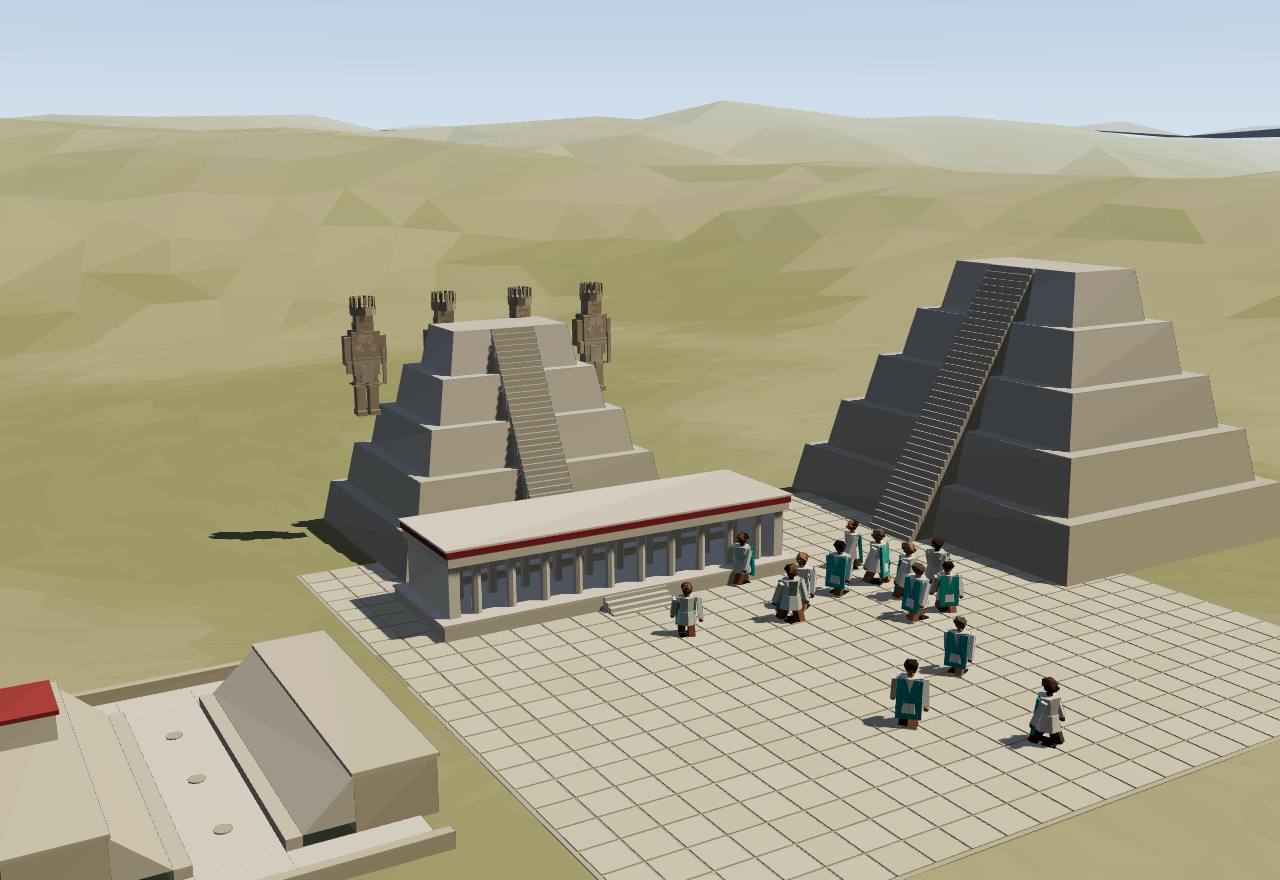
Tula Grande: warrior columns on Pyramid B
Smith describes Epiclassic Central Mexico (c. 650–900) as “a period of political decentralization and warfare”, which “saw the rapid growth of a series of large, fortified, hilltop cities”. Lazcano Arce and Sallum list the centres of this local order: Teotenango, Xico, Xochitécatl-Cacaxtla in Tlaxcala, Xochicalco in Morelos, Cantona in Puebla, Chapantongo, Tula in its first phase and possibly Cholula. 10,23 Consensus Survey Excavation
UNESCO describes Xochicalco as “a fortified political, religious and commercial centre from the troubled period of 650–900”, founded in the second half of the seventh century; it “appears to have been the creation of a confederation of settlements”. Smith calls it “the most extensively studied Epiclassic fortified city”; its end, he writes, “involved the burning and destruction of much of the city”. 24,10 Debated Excavation
Cacaxtla, in the Puebla-Tlaxcala valley, “is best known for an elaborate series of mural paintings showing battles and rituals, executed in Maya style” (Smith). A surface survey found pottery like Xochitécatl-Cacaxtla's at “at least twenty sites” towards the south-centre of the valley; Cantona, further east, is said to have reached about 13 km² and some 80,000 people, an estimate Lazcano Arce and Sallum quote from García Cook. 10,23 Debated Survey
Tula's dates were revised in 2021 from 68 radiocarbon and seven archaeomagnetic dates. Settlement there now begins around 400 (the Early Corral phase), when Teotihuacan still stood; the monuments of Tula Chico were built from about 600–650; the Tollan phase, the city's height, runs from 900 to about 1150, with an Early/Late boundary at 1050. 9 Consensus Dating Excavation
At its height Tula covered about 16 km², up from 5–6 km² (a minimum) in the Late Corral phase. Smith gives it 50,000 people, “the largest city since Classic-period Teotihuacan”, though still much smaller; Seshat codes the Toltecs' largest settlement at 30,000–60,000 and their territory at 20,000–25,000 km², with four levels of settlement and of administration. 9,10 Seshat Debated Survey
Tula Grande, the southern of the city's mound-and-plaza complexes, was its political and religious centre at its height, modelled on the earlier Tula Chico. Its hallmarks are “the Atlanteans and so-called ‘warrior pillars’ atop Pyramid B”, stone warriors that once held up a temple roof, and three buildings with large pillared halls (Edificios 1, 3 and 4) with benches and altars carved with processions. 9 Consensus Excavation
The so-called Palacio Quemado (Edificio 3) at Tula Grande was burned; archaeomagnetic dates on its burned stucco fall around 1140. An end date of about 1150 for the Tollan phase fits a tree-ring record of a “severe and sustained drought” in Central Mexico from 1149 to 1167. Smith, writing earlier, puts the collapse “around 1100” and calls it “not well understood”. 9,10 Debated Dating Excavation
“Tula Grande and the Tollan phase city appear to have already been abandoned and in ruins prior to the arrival of Aztec II peoples.” Later Aztecs dug into the ruins and copied Tula's sculpture at Tenochtitlan (chacmools, processions, figures in “Atlantean” poses), which leads Healan and colleagues to conclude that Tula “was indeed the place the Aztecs called Tollan”. 9 Debated Excavation
Seshat's Epiclassic Basin of Mexico (650–899) has a largest settlement of 25,000–30,000 and four administrative levels, and codes full-time bureaucrats and professional military officers as “inferred present”: inferred, that is, from buildings and objects, not read in texts. Its Toltec polity (900–1199) is coded the same way. Seshat Debated Texts
How power worked Council · Territorial state · A narrow elite · 3 unknown
How power worked
- Who rules
- Unknown
Why?
No ruler of Tula is named in the archaeology read; Healan and colleagues suggest that power may have been shared among groups (see the claims).
- How chosen
- Unknown
Why?
No source read says how Tula's leaders were chosen.
- Limits on power
- Council Speculative
Why?
- Scale
- Territorial state Debated
Why?
- Claim to rule
- Unknown
Why?
No text from Tula survives to say what its rulers claimed; the warrior columns show military display, not a stated claim.
- Who has a say
- A narrow elite Speculative
Why?
1150 CE – 1428 CE
The world of the altepetl
After Tula, the Basin of Mexico filled with dozens of small city-states, each an altepetl with its own ruler, palace, temple and market. Some of them built small empires by conquest. The Mexica, latecomers, settled on islands in the lake; their story puts the founding of Tenochtitlan in 1325. In 1428 they and two allies defeated the strongest power, Azcapotzalco.
Terms: Central Mexico: Teotihuacan to the Triple Alliance: The world of the altepetl
- altepetl a city with its adjacent territory, ruled by a tlatoani: the basic Nahua political unit, which the Spaniards called señorío (Hodge, as quoted by García Chávez and Moragas Segura) 26,10
- tlatoani the ruler of an altepetl, 'he who speaks' (Piorun's gloss); plural tlatoque 27,14
- calpolli a group within an altepetl that people took their identity from (Berdan); spelled calpolli in the sources read 4,10
- chinampa an embanked field built up from swamp soil between hand-dug channels 28
An island altepetl and its chinampas
The political unit of the Postclassic was the altepetl. Hodge's definition, as García Chávez and Moragas Segura quote it: “a city with its adjacent territory, ruled by a tlatoani or king”, which the Spaniards called a señorío. Smith describes them as small urban centres with modest monuments, “a royal palace and one or more temple-pyramids, arranged around a central plaza”, and Smith and Sergheraert as “ruled by kings (tlatoani) and a council of nobles”. 26,10,27 Consensus Excavation Texts
About sixty such polities formed in the Basin after the fall of Tula, García Chávez and Moragas Segura write; in Chalco-Amaquemecan alone there were six city-states, each with its own tlahtoani. For Kenneth Hirth, as they report him, what defined an altepetl was less its borders than its social relations. 26 Debated Survey Texts
People belonged to nested groups. Berdan writes that they “took their identities from their calpolli, altepetl, or ethnicity”, and that city-states were “the building blocks of the Aztec Empire”, which conquered altepetl rather than replacing them. 4 Consensus Texts Excavation
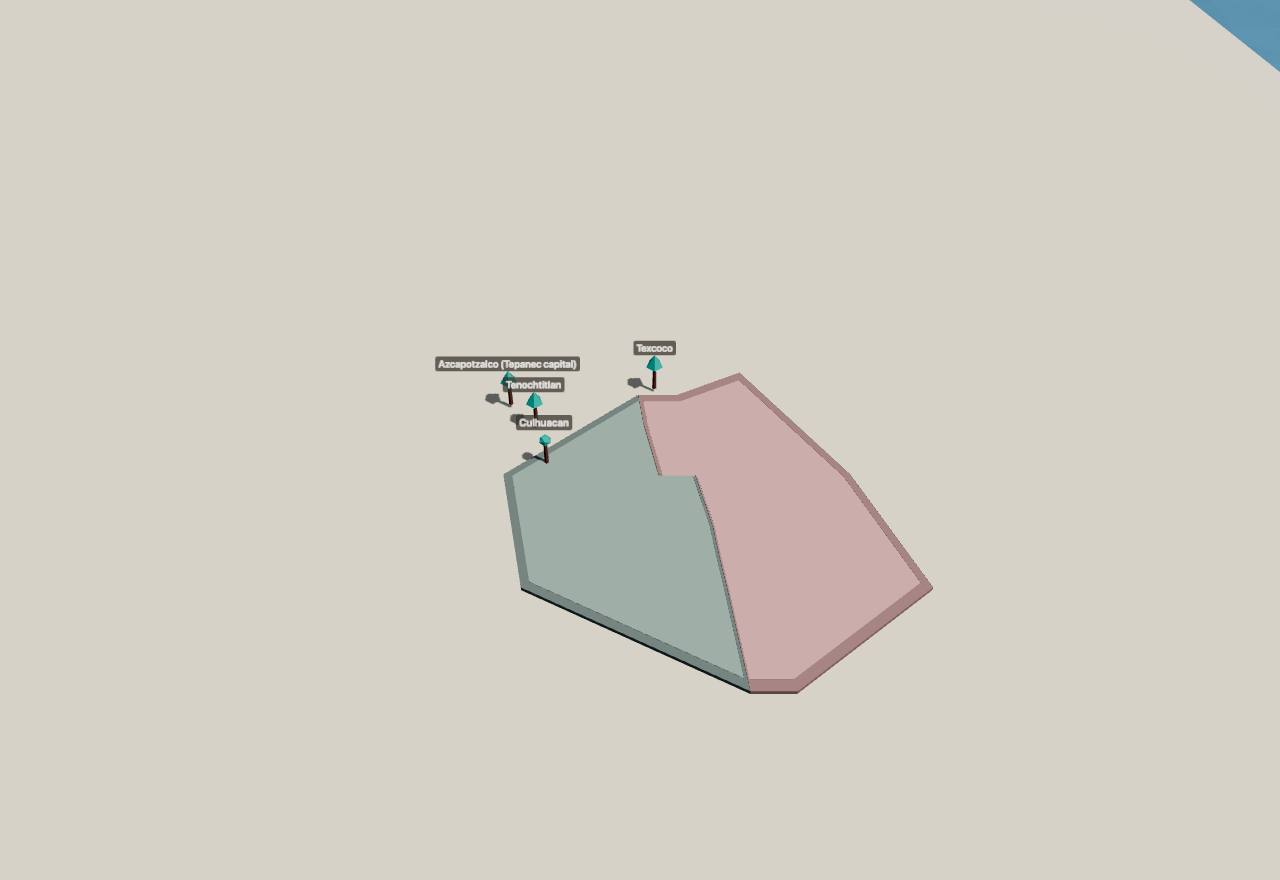
Some city-states conquered others. “By 1400 ad several small empires had been formed through conquest” (Smith and Sergheraert); in the Basin of Mexico, Smith writes, two were based at Azcapotzalco and Texcoco. Of the Tepanec empire of Azcapotzalco “we know little of the size”. 27,10 Consensus Texts Survey
Mexica tradition puts the founding of Tenochtitlan in the year 2 House, 1325 CE, when “a divine vision—of an eagle perched on a nopal cactus” showed the migrants where to settle; López Luján tells it as myth, and has a breakaway group found Tlatelolco on a nearby island around 1337. Romero Galván writes that these stories “can only be considered in the realm of myths… We do not know what really happened”: only that most sources place the portents in 1325. 29,11,26 Debated Texts
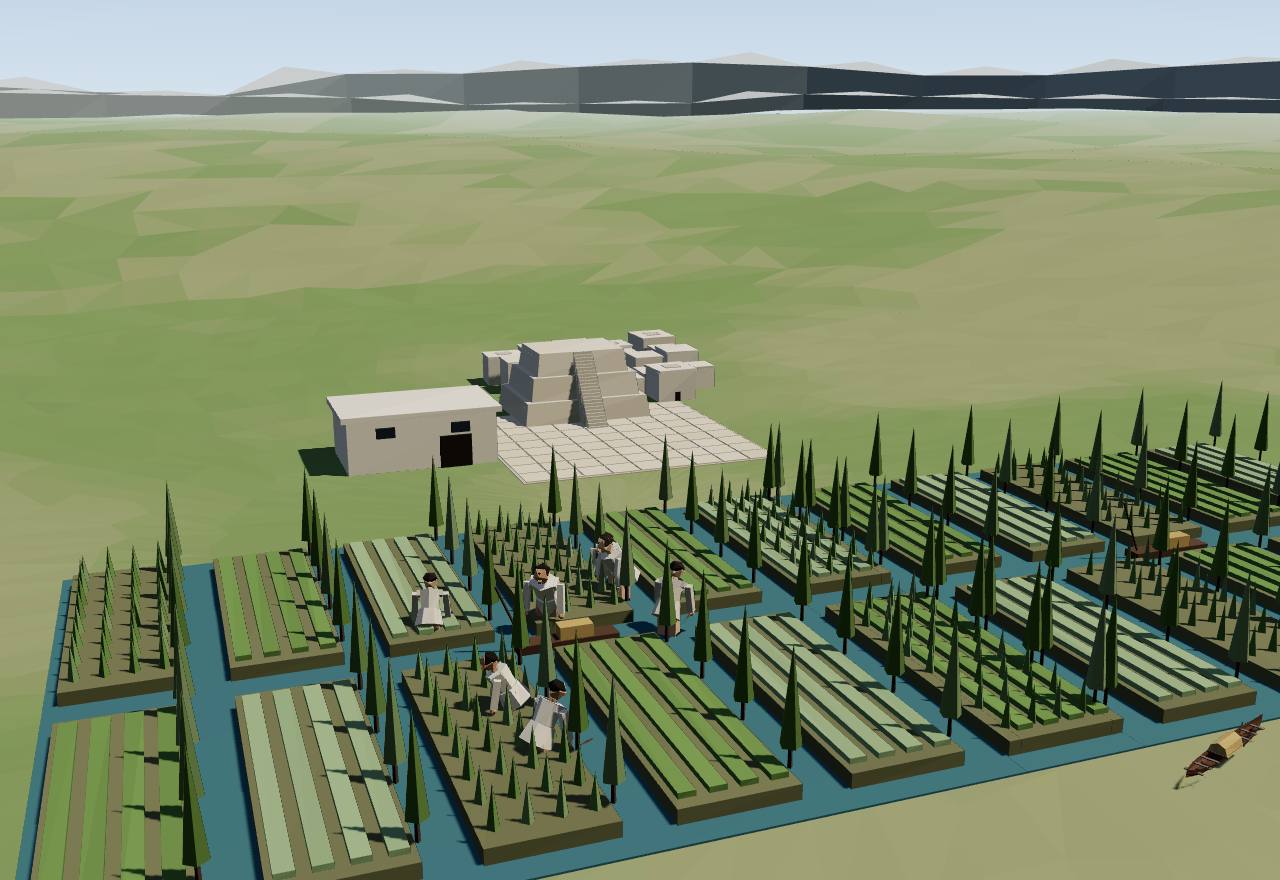
The lakes were farmed. Smith writes that the swampy lakes “were converted to highly productive raised fields”: chinampas, embanked fields built with soil from hand-dug channels. Arco and Abrams estimate that the whole system took “25 million person-days spread over 40 years” to build. Raised fields in the northern Basin, at Xaltocan, are older than the Aztecs: they were abandoned when Xaltocan was conquered in the fourteenth century. 10,28,30 Consensus Excavation Survey Model
“As a result of the so-called Tepanec war, lasting 1427–1428, the dominant altepetl Azcapotzalco was defeated, and its tlatoani Maxtla died” (Piorun). Tenochtitlan, Texcoco and Tlacopan then allied “to conquer other city-states and generate taxes” (Smith). Prescott, following the chroniclers, has Azcapotzalco “razed to the ground”. 14,10,31 Consensus Texts
Seshat's Middle Postclassic Basin of Mexico (1200–1426) is a region of many polities: it codes 700,000–800,000 people, a largest settlement of only 20,000–30,000, a three-level settlement hierarchy, and leaves territory and administrative levels “suspected unknown”. Seshat Debated Texts
How power worked King · Mixed · Council · 1 unknown
How power worked
- Who rules
- King Consensus
Why?
- How chosen
- Mixed Debated
Why?
- Limits on power
- Council Debated
Why?
- Scale
- City-state Consensus
Why?
- Claim to rule
- Unknown
Why?
The sources read describe rulers, lineages and councils but not the claims rulers made for their right to rule before 1428; the Mexica's own founding story, the nearest thing, was written down after the conquest.
- Who has a say
- A narrow elite Debated
Why?
1428 CE – 1521 CE
The Triple Alliance
Three city-states, Tenochtitlan, Texcoco and Tlacopan, conquered hundreds of others in under a century and took tribute from them, mostly leaving their rulers in place. In Tenochtitlan a council of lords chose each new ruler from the royal line; Texcoco was remembered for its councils and judges; and Tlaxcala, which the alliance never conquered, was governed by a council of lords from four districts. In 1521 the Spanish, with Tlaxcalan allies, took Tenochtitlan.
Terms: Central Mexico: Teotihuacan to the Triple Alliance: The Triple Alliance
“The empire of the Triple Alliance was formed in 1428 as the alliance of three city-states: Tenochtitlan, Texcoco and Tlacopan” (Piorun). Ixtlilxochitl's colonial history of Texcoco says Mexico and Texcoco were equal “in dignity, lordship and rents” and Tlacopan had “a certain part, like a fifth”; Prescott found the chroniclers agreed only on Tlacopan's fifth. 14,39,31 Debated Texts
“Armies from the capital, Tenochtitlan, conquered over 500 polities throughout what is today central and southern Mexico” (Smith and Sergheraert). Smith puts the empire at “probably more than 160,000 km²”; Seshat's figure for it, 28,070 km², is far smaller. Rebellions broke out “each time a subjected people had the feeling that the empire was weakened (e.g., at times of tlatoque succession)”. 13,10,27 Seshat Debated Texts Survey
The Codex Mendoza's tribute roll lists the provinces that paid regular tribute: Smith and Berdan define the tributary provinces “simply as the thirty-eight provinces included in the Codex Mendoza tribute roll”. Its gloss says the rulers of Mexico had “Calpixques y hazedores” in all their vassals' towns, “á manera de gobernadores”, and that the garrison towns on folio 17v were there to collect the rents and so that the towns “no se rebelasen”. 15,1,12 Consensus Texts
Most provinces sent cloth: loads of cotton or maguey-fibre mantas, skirts, blouses and loincloths, usually “de seis en seis meses”, every six months; Petlacalco alone owed 4,000 loads of clothing a half-year. Many also sent warrior costumes with shields and bins of maize, beans, chia and amaranth once a year. Coastal and southern provinces sent what grew or was made there: cacao, gold dust, quetzal feathers, rubber, cochineal (Coayxtlahuacan, 40 bags a year), jaguar skins. 12,16,1 Consensus Texts
Not every subject paid by the roll. Smith and Berdan describe “strategic provinces”, city-states kept as buffers with client-like relations, whose tribute was rendered “as ‘gifts’ when asked”; garrisons, “sometimes at newly-constructed fortresses”, served “primarily to hold the empire's borders”. Piorun likewise divides conquered provinces into tributary and strategic ones. 15,14 Consensus Texts Excavation
Administration was thin. Piorun: “In most cases the only form of administration of conquered lands were the calpixque”; governors were appointed rarely, where colonists from the alliance lived. He cites the Spanish account of Cempoallan, where “there were only five calpixque, they had no escort… and yet the Totonacs feared to oppose them”. Cortés, writing in 1520, says Montezuma sent his own people as governors and tax collectors who kept accounts “by means of characters and figures”. 14,2 Debated Texts
Tribute was not the empire's only income. Feinman and Carballo argue that “even the financing of that empire was dependent principally on taxes”, paid by the Basin's own people, “while tribute was secondary”, and give Tenochtitlan a middling score on their scale of collective government (2 of 3), below Tlaxcallan's 3. 40 Debated Texts Model
Seshat codes the Aztec Empire (1427–1526) with 3–4 million people, a largest settlement of 150,000–300,000, five settlement levels, six administrative levels, judges and a formal legal code, and merit promotion; it codes courts as absent. Seshat Debated Texts
The alliance's history is told almost entirely in writing made after its fall. The Spanish, joined by Tlaxcala after its council split over Cortés (Maxixcatzin for the alliance, the younger Xicotencatl for war, as Chavero summarises Muñoz Camargo), took Tenochtitlan in 1521, and built Mexico City on its ruins, where UNESCO's record now lists five Aztec temples identified among the colonial streets. 41,13,34 Consensus Texts Excavation
TenochtitlanTenochtitlan (Mexico City)
The Mexica capital on its island: a city of perhaps 200,000 people joined to the shore by causeways, around a walled precinct of temples. Its ruler, the tlatoani, was chosen from the royal family by a gathering of lords, elders, captains and priests, usually from among four great officers.
Terms: Central Mexico: Teotihuacan to the Triple Alliance: The Triple Alliance, Tenochtitlan
- tecutlatoque the 'senators' who, with the elders, captains and priests, chose a new ruler 3
- achcacauhti the elders of the town, in Sahagún's list of electors 3
- Tlacatecatl the title of one of the four officers of the royal council, from whom the ruler was chosen 42,12
- Calmecac the school in which, Sahagún says, a ruler had to have been raised 3
- huey teocalli 'great temple': López Luján's name for the Templo Mayor 43
Tenochtitlan: the Templo Mayor and the causeways
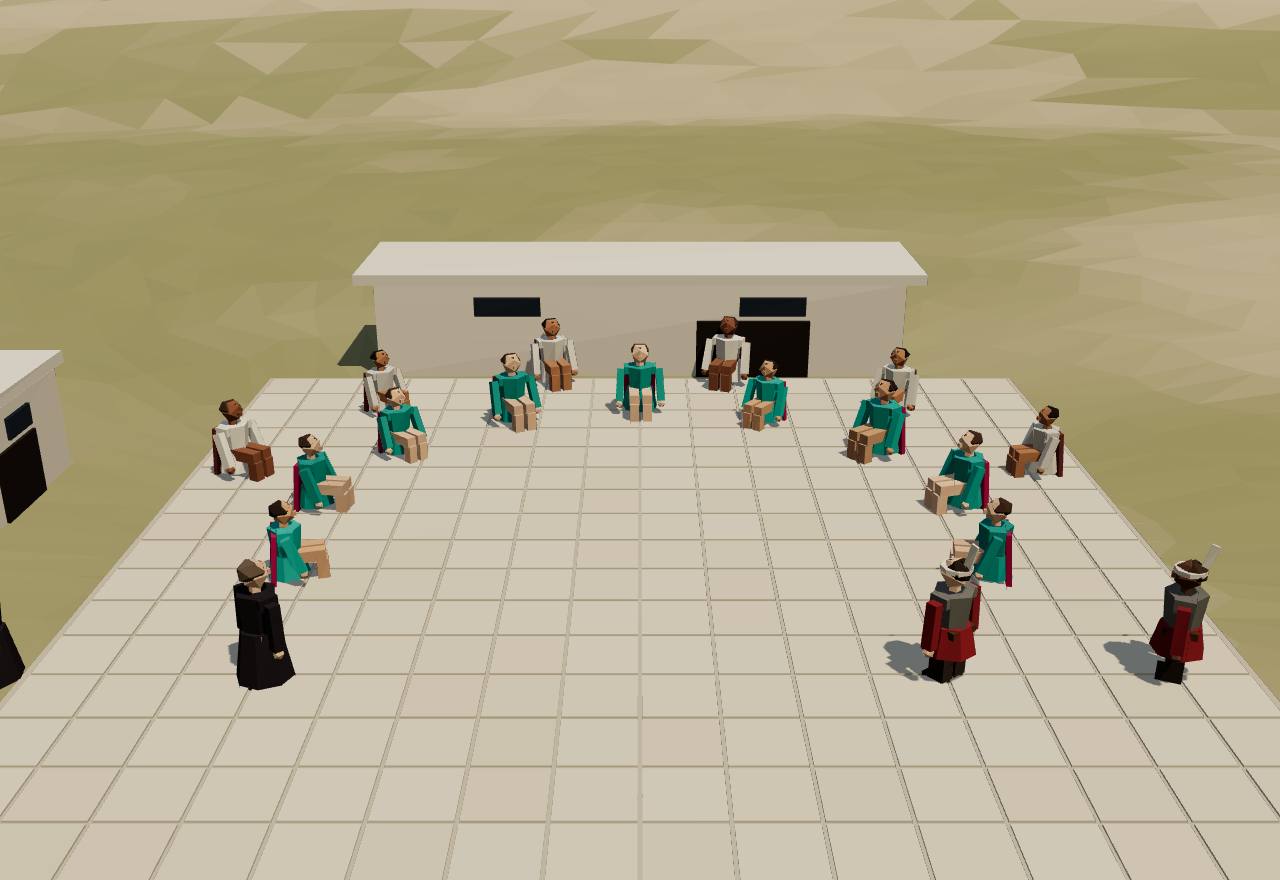
Sahagún's colonial history, Book VIII, describes the election: when the ruler died, the senators (tecutlatoque), the elders (achcacauhti), the veteran war captains and the fire-priests met in the royal houses and chose “one of the most noble of the line of the earlier lords”, a brave man practised in war, not a drinker, raised in the Calmecac. “No se hacia esta elección por escrutinio ó por votos”: there was no ballot; they talked it over until they agreed on one man. 3 Consensus Texts
The choice was narrow. Durán says the king had to be one of the four of the supreme council, one of whom bore the title Tlacatecatl, and of the direct royal line: a brother, son or first cousin of the dead king. The Mendoza's gloss says Tizoc, Ahuitzotl and Motecuhzoma had each held the title Tlacatecatl, the rank from which the next lord came. Once chosen, Sahagún adds, the ruler had four others elected “como senadores” beside him. 42,12,3 Debated Texts
Durán's account of Ahuitzotl's election shows the council at work: four days after Tizoc's death, “all the lords and great men”, the nobles and the heads of the wards met under Tlacaelel, who argued that brothers had always inherited from one another, and the question was referred to the king of Texcoco. Zorita, a Spanish judge, adds that they “never elected a macehual”, a commoner, and that the rulers of Texcoco and Tacuba confirmed the choice. 42,32 Debated Texts
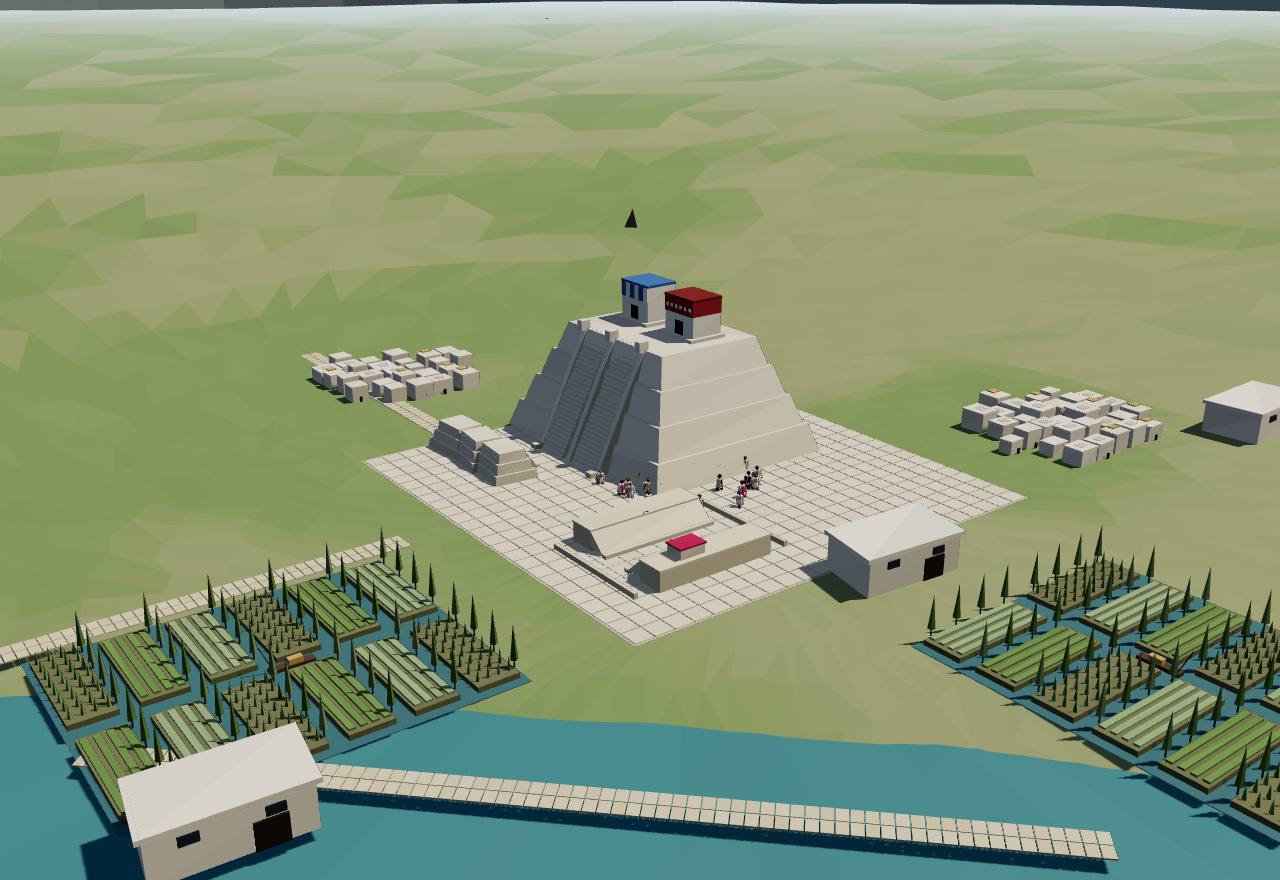
Excavation since the Coyolxauhqui monolith was found in 1978 has uncovered the Templo Mayor: a pyramid with two stairways facing west to twin temples of Huitzilopochtli (south) and Tlaloc (north), enlarged seven times in full and six times in part. Its last platform measured 84 by 77.2 metres, and López Luján estimates a total height of about 45 metres. The project has recorded 169 offerings; about 80 per cent of the objects in them were brought from the tributary provinces, and Mexica manufactures were “the least abundant”. 29,43 Consensus Excavation
Cortés, in his letter of October 1520, wrote that it stood on the salt lake two leagues from the shore, with “four approaches by means of artificial causeways, two cavalry lances in width”, and was “as large as Seville or Cordoba”. Díaz counted three causeways; MacNutt, the translator, explains the fourth as a branch. López Luján gives Tenochtitlan and Tlatelolco together about 13.5 km². 2,44,29 Consensus Texts Survey
How many lived there is an estimate: 150,000 to 200,000 (Smith and Berdan, 1992), 200,000 (Smith and Sergheraert, 2021), “not less than 300,000” (MacNutt, 1908, from the chroniclers' 60,000 households). Seshat codes 150,000–300,000. Smith writes that 70 per cent of the Late Postclassic urban population lived in the capital. 15,13,2,10 Seshat Debated Survey Texts
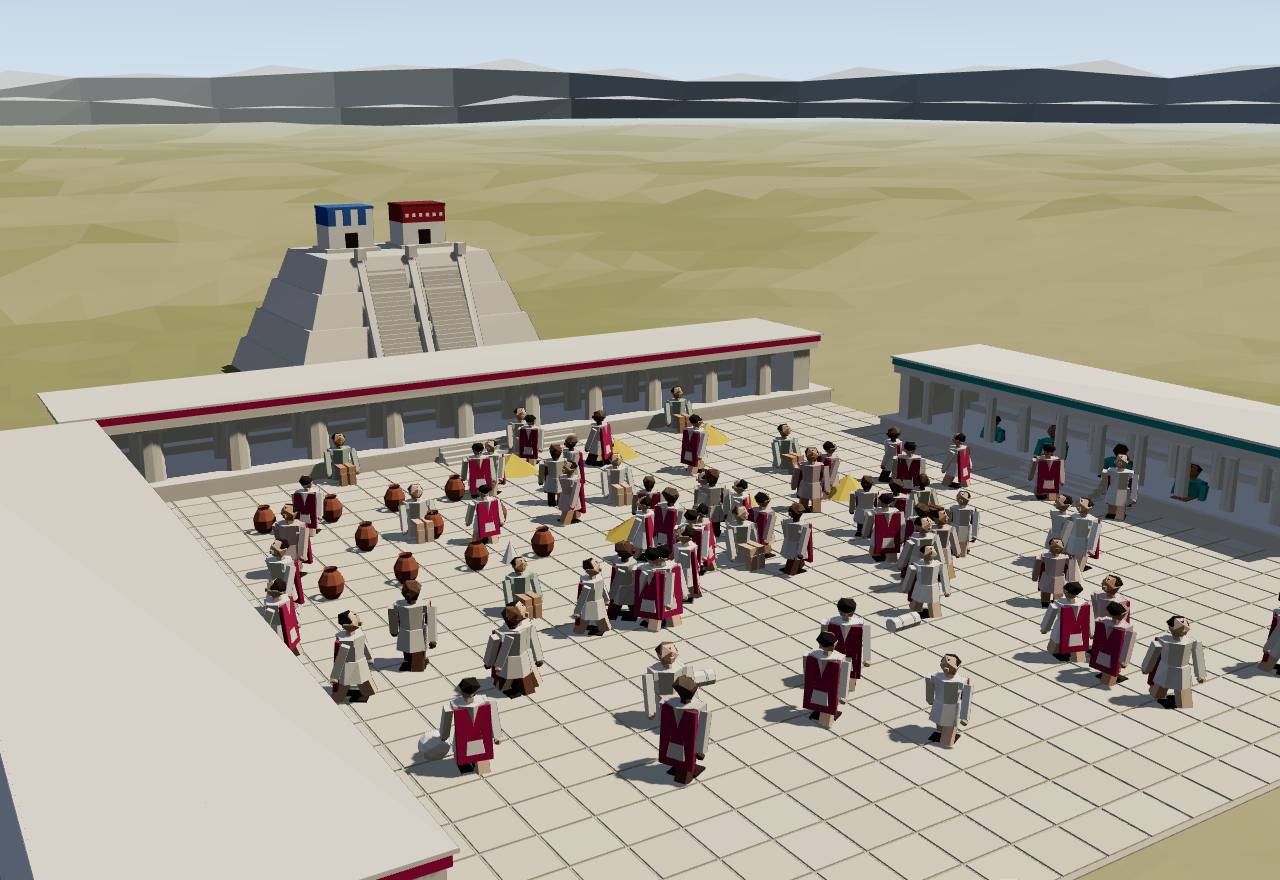
The great market was at Tlatelolco, the twin city conquered in Axayacatl's reign. Cortés: “one square, twice as large as that of Salamanca, all surrounded by arcades, where there are daily more than sixty thousand souls, buying and selling”, each kind of goods in its own street, and a building “like a Court of Justice” where ten or twelve judges sat. Díaz's soldiers who had seen Constantinople and Rome “said that so large a market place and so full of people, and so well regulated and arranged, they had never beheld before”. 2,44,12 Consensus Texts
The subject lords lived at court for much of the year: Cortés writes that “all the other lords of this country… resided… a greater part of the year in the capital”, and that “at dawn every day, six hundred lords, and men of rank, came to his palace”. 2 Debated Texts
The Stone of Tizoc, a carved cylinder of basaltic porphyry about 92.5 cm high and 2.67 m across, weighing 9.5 tonnes, was found in Mexico City's main square in 1791. Round its side, the ruler Tizoc holds captives by the hair, each under the glyph of his town; López Austin and López Luján read it as a summary of Tizoc's victories and the alliance's earlier conquests, made between 1481 and 1486. The museum calls it a cuauhxicalli, used in gladiatorial sacrifice. 45,46 Consensus Excavation
How power worked King · Election · Council
How power worked
- Who rules
- King Consensus
Why?
- How chosen
- Election Debated
Why?
- Limits on power
- Council Debated
Why?
- Scale
- Empire Debated
Why?
- Claim to rule
- Divine mandate Debated
Why?
- Who has a say
- A narrow elite Consensus
Why?
Who chose the tlatoani?
Data: Codex Mendoza, Sahagún, Durán, as cited
Sahagún's rule: on a ruler's death the senators, elders, veteran captains and priests met in the royal houses and chose “one of the most noble of the line of the earlier lords”, not by ballot but by talking until they agreed. 3 For 6 of the 12 reigns below, a source read says how that ruler was chosen; for the rest it gives only the reign. Every row comes from writing made after the conquest.
- By the founders
- chosen as head by the leaders of the migrating Mexica (the Mendoza's founding scene)
- By a council
- chosen by a meeting of lords, elders, war captains and priests, “not by ballot or votes” but by talking until they agreed (Sahagún's general rule)
- From the four
- chosen from the four great officers of the council; the Mendoza and Durán name the Tlacatecatl
- Not stated
- the sources read give the reign but not how the ruler was chosen
12 accessions: 1 by the founders, 1 by a council, 4 from the four, 6 not stated; median reign 16 years. Ended: 11 died in office, 1 not known.
Marks at the end of a bar: ○ died in office · × killed · ▽ deposed · | abdicated · □ conquered
Show the table: Rulers of Tenochtitlan, 1324–1521
| Ruler | Years | Came to power | Reign ended | Source |
|---|---|---|---|---|
| Tenuch | 1324 CE – 1375 CE | By the founders | died in office (the ten leaders “elijieron por cabeza y señor a Tenuch”; 51 years (f. 2r)) | 12,16 |
| Acamapichtli | 1375 CE – 1396 CE | Not stated | died in office (21 years in the Mendoza and in Sahagún (who says “en paz y quietud”); Kingsborough's text dates his start to 1370, Purchas to 1377) | 12,3 |
| Huitzilihuitl | 1396 CE – 1417 CE | Not stated | died in office (21 years (f. 3v)) | 12,3 |
| Chimalpopoca | 1417 CE – 1427 CE | Not stated | died in office (10 years (f. 4v); Purchas misprints 1470) | 12,3 |
| Itzcoatl | 1427 CE – 1440 CE | By a council | died in office (Durán: the Mexica met “en su congregación y cauildo” and by common consent chose Itzcoatl, Acamapichtli's natural son; 13 years in the Mendoza, 14 in Sahagún) | 42,12 |
| Motecuhzoma I | 1440 CE – 1469 CE | From the four | died in office (Durán: he was one of the four of the royal council, titled Tlacatecatl, and the king had to be one of these four; 29 years in the Mendoza, 30 in Sahagún) | 42,12 |
| Axayacatl | 1469 CE – 1481 CE | Not stated | died in office (12 years in the Mendoza, 14 in Sahagún; Purchas dates his start to 1479) | 12,3 |
| Tizoc | 1482 CE – 1486 CE | From the four | died in office (the Mendoza: he had won the title Tlacatecatl, the rank from which the next lord came; 5 years, Sahagún 4 years, “no huvo guerra”) | 12,3 |
| Ahuitzotl | 1486 CE – 1502 | From the four | died in office (the Mendoza: also Tlacatecatl before his election; Durán: a meeting of all the lords, nobles and ward heads under Tlacaelel, who argued that brothers had always inherited from one another; 16 years (18 in Sahagún)) | 12,42 |
| Motecuhzoma II | 1502 – 1520 | From the four | died in office (the Mendoza: Tlacatecatl before his election; 35 at accession, died after 18 years at 53 (Sahagún: 19)) | 12,16 |
| Cuitlahua | 1520 – 1520 | Not stated | died in office (Sahagún: ruled “ochenta dias”) | 3 |
| Quauhtemoc | 1520 | Not stated | not known (Sahagún: “cuatro años”, most of them under Spanish rule) | 3 |
Choosing a tlatoani
The market of Tlatelolco
TexcocoTexcoco
The second city of the alliance, across the lake. Its kings Nezahualcoyotl and Nezahualpilli were remembered in colonial histories as lawgivers who ruled through councils and judges; a modern reading finds much of that memory written to make Texcoco look more civilised.
Terms: Central Mexico: Teotihuacan to the Triple Alliance: The Triple Alliance, Texcoco
Texcoco: the hall of the councils
Pomar's colonial report on Texcoco says the heir was a son of the king's legitimate wife, but that the king rewarded sons “no por ser hijo de rey, sino por pura virtud”; among other lords the heir was “the most virtuous, even if he was the youngest”. After Nezahualpilli, he writes, the government passed “por vía de elección”, and seven brothers held it in turn. 33 Debated Texts
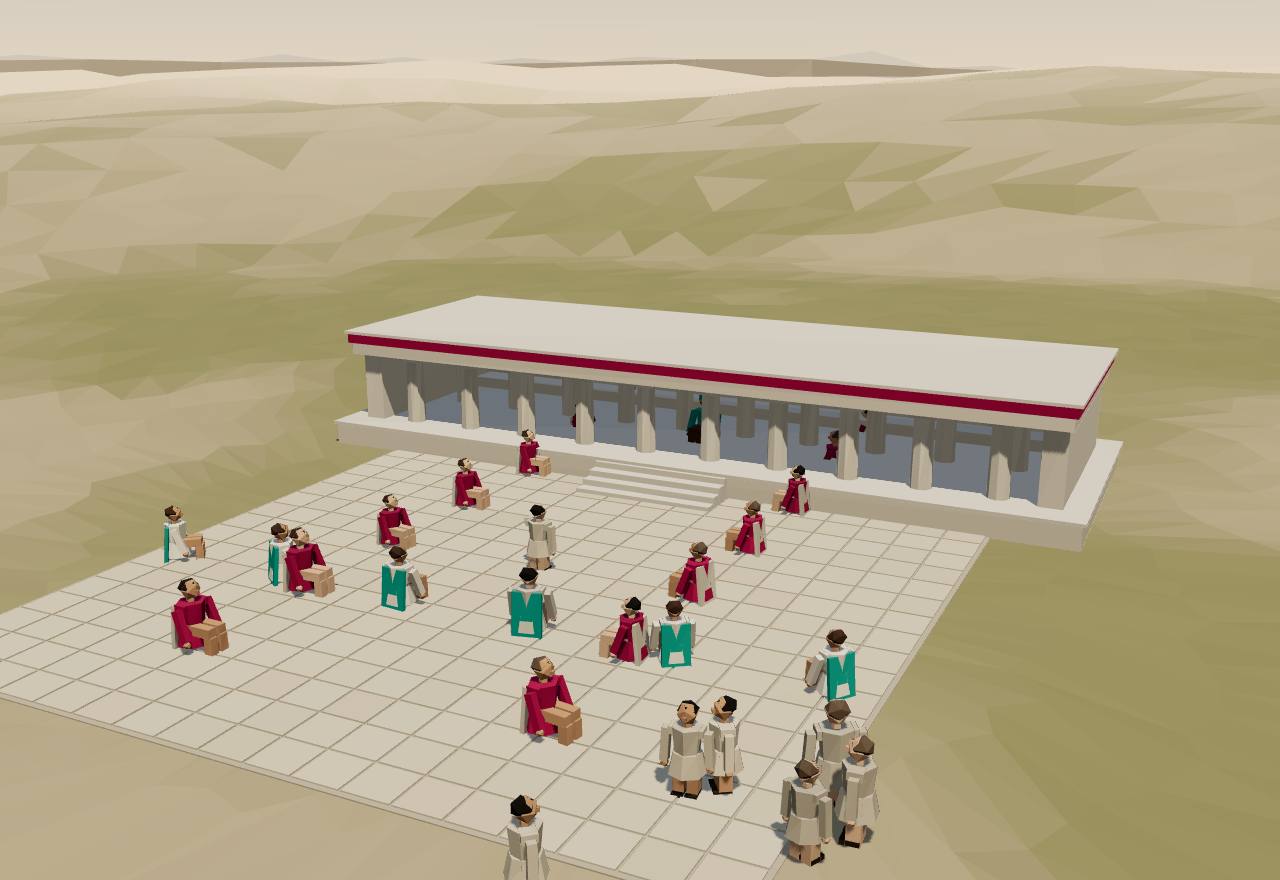
Pomar describes a royal court of justice whose judges, the tetecuhtin, were six of royal blood and as many commoners, took “no payment or gift from the parties”, and were to settle no case in more than eighty days; this council, he says, sentenced a legitimate heir, Tetzauhpiltzintli, to death. Ixtlilxochitl's later account gives different numbers: eight noble judges, four citizens and fifteen provincial judges. 33,39 Debated Texts
Ixtlilxochitl's history credits Nezahualcoyotl with eighty laws “divided into four parts… for four supreme councils”, among them councils of war and of “music and sciences”, and a hall where “the fourteen grandees of the kingdom” sat, each named with his town. The presidents of the councils, he says, were the king's eldest sons. 39 Debated Texts
War, Pomar writes, went through a council of war, the tequihuacacalli, under a captain-general, the tlacochcalcatl, and “no new war was ever undertaken without consulting all three kings, of Tezcuco, México and Tacuba”. Rank was earned: a man became a tequihua by killing or capturing four enemies, and offices were given “only by true merit… at the king's choice”. 33 Debated Texts
Texcoco kept records: Pomar says that “in this city they had the archive of their Council, laws and ordinances”. In general courts, he adds, speakers “spoke in turn, without interrupting one another”. 33 Debated Texts
Jongsoo Lee argues that Ixtlilxochitl “played a decisive role in creating this image of Nezahualcóyotl”. He finds that more than half of the cities the Mapa Quinatzin assigns to Nezahualcoyotl's own domain were also inside Tenochtitlan's boundary, and that the claim that other cities imitated Texcoco's laws “stems from the desire to represent their city as more civilized”. 49 Debated Texts
Piorun, citing Berdan and colleagues, reports that of the three allies' domains “the political organisation of Texcoco's domain was the most centralised and bureaucratised, Tlacopan's the least, and Tenochtitlan's moderately so”. 14 Debated Texts
How power worked King · Heredity · Council
How power worked
- Who rules
- King Consensus
Why?
- How chosen
- Heredity Debated
Why?
- Limits on power
- Council Debated
Why?
- Scale
- Territorial state Debated
Why?
- Claim to rule
- Kinship and descent Debated
Why?
- Who has a say
- A narrow elite Debated
Why?
TlaxcalaTlaxcallan
The alliance's unconquered enemy, east of the Basin: a confederation of settlements whose four districts each had a lord, and whose council of titled lords decided on war and peace. Cortés compared it to Venice; archaeologists call it a republic; others see a federation of noble houses.
Terms: Central Mexico: Teotihuacan to the Triple Alliance: The Triple Alliance, Tlaxcala
- tecuictli a holder of a lord's house (teccalli) and member of the ruling council 50
- teccalli a 'lord's house': an estate and title, in Fargher's reading granted for merit, in Megged's a lineage-based ruling house 50,51
- macehualli a commoner, the peasantry (plural macehualtin) 50,51
- Tecuhtli Muñoz Camargo's spelling (plural Tecuhtles): a lord made by fasting and ordeal 41
Tlaxcallan: the council of four head towns
Fargher, Blanton and Heredia Espinoza describe Tlaxcallan as “a multiethnic confederation of settlements spread over ~2,500 km², with a population of ~250,000 to 300,000”, its city covering about 4.5 km² with some 35,000 people in 1521 (their 2010 paper gave the polity 1,400 km²). Santacruz Cano and López Corral find the city grew from about 2 to 4.5 km² and from some 22,000 to nearly 48,000 people between 1350 and 1519. 50,52,53 Debated Survey Excavation
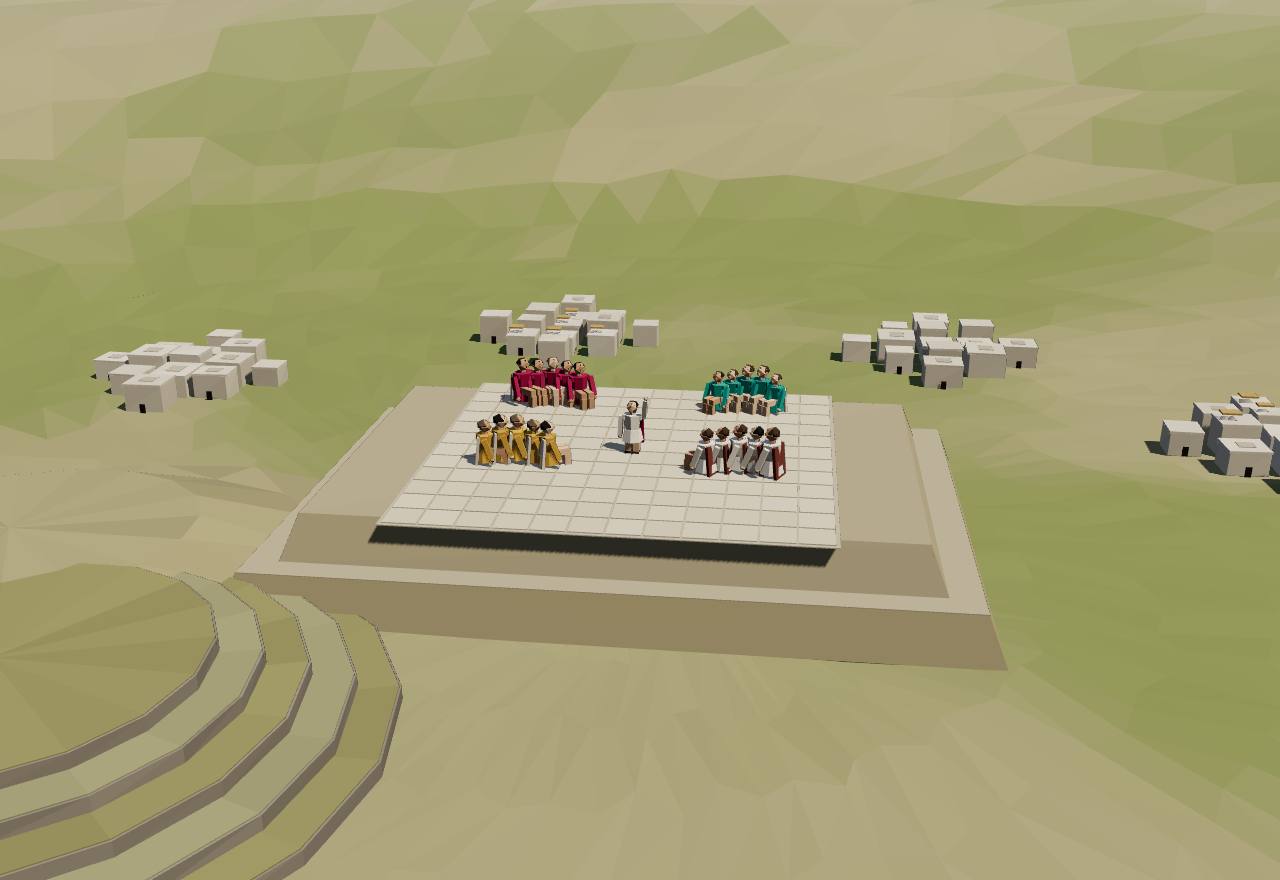
Muñoz Camargo's colonial history of Tlaxcala names four head towns (cabeceras): Tepeticpac, “the first”, Ocotelulco, Tizatlan and Quiahuiztlan, and says the land was “governed by the four lords of the four cabeceras”. Díaz's editor gives the four lords of 1519 as Maxixcatzin, Xicotencatl, Tlehuexolotzin and Citlalpopocatzin. Chavero, Muñoz Camargo's editor, called it “a true federation”, each lord sovereign at home and the four together deciding war, and wrote that some call them “improperly” the Senate of Tlaxcala. 41,54 Consensus Texts
Fargher and colleagues describe a larger body: the holders of lord's houses, the tecuictli, formed “a ruling council or senate consisting of somewhere between 50 and 200 members” (elsewhere in the same paper, 50–250), which acted as a supreme court, declared war and peace, made alliances and appointed, monitored and punished officials. “Decisions were made through speechmaking and debate until a consensus was reached.” 50 Debated Texts Survey
Who could join is the crux. Fargher and colleagues argue that lord's houses and warrior's houses “were bestowed on individuals, from any social status, based on merit”, and their 2010 abstract speaks of a council “whose members could be recruited from the ranks of commoners”. Muñoz Camargo describes the making of a Tecuhtli: forty or sixty days shut in a temple, fasting, insulted, the nose, lips and ears pierced; but he opens it to “any lord or son of lords” who had won honour in war and was of good counsel, and to rich merchants. 50,52,41 Debated Texts
The archaeology shows little display of wealth. The largest house excavated had about 265 m² of roofed space and the city's residential land a Gini index of about 0.23, while palaces in neighbouring states covered 8,000–20,000 m²; the council met in a complex of at least 16,000 m² at Tizatlan, a hilltop about a kilometre outside the city (Fargher and colleagues). Robles Salmerón and colleagues answer that Tlaxcallans “probably had palaces, but they were less ostentatious”. 50,55 Debated Excavation Survey
Cortés, in 1520: “as far as I have been able to judge about the form of government, it is almost like that of Venice, or Genoa, or Pisa, because there is no one supreme ruler. There are many lords all living in this city, and the people who are tillers of the soil are their vassals… In undertaking wars, they all gather together, and thus assembled they decide and plan them.” He counted more than thirty thousand people a day in its market. 2 Consensus Texts
Díaz describes the council deciding how to meet the Spaniards: the two principal lords, Maxixcatzin and the elder Xicotencatl, summoned the other lords and captains, recalled that “the Mexicans make war on us every year, and have done so for more than a hundred years”, so that “we do not dare to go outside even to seek for salt”, and urged peace; all approved, but the younger Xicotencatl, commanding the army, “would not listen to the four chiefs”. 54 Debated Texts
Rulers could be punished. Muñoz Camargo says traitors were killed with their kin “to the fifth generation… and the same was done to those who governed to the harm of the Republic”; Fargher and colleagues, following him, add that a tecuictli who accumulated too much wealth was executed, and that land of the lord's houses “remained state property”. 41,50 Debated Texts
Painted pottery from Tepeticpac and Tlaxcallan carries themes “no fueron regulados por las élites políticas”, in which “anyone, of any rank, could take part” (López Corral and colleagues), which they read as support for collective government. 56 Debated Excavation
How power worked Council of elders or heads · Co-optation · Council
How power worked
- Who rules
- Council of elders or heads Consensus
Why?
- How chosen
- Co-optation Debated
Why?
- Limits on power
- Council Consensus
Why?
- Scale
- Confederation Debated
Why?
- Claim to rule
- Ideology Debated
Why?
- Who has a say
- A narrow elite Debated
Why?
What the provinces sent: the Codex Mendoza's tribute roll
Data: Codex Mendoza, Part 2 (c. 1541), as Kingsborough and Purchas transcribe it
The tribute roll lists 37 entries, from Tlatelolco to Oxitipan. It is a colonial copy: the Codex Mendoza was painted and glossed after the conquest, and its Spanish glosses are read here as Kingsborough transcribed them, with Purchas's English where it differs; folios as Berdan and Anawalt number them. 1,12,16,59 Quantities are as stated, each with its own period; none is converted.
All 37 entries are shown. 35 of 37 entries send cloth (loads of mantas, skirts and blouses, loincloths).29 of 37 entries send warrior costumes and shields.19 of 37 entries send bins of maize, beans, chia, amaranth.6 of 37 entries send gold.6 of 37 entries send cacao.8 of 37 entries send feathers and birds.3 of 37 entries send cochineal (grana).27 of 37 entries send other goods and services.
| Province | Towns | Cloth every 6 months (whatever the filter) | What it sent | Folio; pages |
|---|---|---|---|---|
| Tlatelolco | 1 | – |
2 more
Purchas reads 'every 24. dayes'; the plate's own caption explains four flowers as 4 × 20 = 80 days. | f. 18v–19r; K 54–55, P 437–439 |
| Petlacalco | 18 | 4,000 |
4 more
Purchas: 23 towns, and 70 common costumes. Its governor was the Petlacalcatl, with a calpixque (steward) in each town. | f. 19v–20v; K 55–57, P 439–442 |
| Acolhuacan | 26 | 4,000 |
4 more
Purchas reads 'one hundred' common costumes. The bins held 'cuatro y cinco mil fanegas' each. | f. 21r–22r; K 57–58, P 442–443 |
| Quauhnahuac | 16 | 3,400 |
7 more
Purchas reads 800 white mantas. | f. 22v–23v; K 58–60, P 443–445 |
| Huaxtepec | 26 | 4,000 |
5 more
Purchas lists 23 towns and splits the costumes into 40 plain and 6 rich. | f. 24r–25r; K 60–61, P 445–446 |
| Quauhtitlan | 7 | 1,200 |
4 more
Purchas reads 400 small mantas and 40 common costumes. | f. 25v–26r; K 61–62, P 446–447 |
| Axocopan | 10 | 2,400 |
5 more
| f. 26v–27r; K 62–63, P 447–448 |
| Atotonilco (de Pedraza) | 7 | 1,600 |
4 more
Purchas reads 40 common costumes. | f. 27v–28r; K 63–64, P 448–449 |
| Hueypuchtla | 9 | 1,600 |
4 more
| f. 28v–29r; K 64–65, P 449–450 |
| Atotonilco (el Grande) | 6* | 2,400 |
1 more
| f. 29v–30r; K 65–66, P 450–451 |
| Xilotepec | 7 | 2,800 |
2 more
| f. 30v–31r; K 66–67, P 451–452 |
| Quahuacan | 13 | 1,600 |
5 more
Purchas reads 'every foure dayes' for the wood and lists 12 towns. | f. 31v–32r; K 67–68, P 452–453 |
| Tuluca | 12 | 2,000 |
2 more
The gloss says six bins; the painted caption shows eight. | f. 32v–33r; K 68–69, P 453–454 |
| Ocuilan | 6 | 1,200 |
3 more
| f. 33v–34r; K 69–70, P 454–455 |
| Malinalco (with Xocotitlan) | 3 | 1,600 |
Kingsborough and Purchas give one entry; Berdan and Anawalt count Malinalco and Xocotitlan as two provinces. | f. 34v–35r; K 70–71, P 455 |
| Tlachco | 10 | 2,000 |
6 more
Purchas reads 'every 400. dayes'. | f. 35v–36r; K 71–72, P 456–457 |
| Tepequacuilco | 14 | 3,600 |
7 more
Purchas reads 'every foure dayes' for the copper, bowls, honey and copal. | f. 36v–37r; K 72–73, P 457–458 |
| Cihuatlan | 12* | 4,000 |
2 more
Purchas reads 1,400 mantas, 400 loads of cacao and 400 shells. | f. 37v–38r; K 73–74, P 458 |
| Tlapan | 14* | 1,600 |
4 more
| f. 38v–39r; K 74–75, P 459–460 |
| Tlalcozauhtitlan | 8* | 400 |
1 more
| f. 39v–40r; K 75, P 460–461 |
| Quiauhteopan | 6 | 400 |
3 more
Purchas reads 4 axes. | f. 39v–40r; K 75–76, P 461 |
| Yoaltepec | 6 | 400 |
3 more
| f. 39v–40r; K 76, P 461–462 |
| Chalco | 6* | 800 |
The painted caption shows the twelve bins as 4 + 4 + 2 + 2. | f. 40v–41r; K 76–77, P 462 |
| Tepeacac | 22 | – |
4 more
Purchas reads 'every foure dayes'. | f. 41v–42r; K 77–78, P 462–464 |
| Coayxtlahuacan | 11 | 2,000 |
4 more
| f. 42v–43r; K 78–79, P 464–465 |
| Coyolapan | 11 | 1,200 |
2 more
| f. 43v–44r; K 79–80, P 465–466 |
| Tlachquiauhco | 3 | 400 |
2 more
Purchas reads '4.' mantas. | f. 44v–45r; K 80, P 466 |
| Tochtepec | 22 | 2,800 |
8 more
Purchas lists 21 towns and reads 1,600 balls of rubber. | f. 45v–46r; K 80–82, P 467–468 |
| Xoconochco | 7 | – |
6 more
Purchas lists 8 towns and reads 'Foure' bird skins for the first eighty. | f. 46v–47r; K 82–83, P 468–470 |
| Quauhtochco | 7 | 400 |
| f. 47v–48r; K 83–84, P 470 |
| Cuetlaxtlan | 6 | 3,360 |
6 more
Purchas reads 1002 striped mantas. | f. 48v–49r; K 84–85, P 470–472 |
| Tlapacoyan | 7 | 1,200 |
| f. 49v–50r; K 85, P 472 |
| Tlatlauhquitepec | 11* | 1,600 |
| f. 50v–51r; K 85–86, P 473 |
| Tuchpa | 7 | – |
2 more
| f. 51v–52r; K 86–87, P 473–475 |
| Atlan | 2 | 2,000 |
1 more
| f. 52v–53r; K 87–88, P 475 |
| Tzicoac | 5 | 2,000 |
1 more
| f. 53v–54r; K 88–89, P 476–477 |
| Oxitipan | 1* | 2,800 |
1 more
| f. 54v–55r; K 88, P 475–476 |
* Towns counted from the places the plate names; otherwise the number the gloss states. K = Kingsborough vol. 5, P = Purchas vol. XV.
Artefacts
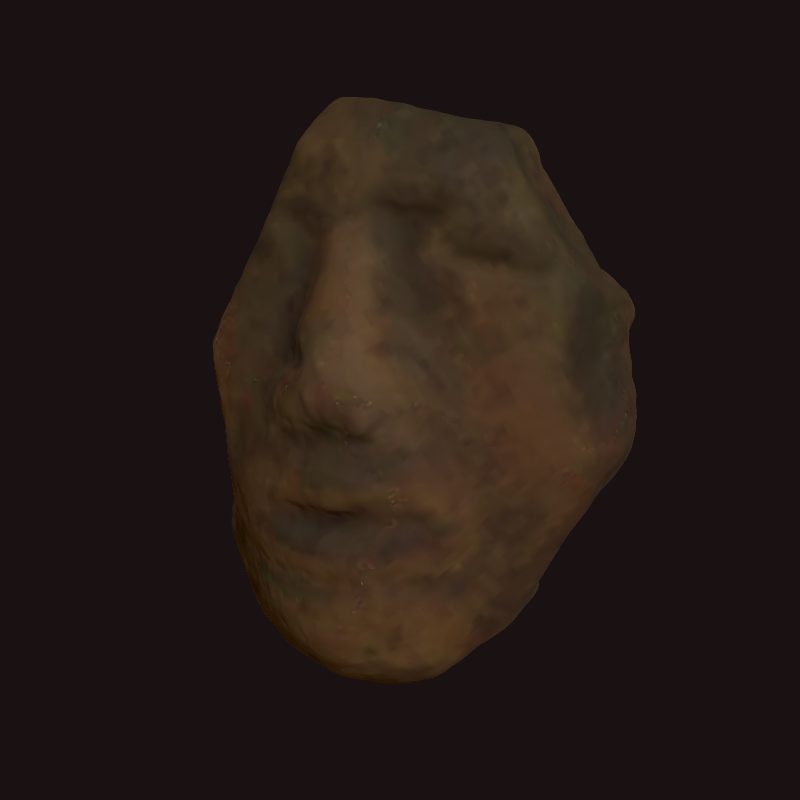
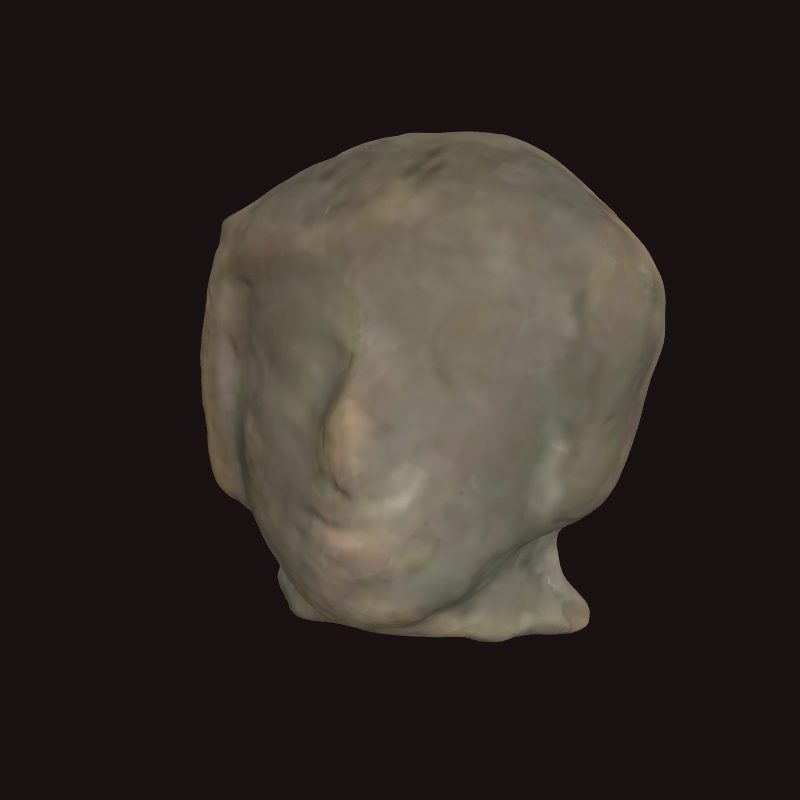
 Model, not a scan
In numbers
- Marks, by Seshat polity:
- Classic Basin of Mexico
- Epiclassic Basin of Mexico
- Toltecs
- Middle Postclassic Basin of Mexico
- Aztec Empire
- Background bands, by phase:
- Teotihuacan
- Epiclassic cities and Tula
- The world of the altepetl
- The Triple Alliance
| Seshat polity | Years | Value |
|---|---|---|
| Epiclassic Basin of Mexico | 650 CE – 899 CE (whole period) | suspected unknown |
| Toltecs | 900 CE – 1199 CE (whole period) | 20,000–25,000 |
| Middle Postclassic Basin of Mexico | 1200 CE – 1426 CE (whole period) | suspected unknown |
| Aztec Empire | 1427 CE – 1526 (whole period) | 28,070 |
| Seshat polity | Years | Value |
|---|---|---|
| Classic Basin of Mexico | 100 CE – 649 CE (whole period) | suspected unknown |
| Epiclassic Basin of Mexico | 650 CE – 899 CE (whole period) | suspected unknown |
| Toltecs | 900 CE – 1199 CE (whole period) | 150,000–200,000 |
| Middle Postclassic Basin of Mexico | 1200 CE – 1426 CE (whole period) | 700,000–800,000 |
| Aztec Empire | 1427 CE – 1526 (whole period) | 3,000,000–4,000,000 |
| Seshat polity | Years | Value |
|---|---|---|
| Classic Basin of Mexico | 100 CE – 649 CE (whole period) | 100,000–125,000 |
| Epiclassic Basin of Mexico | 650 CE – 899 CE (whole period) | 25,000–30,000 |
| Toltecs | 900 CE – 1199 CE (whole period) | 30,000–60,000 |
| Middle Postclassic Basin of Mexico | 1200 CE – 1426 CE (whole period) | 20,000–30,000 |
| Aztec Empire | 1427 CE – 1526 (whole period) | 150,000–300,000 |
| Seshat polity | Years | Value |
|---|---|---|
| Epiclassic Basin of Mexico | 650 CE – 899 CE (whole period) | 4 |
| Toltecs | 900 CE – 1199 CE (whole period) | 4 |
| Middle Postclassic Basin of Mexico | 1200 CE – 1426 CE (whole period) | suspected unknown |
| Aztec Empire | 1427 CE – 1526 (whole period) | 6 |
| Seshat polity | Years | Value |
|---|---|---|
| Classic Basin of Mexico | 100 CE – 649 CE (whole period) | 3 |
| Epiclassic Basin of Mexico | 650 CE – 899 CE (whole period) | 3 |
| Toltecs | 900 CE – 1199 CE (whole period) | 4 |
| Middle Postclassic Basin of Mexico | 1200 CE – 1426 CE (whole period) | 3 |
| Aztec Empire | 1427 CE – 1526 (whole period) | 5 |
| Seshat polity | Years | Value |
|---|---|---|
| Epiclassic Basin of Mexico | 650 CE – 899 CE (whole period) | 2 |
| Toltecs | 900 CE – 1199 CE (whole period) | 2 |
| Middle Postclassic Basin of Mexico | 1200 CE – 1426 CE (whole period) | suspected unknown |
| Aztec Empire | 1427 CE – 1526 (whole period) | 6–7 |
Values as Seshat codes them: bands are ranges, dots single values, flat bars values given for a whole period, hatching “unknown”; from one Seshat polity to the next, marks alternate between a light tone and a darker one with dashed joining lines (the key above names each polity). Source: Seshat Global History Databank (Equinox-2020), CC BY 4.0.
Governance fingerprint
Seshat's institutional variables, phase by phase. Hover or focus a cell for the values and years.
- Present
- Inferred present
- Absent
- Inferred absent
- Unknown
- Not coded in Seshat
- Mixed: present in one Seshat polity or period, absent in another
Not coded in Seshat: The Triple Alliance: Texcoco, The Triple Alliance: Tlaxcala. The Seshat Databank has no polity for them, so their six axes rest on the cited scholarship alone.
Source: Seshat Global History Databank (Equinox-2020), CC BY 4.0.
Compare
| Axis | Central Mexico: Teotihuacan to the Triple Alliance | The Maya: Holy lords and Teotihuacan | The Andes: Cuzco | Greece: Athens |
|---|---|---|---|---|
| Who rules | Unknown | King | King | Elected magistrates |
| How chosen | Unknown | Heredity | Mixed | Mixed |
| Limits on power | Council | Custom and kin | Custom and kin | Written law |
| Scale | Territorial state | City-state | Territorial state | City-state |
| Claim to rule | Divine mandate | Divine mandate | Divine mandate | Law |
| Who has a say | Unknown | A narrow elite | A narrow elite | Property owners |
Legacy
Mexico City was built “on the ruins of Tenochtitlan” (UNESCO), and the old city has been coming back to light: the Stone of Tizoc was found in the main square in 1791, and the Templo Mayor project, begun after the Coyolxauhqui monolith was found in February 1978, has recorded 169 offerings. 34,45,43 Consensus Excavation
Teotihuacan and Tlaxcallan have become test cases in a wider argument. Blanton, Feinman, Kowalewski and Fargher “challenge the traditional consensus that despotic rule and relations characterized most premodern states”, from a sample of 30 states; Feinman and Carballo score Tlaxcallan at the top of their scale of collective government and Tenochtitlan below it. 62,40 Debated Texts Model
The Aztecs had their own past to look back on: they dug into Tula's ruins and copied its sculpture at Tenochtitlan, which, Healan and colleagues argue, shows that Tula “was indeed the place the Aztecs called Tollan”. 9 Debated Excavation
See also forms of government and the country edition.
Sources
Bibliography
62 sources, numbered as cited: 30 papers · 6 books · 12 datasets · 12 primary sources · 2 popular syntheses
- Primary Codex Mendoza (Bodleian Library MS. Arch. Selden. A. 1) (1541). Bodleian Library MS. Arch. Selden. A. 1. Digital Bodleian (images). The manuscript, painted and glossed after the conquest. Read through the Spanish glosses in Kingsborough's transcription and Purchas's English; folio numbers as Berdan and Anawalt give them.
- Primary Cortés, H. (trans. F. A. MacNutt) (1908). Fernando Cortes: his five letters of relation to the Emperor Charles V, vol. 1. Cleveland: A. H. Clark. Second Letter (30 Oct 1520): Tlaxcala pp. 209–212, Tenochtitlan pp. 231–267; MacNutt's Appendix II pp. 329–331. Read 16 Nov 2026.
- Primary Sahagún, B. de (ed. C. M. de Bustamante) (1829). Historia general de las cosas de Nueva España, tomo 2. México: Imprenta del ciudadano Alejandro Valdés. Book VIII ch. I (the lords of Mexico, pp. 268–273) and ch. XXX (how a lord was elected, pp. 318–319), read 16 Nov 2026.
- Book Berdan, F. F. (2014). Aztec Archaeology and Ethnohistory. Cambridge University Press. Chapter 1, 'Discovering, Uncovering, and Interpreting the Aztec World' (pp. 3–30), free PDF read 16 Nov 2026; the rest not read.
- Paper Manzanilla, L. R. (2015). Cooperation and tensions in multiethnic corporate societies using Teotihuacan, Central Mexico, as a case study. Proceedings of the National Academy of Sciences 112(30): 9210–9215. Full text read on PubMed Central (PMC4522775), 16 Nov 2026: Teopancazco's phases and burials, the barrios, the corporate top and exclusionary neighbourhoods, the fire of A.D. 550.
- Paper Beramendi-Orosco, L. E., Gonzalez-Hernandez, G., Urrutia-Fucugauchi, J., Manzanilla, L. R., Soler-Arechalde, A. M., Goguitchaishvili, A., Jarboe, N. (2009). High-resolution chronology for the Mesoamerican urban center of Teotihuacan derived from Bayesian statistics of radiocarbon and archaeological data. Quaternary Research 71(2): 99–107. Abstract read (OpenAlex record), 16 Nov 2026.
- Book Cowgill, G. L. (2015). Ancient Teotihuacan: Early Urbanism in Central Mexico. Cambridge University Press. Publisher description and the free chapter 4, 'Teotihuacan Takes Off: 100–1 BCE' (pp. 53–60), read 16 Nov 2026; the rest of the book not read.
- Dataset UNESCO World Heritage Centre (1987). Pre-Hispanic City of Teotihuacan (World Heritage List no. 414). UNESCO open data, World Heritage List dataset whc001. Record read 16 Nov 2026: 'Built between the 1st and 7th centuries A.D.', 36 km² at its peak, the Pyramid of the Sun 225 × 222 m at the base; 'razed by fire and subsequently abandoned during the 7th century'; coordinates 19.69167 N, 98.84167 W.
- Paper Healan, D. M., Cobean, R. H., Bowsher, R. T. (2021). Revised Chronology and Settlement History of Tula and the Tula Region. Ancient Mesoamerica 32(1): 165–186. Full CC BY text read on Cambridge Core, 16 Nov 2026 (Crossref prints the title in capitals).
- Paper Smith, M. E. (2018). From Teotihuacan to Tenochtitlan. Two Trajectories of Social Change. Revista Española de Antropología Americana 47: 239–254. Full PDF read (revistas.ucm.es), 16 Nov 2026. The issue is dated 2017 on its pages; Crossref's issued date is 2018.
- Paper Romero Galván, J. R. (2025). La fundación de la Ciudad de México. 1325. Su conmemoración. Cliocanarias 7: 513–515. Full text read 16 Nov 2026.
- Primary Kingsborough, Edward King, Viscount (1831). Antiquities of Mexico: comprising fac-similes of ancient Mexican paintings and hieroglyphics, vol. 5. London: James Moyse. 'Esplicacion de la Coleccion de Mendoza' (the Spanish glosses), Part 1 pp. 40–53, Part 2 (tribute) pp. 54–89, read 16 Nov 2026.
- Paper Smith, M. E., Sergheraert, M. (2021). The Aztec Empire. The Oxford World History of Empire, vol. 2, pp. 671–691. Abstract read 16 Nov 2026.
- Paper Piorun, M. (2017). Aztec Empire of the Triple Alliance as an Example of the Hegemonic Empire. Res Historica 42: 63–73 (in Polish). Polish full text and English abstract read 16 Nov 2026 (the article also has the DOI 10.17951/rh.2016.42.63-73 with its Polish title); quotations are our translations.
- Paper Smith, M. E., Berdan, F. F. (1992). Archaeology and the Aztec empire. World Archaeology 23(3): 353–367. Full text read 16 Nov 2026 from a copy reposted by latinamericanstudies.org (not publisher open access); cited by DOI.
- Primary Purchas, S. (1906). Hakluytus posthumus, or Purchas his pilgrimes: contayning a history of the world in sea voyages and lande travells by Englishmen and others, vol. XV. Glasgow: James MacLehose and Sons (first published 1625). Ch. VII, the English Codex Mendoza commentary: Part 1 pp. 414–436, Part 2 pp. 437–477, read 16 Nov 2026.
- Paper Froese, T., Gershenson, C., Manzanilla, L. R. (2014). Can Government Be Self-Organized? A Mathematical Model of the Collective Social Organization of Ancient Teotihuacan, Central Mexico. PLoS ONE 9(10): e109966. Full text read (journals.plos.org, CC BY), 16 Nov 2026: the review of the archaeology (population, area, compounds, absent royal imagery) and the model.
- Paper Cowgill, G. L. (1997). State and Society at Teotihuacan, Mexico. Annual Review of Anthropology 26: 129–161. Abstract read (OpenAlex record), 16 Nov 2026.
- Book Sugiyama, S. (2005). Human Sacrifice, Militarism, and Rulership: Materialization of State Ideology at the Feathered Serpent Pyramid, Teotihuacan. Cambridge University Press. Publisher description read on Cambridge Core, 16 Nov 2026.
- Paper White, C. D., Spence, M. W., Longstaffe, F. J., Stuart-Williams, H., Law, K. R. (2002). Geographic Identities of the Sacrificial Victims from the Feathered Serpent Pyramid, Teotihuacan: Implications for the Nature of State Power. Latin American Antiquity 13(2): 217–236. Abstract read (OpenAlex record), 16 Nov 2026.
- Paper Paulinyi, Z. (2025). Ruler and Palace in Teotihuacán: an Iconographic Analysis. Anales del Instituto de Investigaciones Estéticas 47(127): 47–83. Full PDF read (analesiie.unam.mx), 16 Nov 2026. Crossref spells the author 'Paulingy'; the article reads Zoltán Paulinyi.
- Dataset Instituto Nacional de Antropología e Historia (2026). Tula. Lugares INAH. Page read 16 Nov 2026; its schema.org data gives 20.064249 N, 99.341093 W (the Secretaría de Cultura's SIC record agrees within about 100 m).
- Paper Lazcano Arce, J. C., Sallum, M. (2015). Patrón de Asentamiento de los Grupos que Habitaron el Valle Puebla-Tlaxcala, México durante el Periodo Epiclasico (650-950 AD). Fase de recorrido de superficie. Revista do Museu de Arqueologia e Etnologia 25: 45–60. Full Spanish PDF read (revistas.usp.br), 16 Nov 2026.
- Dataset UNESCO World Heritage Centre (1999). Archaeological Monuments Zone of Xochicalco (World Heritage List no. 939). UNESCO open data, World Heritage List dataset whc001. Record read 16 Nov 2026: 'a fortified political, religious and commercial centre from the troubled period of 650–900', founded 'in the second half of the 7th century A.D.', apparently 'the creation of a confederation of settlements'; coordinates 18.803972 N, 99.29639 W.
- Dataset Wikidata contributors (2026). Cholula (pre-Columbian city) (Wikidata Q7380613). Wikidata, entity data (CC0). Coordinates 19.0569 N, 98.3014 W, read 16 Nov 2026.
- Paper García Chávez, R., Moragas Segura, N. (2018). Historia y arqueología de la formación del "altepetl" en la Cuenca de México durante el Posclásico Medio. Revista Española de Antropología Americana 47: 219–238. Full PDF read 16 Nov 2026 (printed in vol. 47, 2017; Crossref issued 2018).
- Paper Smith, M. E., Sergheraert, M. (2012). The Aztec Empire. The Oxford Handbook of Mesoamerican Archaeology, pp. 449–458. Abstract read 16 Nov 2026.
- Paper Arco, L. J., Abrams, E. M. (2006). An essay on energetics: the construction of the Aztec chinampa system. Antiquity 80(310): 906–918. Abstract read 16 Nov 2026.
- Book López Luján, L. (2001). Tenochtitlán: Ceremonial Center. In S. T. Evans and D. L. Webster (eds), Archaeology of Ancient Mexico and Central America: An Encyclopedia, Garland, pp. 712–716. Author's PDF on Mesoweb read 16 Nov 2026.
- Paper Morehart, C. T., Frederick, C. (2014). The chronology and collapse of pre-Aztec raised field (chinampa) agriculture in the northern Basin of Mexico. Antiquity 88(340): 531–548. Abstract read 16 Nov 2026.
- Book Prescott, W. H. (1848). History of the conquest of Mexico, vol. 1. New York: Harper. pp. 16–19 (the founding tradition and the division of tribute as the chroniclers reported it), read 16 Nov 2026; used only for what the chronicles claimed.
- Primary Zorita, A. de (ed. J. García Icazbalceta) (1891). Breve y sumaria relación de los señores de la Nueva España. In Pomar y Zurita (Nueva colección de documentos para la historia de México, vol. 3). pp. 80–81 (how lords were succeeded and elected), read 16 Nov 2026.
- Primary Pomar, J. B. (ed. J. García Icazbalceta) (1891). Pomar y Zurita: Pomar. Relación de Tezcoco; Zurita. Breve relación de los señores de la Nueva España; varias relaciones antiguas (siglo XVI). México: Impr. de F. Díaz de León (Nueva colección de documentos para la historia de México, vol. 3). Pomar's Relación de Tezcoco, pp. 21–43, read 16 Nov 2026.
- Dataset UNESCO World Heritage Centre (1987). Historic Centre of Mexico City and Xochimilco (World Heritage List no. 412). UNESCO open data, World Heritage List dataset whc001. Record read 16 Nov 2026: built by the Spanish 'on the ruins of Tenochtitlan'; five Aztec temples identified; Xochimilco's canals and artificial islands; components 412-001 at 19.433481 N, 99.13301 W and 412-002 at 19.249828 N, 99.098926 W.
- Dataset Wikidata contributors (2026). Tlatelolco archaeological site (Wikidata Q14623034). Wikidata, entity data (CC0). Coordinates 19.4511 N, 99.1375 W, read 16 Nov 2026.
- Dataset Wikidata contributors (2026). Azcapotzalco (Wikidata Q994867). Wikidata, entity data (CC0). The modern borough's coordinates, 19.48731 N, 99.18766 W, read 16 Nov 2026.
- Dataset Wikidata contributors (2026). Texcoco (pre-Columbian city-state) (Wikidata Q2047652). Wikidata, entity data (CC0). Coordinates 19.5294 N, 98.8967 W, read 16 Nov 2026.
- Dataset Wikidata contributors (2026). Pueblo Culhuacán (Wikidata Q11159224). Wikidata, entity data (CC0). Coordinates 19.3395 N, 99.1078 W, read 16 Nov 2026.
- Primary Alva Ixtlilxóchitl, F. de (ed. A. Chavero) (1891). Obras históricas de don Fernando de Alva Ixtlilxochitl, tomo II (Historia chichimeca). México: Oficina tip. de la Secretaría de Fomento. pp. 155, 165, 176–179, 187–189, 242, read 16 Nov 2026.
- Paper Feinman, G. M., Carballo, D. M. (2018). Collaborative and competitive strategies in the variability and resiliency of large‐scale societies in Mesoamerica. Economic Anthropology 5(1): 7–19. Author manuscript read 16 Nov 2026 (Boston University OpenBU, hdl.handle.net/2144/26914); page numbers are the manuscript's.
- Primary Muñoz Camargo, D. (ed. A. Chavero) (1892). Historia de Tlaxcala. México: Oficina tip. de la Secretaría de Fomento. pp. 45–47, 78–91, 103–106, 159–160, 184–187, read 16 Nov 2026. Chavero's notes are the editor's (1892).
- Primary Durán, D. (ed. J. F. Ramírez) (1867). Historia de las Indias de Nueva España y islas de Tierra Firme, tomo 1. México: J. M. Andrade y F. Escalante. Chs. VIII (Itzcoatl, pp. 66–67), XV (Motecuhzoma I, pp. 124–125), XLI (Ahuitzotl, pp. 323–326), read 16 Nov 2026.
- Popular López Luján, L. (2014). El Proyecto Templo Mayor (2007-2014). Arqueología Mexicana, edición especial 56, pp. 76–79. PDF on Mesoweb read 16 Nov 2026.
- Primary Díaz del Castillo, B. (trans. A. P. Maudslay) (1910). The True History of the Conquest of New Spain, vol. 2. London: Hakluyt Society. Chs. LXXXVIII–XCII (Tenochtitlan, the market and the view from the temple of Tlatelolco), pp. 37–75, read 16 Nov 2026.
- Dataset Museo Nacional de Antropología (INAH), text by H. García Capistran (2026). Piedra de Tizoc. Google Arts & Culture. Record read 16 Nov 2026: 'h925 x d2670 cm' as printed (read as 92.5 cm high, 267 cm across), 1481/1486, basaltic porphyry; found 17 Dec 1791; Tizoc holding captive rulers by the hair, each under the glyph of his town.
- Popular INAH, Dirección de Medios de Comunicación (2024). Reinstalan placas conmemorativas a los descubrimientos de la Coatlicue y las piedras del Sol y de Tízoc, en el Zócalo capitalino (Boletín 641). Instituto Nacional de Antropología e Historia. Read 16 Nov 2026: the monolith weighs 9.5 tonnes and, per López Austin and López Luján, was made between 1481 and 1486.
- Paper Chase, A. F., Chase, D. Z., Smith, M. E. (2009). States and Empires in Ancient Mesoamerica. Ancient Mesoamerica 20(2): 175–182. Abstract read 16 Nov 2026.
- Paper Hicks, F. (1992). Subject States and Tribute Provinces: The Aztec Empire in the Northern Valley of Mexico. Ancient Mesoamerica 3(1): 1–10. Abstract read 16 Nov 2026.
- Paper Lee, J. (2006). Reexamining Nezahualcóyotl´s texcoco: politics, conquests and law. Estudios de Cultura Náhuatl 37. Full PDF read 16 Nov 2026 (pp. 231–246); linked through the Internet Archive (the journal site fails certificate checks).
- Paper Fargher, L. F., Blanton, R. E., Heredia Espinoza, V. Y. (2022). Collective Action, Good Government, and Democracy in Tlaxcallan, Mexico: An Analysis Based on Demokratia. Frontiers in Political Science 4. Open access (Frontiers); full text at https://www.frontiersin.org/articles/10.3389/fpos.2022.832440/full, read for the aztec page (the Tlaxcaltecan section, discussion and conclusion).
- Paper Megged, A. (2021). The Institution of the Teccalli in the Pre-Columbian and Colonial Altepetl of Tlaxcallan/Tlaxcala: A Re-Evaluation. Estudios de Cultura Náhuatl 61: 121–159. Full PDF read 16 Nov 2026.
- Paper Fargher, L. F., Blanton, R. E., Heredia Espinoza, V. Y. (2010). Egalitarian Ideology and Political Power in Prehispanic Central Mexico: The Case of Tlaxcallan. Latin American Antiquity 21(3): 227–251. Abstract read 16 Nov 2026.
- Paper Santacruz Cano, R., López Corral, A. (2026). El centro urbano de Tlaxcallan: evidencias arqueológicas de un gobierno colectivo del Posclásico tardío (1250/1300-1519 dC). Antropología Americana 11(21). Abstract read 16 Nov 2026.
- Primary Díaz del Castillo, B. (trans. A. P. Maudslay) (1908). The True History of the Conquest of New Spain, vol. 1. London: Hakluyt Society. Chs. LXIII–LXXV (Tlaxcala), pp. 236–273, read 16 Nov 2026. Written decades after the events.
- Paper Robles Salmerón, A., López Corral, A., Salomón Salazar, M. A. (2023). Noble houses and palaces: reconsidering the existence of palaces in Late Postclassic (A.D. 1250/1300–1519) Tepeticpac, Tlaxcallan. Ancient Mesoamerica. Abstract read 16 Nov 2026.
- Paper López Corral, A., Velasco Almanza, M., Ibarra Narváez, J., Santacruz Cano, R. (2019). Iconografía y gobierno colectivo durante el posclásico tardío en Tepeticpac y Tlaxcallan, México. Latin American Antiquity 30(3). Abstract (Spanish) read 16 Nov 2026.
- Paper Fargher, L. F., Blanton, R. E., Heredia Espinoza, V. Y., Millhauser, J., Xiuhtecutli, N., Overholtzer, L. (2011). Tlaxcallan: the archaeology of an ancient republic in the New World. Antiquity 85(327): 172–186. Abstract read 16 Nov 2026.
- Paper Venter, M. L. (2012). A Reassessment of the Extent of the Eastern Aztec Empire in the Mesoamerican Gulf Lowlands. Ancient Mesoamerica 23(2): 235–250. Abstract read 16 Nov 2026 (Crossref prints the title in capitals).
- Book Berdan, F. F., Anawalt, P. R. (1997). The essential Codex Mendoza. Berkeley: University of California Press. Used only for the folio numbering of the Mendoza's sections (contents and headings), 16 Nov 2026. In copyright: linked, not copied.
- Dataset The Hunt Museum, Limerick (2026). Teotihuacán (?) Human Figure Head Fragment. Zenodo (3D model and record, CC BY 4.0). Record read 16 Nov 2026: 'Similar fragments have been attributed to the Teotihuacán style of Central México during the Classical Period'; licence cc-by-4.0.
- Dataset The Hunt Museum, Limerick (2026). Aztec Figure Fragment. Zenodo (3D model and record, CC BY 4.0). Record read 16 Nov 2026: 'similar examples have been dated back to the Aztec culture of Mesoamerican México'; licence cc-by-4.0.
- Paper Blanton, R. E., Feinman, G. M., Kowalewski, S. A., Fargher, L. F. (2020). Moral Collapse and State Failure: A View From the Past. Frontiers in Political Science 2: 568704. Full text read 16 Nov 2026: the comparative thesis over 30 premodern states (it does not discuss Tlaxcallan).
Quantitative values from the Seshat Global History Databank (Equinox-2020), licensed CC BY 4.0. Dataset: Seshat Equinox Packaged Data (v.1). See also Seshat: The Global History Databank (Turchin et al. 2015).